

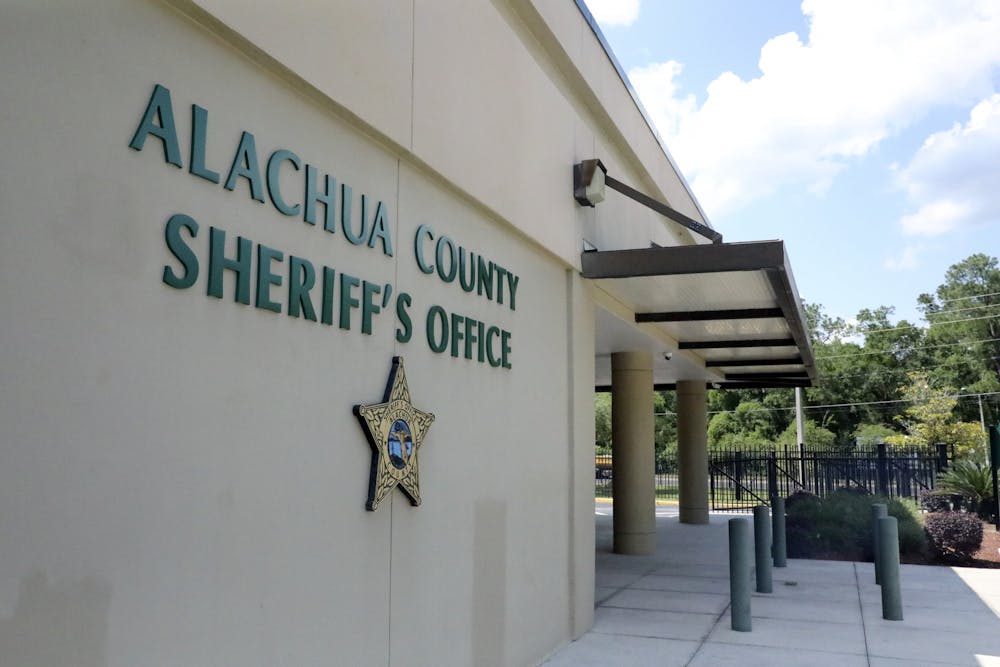
As his pregnant wife went to the hospital, Leviticus Murray got into a fight in Dixie County.
Murray, a 28-year-old then-Alachua County Sheriff’s Office deputy, was accused of grabbing one woman by the neck, striking another and threatening to shoot those nearby. The fight began after he allegedly flirted with a woman who, according to the arrest report, had a boyfriend.
Murray was arrested by the Dixie County Sheriff’s Office on two counts of battery and four counts of felony aggravated assault.
Within 12 hours of the incident, he was fired from ACSO, and the agency opened an investigation.
“We strengthen the trust of our community by holding accountable anyone who dishonors the badge,” Alachua County Sheriff Chad Scott wrote in a social media statement.
Because Murray was within his first year of employment, he was considered a probationary employee and could be terminated more easily for failing to meet agency standards. Murray had been employed with ACSO since December 2025.
If Murray had been a permanent employee, the agency would have had to complete an investigation before deciding whether to fire him. That process can take longer, and the officer may try to appeal the decision.
The agency’s investigation was ongoing as of June 8.
Murray isn’t the only local law enforcement officer to face criminal allegations in recent years.
Between 2015 and 2025, at least five other ACSO officials have faced criminal charges and had their law enforcement certifications revoked, according to data from the Florida Department of Law Enforcement.
Among the revoked certifications were deputies convicted of child sex crimes, battery, weapons offenses and false imprisonment.
The FDLE issues certifications to officers and can take disciplinary action against those certifications. When an officer loses their certification, they can no longer work as a law enforcement official in Florida.
Certification revocation is separate from criminal prosecution and agency discipline. Before it can happen, local agencies are required to investigate allegations of misconduct and forward findings to the state department for further review.
After the agency investigates, the FDLE then decides if further action is warranted.
Ryan Scott, an assistant professor of law at Barry University and a former law enforcement officer, said certification revocation is separate from an agency’s decision to fire an employee. Officers can be fired without losing their state certification.
“Maybe someone would be fired from their agency, but it doesn’t rise to the level of something that the Florida Department of Law Enforcement is concerned with,” Scott said.
Incident accounts can be complicated and sometimes inconsistent due to stress and perspective, he added. Further investigation is often needed to understand all sides of a story.
“There’s a lot of demands that society places on these officers, and we want to ensure that officers are upholding those standards,” Scott said. “There is research, there are investigations that are conducted. But it is a very complex dynamic.”
ACSO’s Office of Professional Standards is responsible for conducting internal investigations.
Last year, the office reported 93 formal investigations. The searches found 56 policy violations across 46 employees. In 10 of those cases, a majority of evidence seemed to indicate the employee had committed a crime and violated agency policy.
Maj. Scott Anderson, the chief inspector for ACSO’s Office of Professional Standards, said the office also uses an Early Intervention System, which tracks patterns of behavior like use-of-force incidents and citizen-submitted complaints.
He said the system is designed to flag officers who show signs of professional strain affecting their work. Thresholds vary by assignment, he added; officers in different units aren’t treated as if they face the same risks or demands.
The system is intended to catch employees whose personal issues may be “bleeding over” into work, Anderson said, which is often revealed through repeated complaints or other recurring problems.
But the system requires regular adjustment, he added. If too many employees trigger alerts, the criteria may be too broad to be useful, but if thresholds are set too high, struggling employees could be missed.
In 2025, the Early Intervention System flagged 61 ACSO employees. None of the deputies recorded by the system had any job-related stress or performance issues that needed to be followed up on.
Some warning signs, such as changes in mood or demeanor, are difficult to measure, he added, and they might only be noticed by supervisors or coworkers.
“It’s definitely not perfect, and we do adjust it often,” he said.
Disciplinary processes often move slowly because Florida law grants officers significant legal protections, Anderson added.
Investigators must gather evidence, interview witnesses and complete an internal investigation before the department can discipline permanent employees.
Officers can appeal suspensions and terminations through an independent Career Service Appeals Board, which has the authority to reduce discipline or overturn a firing.
For example, an Alachua County Jail detention officer, Philip Carr, was fired after an October 2024 incident in which he was accused of falsifying records and failing to check on an inmate who died by suicide.
He was rehired at the jail in March 2025 after the Sheriff’s Office Career Service Appeals Board overturned his termination and imposed a suspension instead. Carr was placed on one year of probation and required to complete an ethics course, among other conditions.
“It’s that balance between the power of government versus the rights of that citizen,” Anderson said. “And in this case, that citizen just happens to be an employee.”
Contact Julianna Bendeck at jbendeck@alligator.org.
Julianna Bendeck is a first-year journalism student and the Summer 2026 criminal justice reporter. She previously worked as a contributing writer and race and equity reporter at The Alligator. Outside the newsroom, she enjoys reading, surfing the web and playing video games.