
When Stuart Bell was voted in as UF’s 14th president, he inherited much more than one of the country’s largest public universities — he inherited years of leadership turnover, growing political scrutiny of higher education and a campus divided over what successful leadership should look like.
For now, faculty leaders and higher education experts say Bell’s upcoming time in office may be assessed by how he can rebuild institutional trust among faculty, while also navigating the political landscape around Florida’s public university system.
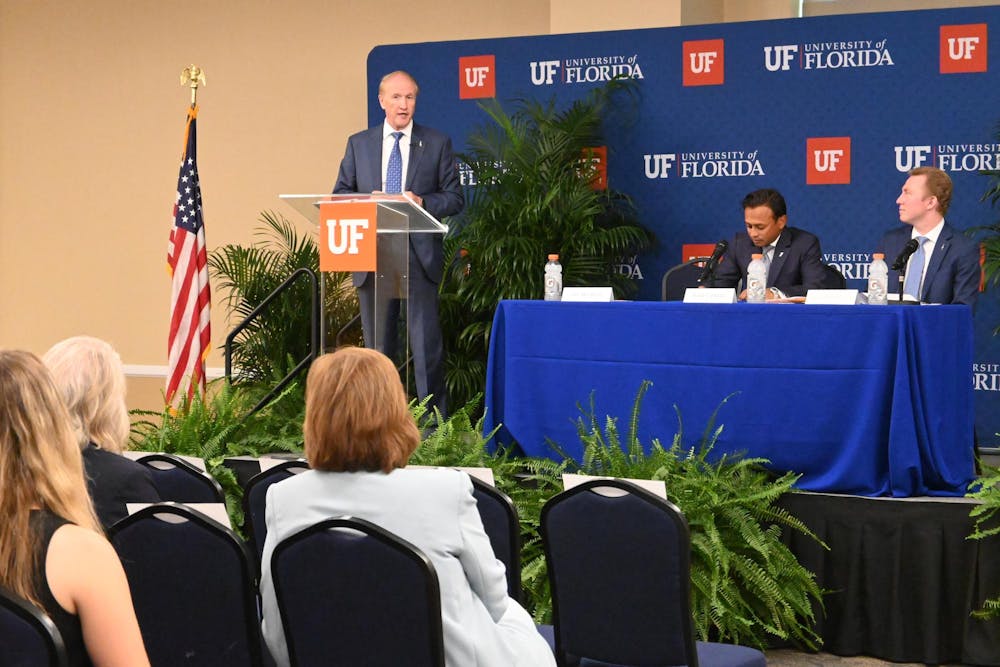
Bell’s confirmation was delayed as a result of a dispute between the UF Board of Trustees and the Florida Board of Governors. His five-year contract took effect July 1 after confirmation by the Board of Governors.
In a July 1 Board of Governors special meeting, Bell emphasized he would make it a priority to make UF one of the top public universities in the nation.
Bell’s employment agreement outlines a list of 20 expectations for his time as president. Among them are appointing a permanent provost, filling interim dean and leadership positions, expanding artificial intelligence initiatives and continuing major construction projects.
The agreement also requires progress on the Hamilton School for Classical and Civic Education, oversight of post-tenure review and maintaining campus safety, especially for Jewish students.
According to his contract, completing these responsibilities will factor into Bell’s evaluation and pay.
James Finkelstein, a professor emeritus of public policy at George Mason University, said Bell will be expected to operate within priorities established by the Board of Trustees and Board of Governors while simultaneously trying to advance his own vision for the university.
“All of those things are going to be required of him whether he thinks they're important or not,” Finkelstein said. “He doesn’t have much room for his own agenda.”
Among Bell’s greatest challenges, he said, will be recruiting and retaining top faculty while balancing Florida’s evolving higher education priorities.
“You can’t become a top-three public university without high-quality top faculty,” Finkelstein said. “Universities’ reputations are not established by their administrators. It’s established by their faculty.”
In a July 13 press release, Bell said one of his first priorities is to recruit outstanding faculty for the university.
“Great universities are built by great people,” he wrote.
Finkelstein said attracting nationally recognized scholars could become increasingly difficult if faculty perceive Florida’s political climate as limiting academic freedom.
“Having people review their syllabus for their course to make sure it doesn’t violate some DEI restriction, you’re going to see faculty leave,” he said. “In fact, Florida has seen a lot of faculty leave.”
According to a survey administered by faculty organizations in Texas, Florida, Georgia and North Carolina in 2023, almost 300 respondents from Florida said they planned to seek employment in another state within the next year.
A report by UF’s faculty senate also found some departments, like the College of the Arts, “[struggle] to hire or retain good faculty and graduate students in the current political climate.”
If Bell happens to step over the line concerning issues politicians disagree with, Finkelstein said, his only chance of keeping his position will be to have strong faculty support.
Faculty leaders also say rebuilding confidence in the university should become Bell’s biggest priority.
Meera Sitharam, a co-president of the United Faculty of Florida at UF, wrote in an email to The Alligator that she believes Bell’s highest priority should be to quietly put an end to how UF currently manages political and corporate influence from politicians, AI donors or people with financial interests in the institution’s resources.
Michelle Nolan, UFF-UF’s other co-president, wrote that faculty have had to battle politicized interference in curricula and cuts to research funding.
“The past several years have been exhausting and demoralizing for faculty at UF,” Nolan wrote.
She said Bell’s main challenge will be to regain the trust and confidence of the university’s faculty.
Rather than simply responding to political pressures, Nolan said the president should earnestly work to protect shared governance, academic freedom and the university’s ability to function independently.
Others hope Bell’s presidency emphasizes student well-being alongside institutional stability.
UF College Democrats President Harper Miller wrote in a statement to The Alligator that she hopes no voice goes unheard, especially during the government’s crackdown on diversity, equity and inclusion initiatives.
In the past few years, the university has been forced to remove campus cultural engagement centers, cut DEI-focused grants and remove sociology as a general education requirement, Miller said.
She’s excited to see how Bell prioritizes strategies that ensure students and faculty are able to feel safe, valued and respected in a “divisive political climate.”
Rabbi Jonah Zinn, the executive director of UF Hillel, wrote in an email statement to The Alligator the Jewish community is excited to welcome Bell as president with hopes that “Jewish students, and all students, have the opportunity to live, learn and grow in a campus community where they feel safe, supported and able to thrive.”
Bell’s employment agreement places emphasis on the safety and comfort of Jewish students.
Judith Wilde, a research professor at the Schar School of Policy and Government at George Mason University, said Bell should prioritize transparency as his tenure begins.
Because the president emerged from a confidential search process and follows so many recent leadership transitions, Wilde said Bell will need to focus on building relationships across the university.
“He will need to meet with all his constituencies,” Wilde said. “He needs to assure [them] that he understands their needs and to build their trust.”
She added Bell would need to maintain strong communication with the Board of Trustees while carefully managing university finances, particularly after the controversies that likely contributed to former president Ben Sasse’s resignation.
In the July 13 press release, Bell said he intends to spend time listening to feedback and ideas from the UF community.
“I truly believe our best days are still ahead,” he wrote.
As Bell begins his first year as president, higher education experts and faculty voices seem to agree on one point: Before prioritizing rankings or anything else, the university’s next chapter will depend on whether the new president can restore confidence and trust in an institution that has undergone years of constant change.
Contact Swasthi Maharaj at smaharaj@alligator.org. Follow her on X @s_maharaj1611.
Swasthi Maharaj is a political science and politics, philosophy, economics and law (PPEL) junior at UF. This is Swasthi's fourth semester at The Alligator, and her third semester on the university desk. She's also reported on the enterprise desk. Swasthi loves coffee, reading, going to concerts, baking and taking long walks.