
UF’s campus has a lot to offer. It has the Reitz Student Union, events in Plaza of the Americas, cats crawling around and lounging in front of dining halls …. Wait. Cats?
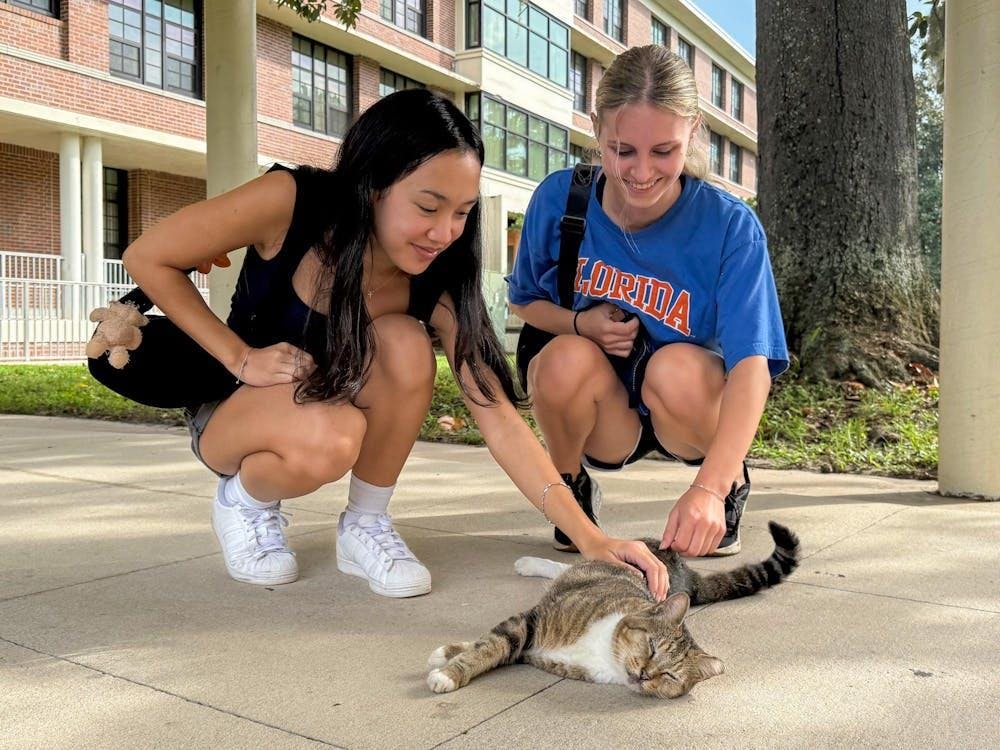
Yes, The Swamp has a rich history of campus kitties. Many cats have gained love from the community and become quite well known for their lazy lie-downs and loud meows.
Every student should know where to find some of these adorable cats and how to properly take care of them —- by leaving them be.
Ham and Burger are just a couple of the felines that can be seen around campus.
Both sharing piercing green eyes, Burger is a black and white cat, and Ham is a brownish-grey and white tabby cat. The duo is often seen by each other's side near Yulee Hall with their tails intertwined.
Michelle Moore and Amelia Edelman, 18-year-old UF freshmen, run the Instagram account @burgerhamuf where they post photos of the dynamic duo.
“A bunch of people were taking photos of them,” Moore said, explaining why she and Edelman started the account. “I figured, ‘You know, that's kinda cute!’”
The account also advises students to follow UF rules and do their utmost best to take care of the cats from a distance.
“Don't feed them,” Edelman said. “It's not good for them. They don't need human food.”
While no one knows the exact number of cats hanging around campus, it can be assumed at least 15 call The Swamp home.
Eight in the Tolbert area, including the cat who is arguably UF’s most famous: Tenders.
If you've heard of any feline in Gainesville, Tenders is probably it. Her silly demeanor and friendly personality attracts eager kitty lovers to Tolbert Hall, where she frequently strolls. She even has her own Instagram account, @gatorcats, which has amassed over 8,000 followers.
Tenders and the other campus cats are well loved, fed and taken care of. When well-meaning people try to feed the felines human food, they can unintentionally injure the animal or put them at risk.
Last Fall, Tenders cut her tongue on a tin can someone had left while trying to feed her, resulting in a hospital trip for the cat.
It's important to remember not to drop your own food off in the hopes of feeding a stray campus kitty or try to search out what is considered “safe” for the cats. They don't need the additional food or resources; they have a whole community supporting them.
Outside organizations like Operation Catnip try to support the campus cats as much as possible, providing emergency aid, vaccinations and neutering to strays that wander the area.
Leah Hawes, the 27-year-old development director of Operation Catnip, takes pride in the organization being a safe and accessible resource for the Gainesville area's community cats. Operation Catnip started in 1997 and has since grown to serve over 100,000 community cats.
The non-profit organization finds and nourishes free-roaming cats through protective measures that ensure the cats have a stable life outdoors. Volunteers spay, neuter and give medical attention to the feral felines, bringing them to the best version of themselves, marking them off with a little nip of the ear to indicate they have been taken care of before.
In the last year, Operation Catnip has taken care of 11 campus cats.
Operation Catnip knows how beloved these animals are and exactly the best way to care for the free-roaming felines when you see them out in public.
“Respect their autonomy,” Hawes said. “Sometimes they want to say hi, [and] sometimes they don't. Don't force an interaction. But if you're lucky enough to be chosen by one of these community cats, please feel comfortable.”
Whether you’re strolling between back-to-back classes, running late to class while grabbing a coffee or you've just missed your bus, it's nice to know there’s a furry feline somewhere nearby cheering and meowing you on.
Just remember to respect UF's policies on feeding and taking care of the cats and avoid giving them human food.
Contact Mackenzie Haas at mhaas@alligator.org

Mackenzie Haas is a Media Production, Management, and Technology junior at UF and the Fall 2026 General Assignment reporter. This is her second semester on The Avenue. Mackenzie can be found at the movies, scrapbooking, thrifting, or sending out too many emails.