

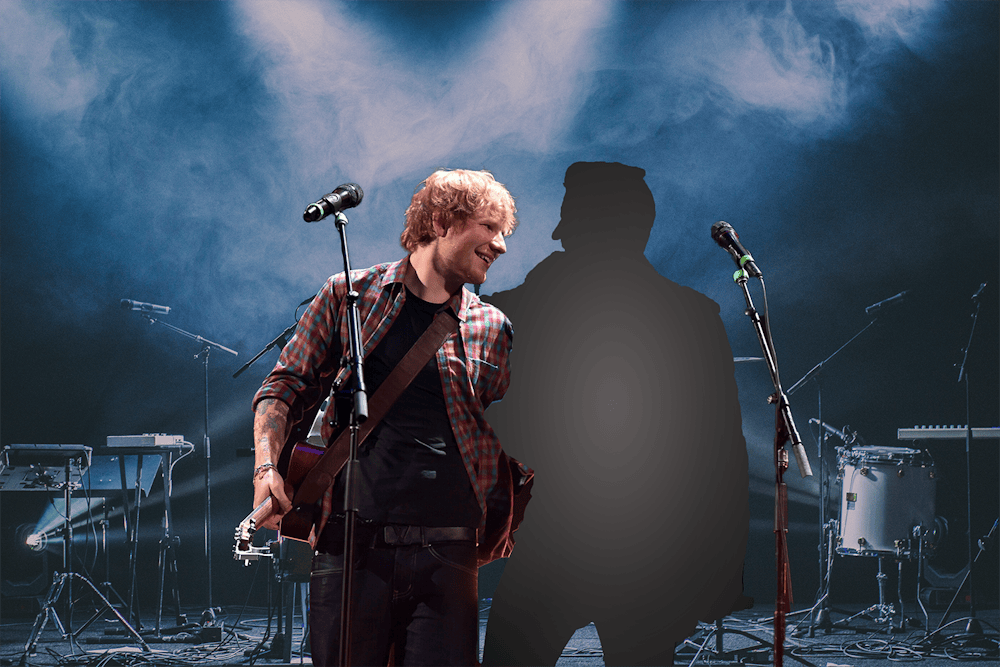
There are plenty of reasons I would go to an Ed Sheeran concert. Hearing his thoughts on international geopolitics probably isn't one of them. And Sheeran seems to agree.
For most of the singer’s career, he’s kept his politics separate from his public image. But after Macklemore, one of Sheeran’s opening acts, was removed from the Loop Tour after sharing pro-Palestinian sentiments during his set, avoiding politics suddenly became a lot more complicated for Sheeran.
During a Sept. 4 performance at MetLife Stadium, Macklemore performed "Hind's Hall," a protest song he released in 2024 in solidarity with pro-Palestinian student demonstrations, and ended his set by shouting “Free Palestine.” Two days later, Macklemore announced he had been removed from the remainder of Sheeran's U.S. tour.
Rolling Stone reported several venues had indicated they wouldn’t host shows if Macklemore was on the lineup after his “Free Palestine" remarks, and tour promoter Messina Touring Group told Reuters the same. Sheeran has continued to emphasize that removing Macklemore was ultimately the promoter's decision, not his, and he spent days trying to find another solution.
The distinction is important. Sheeran didn’t personally fire Macklemore, and continuing the tour doesn’t tell us how he stands on Israel, Palestine or the conflict in Gaza. But that's exactly why this situation interests me.
Sheeran initially defended his desire to keep his concerts apolitical. He said his shows are meant to provide unity, joy and escapism rather than act as political forums. I understand the appeal of that philosophy. Musicians aren't foreign policy experts, and having millions of fans shouldn't automatically obligate them to tell those fans what to believe. There are days when I use music to relax and escape my responsibilities, too.
But Sheeran’s position became more complicated Sept. 20. At his Sept. 19 concert in Philadelphia, his first performance since Macklemore’s removal, Sheeran directly addressed the controversy and apologized for mistakes he made in handling it. He called the Oct. 7 Hamas attack “horrific” and described Israel’s subsequent war in Gaza as “catastrophic and unjustifiable and disproportionate.” He also condemned what he called “systemic injustice” in the West Bank.
Sheeran also said he was “deeply worried” about concert venues vetting performers' content, arguing that although he’s encountered such restrictions elsewhere, it should “never happen in the free world.”
But Macklemore's removal presents a different question. This isn't simply about whether Sheeran owes his audience a public stance on Israel and Palestine. It's about whether remaining "apolitical" is actually possible when political expression directly affects who’s allowed to remain onstage on your own tour. And that's where neutrality starts to fall apart.
Macklemore chose to use one of the largest platforms available to him to advocate for Palestinians in Gaza and the West Bank. He told Reuters the opportunity to draw greater attention to the Palestinian cause was part of why he agreed to join Sheeran's tour in the first place. I admire that conviction.
Macklemore knew an Ed Sheeran concert wouldn’t necessarily attract an audience expecting to hear him talk about Gaza. He also knew his advocacy was contentious. As the fallout demonstrated, speaking out carried professional consequences, but Macklemore spoke anyway. Fame doesn't make him a foreign policy expert any more than it makes Sheeran one, but advocacy doesn't always require expertise. Sometimes it means deciding to use your platform for an issue that matters, even when doing so risks making people uncomfortable or losing an opportunity.
Sheeran initially took a different perspective. In a statement after Macklemore's removal, he said he wants his professional platform to remain a place where people from different backgrounds can come together. He also expressed respect for Macklemore's determination to publicly advocate for Palestine even though he chose a different approach.
That difference is what makes this controversy bigger than two musicians disagreeing on concert content. Macklemore wasn't the only person willing to lose something over his beliefs.
After his removal, Finneas, Lukas Graham and Aaron Rowe withdrew from Sheeran's tour. Members of Beoga, Sheeran's backing band, also left. Their statements expressed solidarity with Macklemore and concerns about artists being able to speak about Palestinian suffering.
Those decisions don't mean every artist is required to respond identically. But they demonstrate something important: Continuing the tour wasn’t a given. Those artists were willing to give something up. Sheeran wasn’t.
To be fair, walking away wouldn’t have affected Sheeran alone. He has emphasized that his tours support crew members, musicians and others who rely on the shows for their livelihoods. Fans had also purchased tickets, booked hotels and made plans around these concerts. Canceling stadium shows isn't as simple as one wealthy musician deciding not to walk onto a stage.
Sheeran also reportedly tried to persuade the venues to reconsider Macklemore’s removal, but making a reasonable decision doesn't make that decision neutral. Sheeran is not an emerging artist wondering whether losing a stadium booking could end his career. He is one of the most commercially successful musicians in the world, capable of filling stadiums all over the world. According to CBS8, while promoters and venues hold considerable power over concert tours, experts say an artist of Sheeran's stature generally has the final say over the conditions of his shows.
Still, his reported attempts at persuading venue owners to reconsider suggest there are real limits to his influence. But being unable to control a venue owner's decision isn't the same as having no decision of your own. Sheeran couldn’t necessarily decide whether those venues would welcome Macklemore back, but he could decide whether he was willing to continue performing without him.
When venues made Macklemore's absence a condition for shows to continue, Sheeran decided he was willing to accept it. That's where I struggled with his insistence on remaining "apolitical."
His comments in Philadelphia complicate that criticism. Sheeran ultimately did use his stage to address both the conflict and his concerns about restricting artists’ expression, but his decision to speak also illustrates how difficult maintaining that separation became once the controversy reached his own tour.
There is a difference between choosing not to use your platform for activism and continuing when someone on your tour loses his place after expressing his beliefs. The first can reasonably be called neutrality. I'm not convinced the second can.
Venue owners have their own argument. Robert Kraft, who owns Gillette Stadium, confirmed he barred Macklemore from performing there. Kraft said his objection extended beyond support for Palestinians and involved what he characterized as a broader pattern of antisemitic rhetoric and imagery. Macklemore has rejected accusations of antisemitism, saying his criticism is directed toward what he characterizes as apartheid and genocide rather than at Jewish people.
Suggesting venue owners’ objection stems solely from the words "Free Palestine" would ignore the concerns Kraft says motivated his decision. But acknowledging those concerns only raises another question: Who gets to determine what kind of political expression is acceptable on a stage?
Macklemore chose to use his stage to publicly advocate for Palestinians. Venue owners chose what speech and performers they were willing to host. The promoter chose to remove Macklemore after venues objected. Other opening acts chose to leave rather than continue under those circumstances.
Everyone involved exercised some form of agency — and Sheeran chose to keep performing.
Those choices aren't equivalent, nor do they reveal private beliefs. But they make it difficult for me to accept the idea that anyone at the center of this controversy can simply stand outside of it.
That's what I find admirable about Macklemore's response. He didn't pretend his platform was limited to the inside of a stadium. He decided drawing attention to Palestinian suffering mattered enough to risk the platform itself.
I don't know what Sheeran personally believes, and his choice to continue the tour doesn't answer that question. But it answers a different one. When a political dispute shapes the conditions for continuing your own tour, continuing becomes a decision.
Maybe celebrities don't owe us their political views. I don't especially need to know Sheeran's position on every election, war or piece of legislation before listening to "Thinking Out Loud." But when another artist's political speech determined whether he could remain onstage, this stopped being a simple question of whether Sheeran should speak about current events.
And by Sept. 20, Sheeran was no longer avoiding politics altogether. He opened his Philadelphia concert by addressing the conflict and controversy surrounding his tour, a shift from his earlier insistence that his concerts are not political forums. His decision to speak doesn’t erase the choices that preceded it, but it reinforces the question at the center of this: How long can someone remain apolitical when politics determine the conditions of their stage?
Sheeran didn't bring politics into his tour. But calling himself apolitical doesn't make politics go away.
Contact Shirin Khizzar at Skhizzar@alligator.org. Follow her on X @Shirinkhizzar.

Shirin Khizzar is a sophmore studying Public Health. This is her first semster working on the Alligator staff. In her free time, she enjoys reading, listening to music, and watching movies.


