

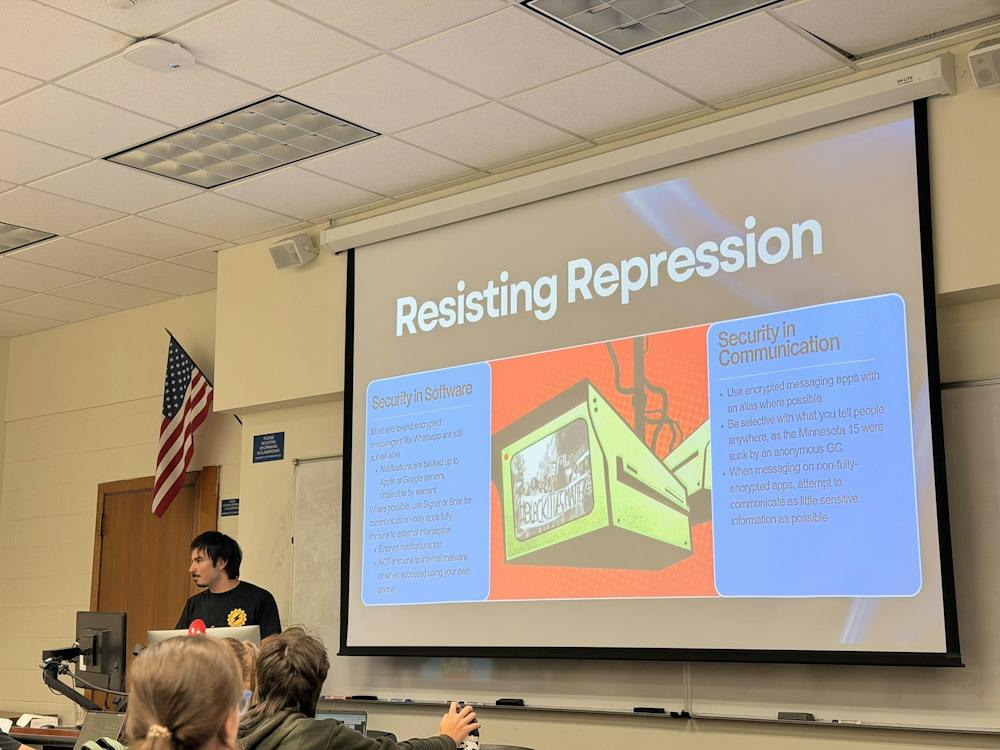
Two UF student organizations used a federal conspiracy case against 15 Minnesota activists as a lesson plan for protecting student protest organizers.
Solidarity, a UF anarchist organization, and Chispas, a UF immigrant rights group, co-hosted the information session Thursday night in Matherly Hall.
The event flyer invited students to learn about Minnesota's Operation Metro Surge, the Department of Homeland Security's immigration crackdown in the Twin Cities, and "how to fight repression." It paired a breakdown of the case with a crash course in operational security practices meant to prevent organizers' names, messages and locations from being tracked.
The "Minnesota 15" refers to heavily involved members of Direct Action Minnesota, organizers of anti-ICE movements triggered by local occupation, who were indicted in June on charges of conspiracy to impede or injure a federal officer over their efforts fighting the DHS operation.
The surge sparked protests nationwide, including in Gainesville, after federal agents fatally shot U.S. citizens Renee Good and Alex Pretti in Minneapolis in January.
Prosecutors said the 15 members crossed from protected speech into a coordinated conspiracy to obstruct federal officers. Fourteen of the defendants pleaded not guilty July 1.
Defense advocates have accused the indictment of relying heavily on social media posts and said it struggles to show actual force or threats.
Dimitris Liveris, a 20-year-old UF sociology junior and Solidarity member, emphasized at Thursday’s meeting the importance of campus organizers understanding the connection between their own efforts and cases elsewhere.
"Not only do we have a lot to learn from the case, in terms of how innocuous their actions were that led to federal charges," Liveris said, “but also the fact that we still have the opportunity to increase awareness and to steer the course of their trial before it happens."
Solidarity registered with UF this semester after unofficially launching last Spring. The two speakers said the group is horizontally organized without any leaders, and it only lists officers on GatorConnect because UF requires it.
The organization makes decisions by consensus, Liveris said, and around seven members worked on Thursday's presentation.
The biggest misconception about the group, Liveris said, is that its anarchist and libertarian socialist politics are unrelated to causes students care about.
"When people describe Solidarity as ideology, they see it as separate from all of the things that that ideological belief calls on us to support and to fight for," he said.
Liveris pointed to the group's history of protesting ICE, helping delay the removal of Graham Woods and advocating against mass surveillance. Those issues are "interwoven into the fabric" of what Solidarity believes, he said.
Chispas has advocated for immigrant students at UF since 2008 and funds an annual scholarship for undocumented students. The group designed the flyer for Thursday’s event, created the announcement post and provided Chispas pins for winners of a Kahoot-style quiz.
Angie Pleitez, a 21-year-old UF psychology senior and Chispas member, said the collaboration was a response to rising immigration oppression.
Pleitez has been involved with Chispas for two years. The goal of the meeting was to teach people ways to stay protected while serving their community, she said.
Leading up to the meeting, Pleitez said she already knew about ICE’s activity in Minnesota, but the meeting taught her one defendant is being held for reasons unrelated to the conspiracy charges. That defendant, Kyle Wagner, remains in custody on earlier federal charges.
Social media is full of protest footage, she said, but it rarely explains what happens to protesters afterward.
"It's just important to be an informed person," Pleitez said.
S.B. Flowers, a 20-year-old UF sociology sophomore and Chispas member, said the session provided students with tools that can protect others.
"I think it's just important to look out for yourself and have the knowledge to be able to do that," Flowers said. "[At] this event, they taught us how we can better look out for ourselves and especially our neighbors as student orgs to make sure that everybody is safe from surveillance and from ICE."
Most of the session focused on how the government built its case against the Minnesotan activists and how students can avoid documenting personal data that could be accessed and used against them.
The main pieces of evidence presented in the Minnesota case were social media posts criticizing ICE, which are protected under the First Amendment.
Court filings released in August showed undercover DHS agents attended community meetings, joined a Signal chat residents used to track ICE and used artificial intelligence to search for protesters' photos online. Agents also used chat-capturing software to record Signal group chats.
At Thursday’s meeting, one slide read, "Your group chat is not a private room."
Jay Kalogiros-Pepper, a 20-year-old UF wildlife ecology and conservation junior, presented the information about operational security and its connection to social media.
"I know that it is technically impossible to be 100% private, but we can still control to an extent," he said.
He said he tested a free facial recognition website with a photo of himself, and within about five minutes, it accurately surfaced pictures of him and named his high school and the campus clubs he belongs to.
Law enforcement has used tools like Clearview AI to identify protesters, according to the Electronic Frontier Foundation, a digital-rights nonprofit.
In line with EFF’s recommendations, Thursday’s presentation urged students to use Signal for organizing, keep group chats small, turn on disappearing messages, disable face or fingerprint unlock and turn off location services before a protest to avoid geofencing, a tactic used as a preface to charging crimes by using warrants ahead of time to continuously track suspects’ location.
Another slide warned activists not to drive past automated license plate readers on the way to and from protests. Gainesville police turned off all Flock-style cameras Sept. 3 after Gov. Ron DeSantis ordered them off state roads. A crowdsourced map had previously counted about 100 of the cameras around Gainesville, many of which were located near campus.
Kalogiros-Pepper also tied the case to National Security Presidential Memorandum-7, a 2025 Trump directive that ordered federal agencies to investigate and disrupt networks behind what it calls “organized political violence.” Thursday’s meeting cited the Prairieland case in Texas, where defendants received sentences of up to 100 years after a police officer was shot outside an ICE detention center.
The risks aren't the same for everyone, Kalogiros-Pepper said. Students regularly approach the organization's table for resources and participation opportunities but are afraid to join because of their immigration status, including those on F-1 student visas, he said. The UF Police Department signed a 287(g) agreement with ICE in April 2025, allowing campus officers to act as immigration enforcement, which has drawn student protests and walkouts.
While Kalogiros-Pepper doesn’t face risks surrounding non-permanent legal status, he said students shouldn’t be "scared to participate in these organizations." He encouraged each student to contribute at the level that’s safest for them.
"You need to do threat modeling on yourself, and you need to recognize not only what are you comfortable with, but also what can harm you," Kalogiros-Pepper said.
Solidarity closed the presentation announcing a Nov. 14 Minnesota 15 Fundraiser Party to collect funds for the defendants’ legal fees. The time and place are to be determined.
Contact Aaron Zagal Yaji at azagalyaji@ufl.edu. Follow him on X @azagalyaji.
Aaron Zagal Yaji is a Public Relations and Economics freshman in his first semester at The Alligator. He covers El Caimán's metro beat. In his free time, he enjoys going to the beach (or reminiscing about it), cooking Peruvian food, and squandering his money on golden shiny things.


