

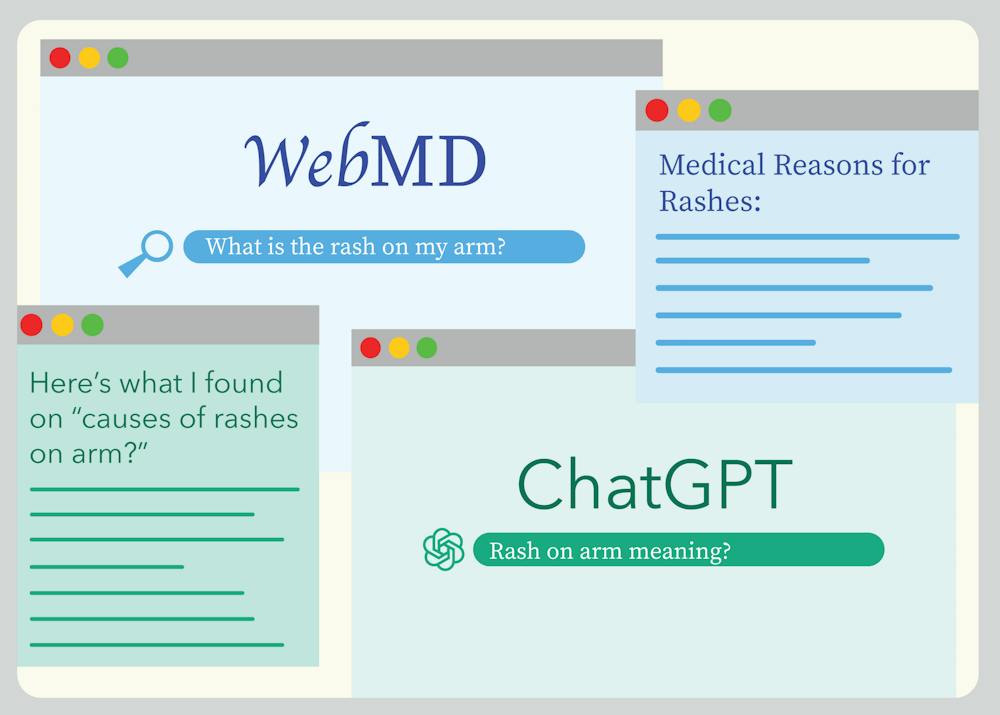
If you woke up with an itchy, unexplainable rash, who would you tell first: your doctor or the internet?
For years, people have turned to sources outside of doctors and hospitals for medical information, using websites like Reddit and WebMD to look up their symptoms. Today, when artificial intelligence can find answers in seconds, it’s easier than ever.
As doctors, researchers and healthcare professionals make use of new technologies, patients are turning to AI for treatment and diagnosis. But while they can lessen the financial burden of seeking a doctor, generic AI tools also have pitfalls.
Plugging symptoms into Google will automatically bring up an AI overview, which suggests possible causes, remedies and whether a doctor’s visit is necessary.
“Itchy rash” returned various possible culprits, including chickenpox, allergies and eczema. The AI summary used a variety of sources, pulling from YouTube videos, online symptom checkers, blogs and hospital press releases. But problems begin by casting too wide of a net.
Depending on what AI tool is being used, summarized results scoured from the internet could mix and match misinformation with real, peer-reviewed research.
“If you're getting a generative AI summary of biased information, that summary is just as incorrect as the source that it came from,” said Margaret Ansell, a librarian at the UF Health Science Center Libraries. “If it’s just from the open internet, well, do you trust the whole internet?”
Where less is more, AI tools with more limited datasets may be more accurate.
Databases like OpenEvidence, which is trained on only peer-reviewed journal literature and runs on three AI models, could provide more reliable textbook information. However, only doctors, healthcare professionals and medical students can access it.
A lack of context offers another issue with AI-powered health diagnoses.
Generic AI tools can easily miss individual health needs when given limited prompting from the user. Meanwhile, healthcare professionals have access to a patient’s full medical history.
When patients come to hospitals or clinics with preconceived notions about their diagnosis based on results from an AI-generated summary or WebMD article, it can slow down the official diagnosis. To the average person, the difference between throbbing, burning and burgeoning pain might not seem important, but those terms are critically distinct to doctors.
“As a patient, it’s our responsibility to recognize that we know our bodies best, but we don’t know medicine best,” Ansell said. “It is always good to prepare for an appointment … but you should definitely not let your research bias the way that you describe your experiences.”
Asking the right questions
A doctor’s visit doesn’t always define how sick someone feels. Those without primary care providers or insurance often can’t afford regular checkups, and for serious health issues, the emergency room or urgent care can be an expensive last resort.
Nearly 11% of Floridians were uninsured in 2024, according to data from the U.S. Census Bureau. Florida ranked in the bottom five among all states based on population percentage covered by private or public health insurance.
For many, AI and other online medical tools are more accessible and sometimes quicker than a traditional doctor’s visit, bridging an important gap in healthcare. But these tools should only be used to see whether symptoms warrant professional healthcare — not as a reliable diagnosis, Ansell said.
AI can also break down medical jargon and numbers, making lab results, long medication names and intimidating diagnoses easier to understand.
Free online tools include Kaiser Permanente’s vetted symptom checker and vast health information resource MedlinePlus from the National Library of Medicine.
A learning curve
For many in the field, AI isn’t the future — it’s been here.
This Fall marked the launch of UF’s Artificial Intelligence in Biomedical and Health Sciences master’s degree, a 30-credit program that lets students learn AI ethics, analyze AI-compiled data and work side-by-side with AI medical researchers from UF’s Intelligent Clinical Care Center.
Since debuting at UF’s Gainesville and Jacksonville campuses, the program has seen strong engagement from its first cohort, said Zach Krauss, the assistant director of strategy, communications and education programs at UF’s College of Medicine.
The cohort has 28 students — 14 at each campus — who come from majors ranging from physics to health science. Applicants didn’t need to have experience with AI or coding to be admitted. Separated only by distance, the same classes are offered in Gainesville and Jacksonville.
“The community they’ve formed already is amazing,” Krauss said, who works primarily at the Gainesville campus. “They’re already a team, even though they’re from different backgrounds and they’re all different ages.”
The students range from working professionals to full-time graduate students.
Program director Dr. Azra Bihorac said the goal of teaching students about AI is “amplification,” using technology to expand human capabilities — not replace them. She hopes students in the course evolve from using AI to creating with it, she said, developing original solutions to solve medical problems.
Part of that means bringing thorough scientific thinking to the table, she said.
“If you don't understand how you rigorously test something and bulletproof [it], you're never going to be able to use this technology safely,” Bihorac said. “You're going to completely miss red herrings.”
When using generative AI — which is prone to hallucinations — the program follows existing industry standards and appropriate red tape to avoid misinformation, Bihorac said. Nongenerative AI tools used in the program don’t run into the same problem but have their own limits, she added, like any other technology.
The students learn AI literacy through UF’s AI Passport Program, a 14-week online course that explores the pitfalls and responsibilities of using AI in biomedical research. Funded by the National Institute of Health, the program is available for free through the university.
In the future, Bihorac said she hopes to see the program grow to include doctorate degrees, enroll more students and expand across Florida and beyond.
The human cost
AI is pushing human innovation to new heights, but not everyone will be able to see the view from the top.
Medical transcription, traditionally performed by medical scribes, is one healthcare profession that could take a massive hit as AI voice recognition and transcription rapidly improve. The profession is expected to cut almost 2,000 jobs, which is an overall decline of about 4%, by 2035, according to the U.S. Bureau of Labor Statistics.
Other healthcare jobs like medical coders, appointment schedulers, receptionists, insurance verification specialists and pharmacy technicians are most at risk of being replaced by AI, according to Forbes. Medical scribes ranked No. 1 on its list.
But the social side of healthcare, where patient interaction is a necessity, isn't going anywhere, said Bryana Lore, a 20-year-old third-year nursing student at UF.
“I think nurses will always be needed,” said Lore, who uses AI technology like Google’s NotebookLM for schoolwork. “You can’t fully rely on tools like that when it comes to patient care.”
Contact Chloe Santiago at csantiago@alligator.org. Follow her on X @csant860.

Chloe Santiago is a junior journalism major with a focus on data and coding. She previously served as one of the Summer 2026 copy editors. Her idea of fun is a scary movie or video game at night with all the lights turned off.


