

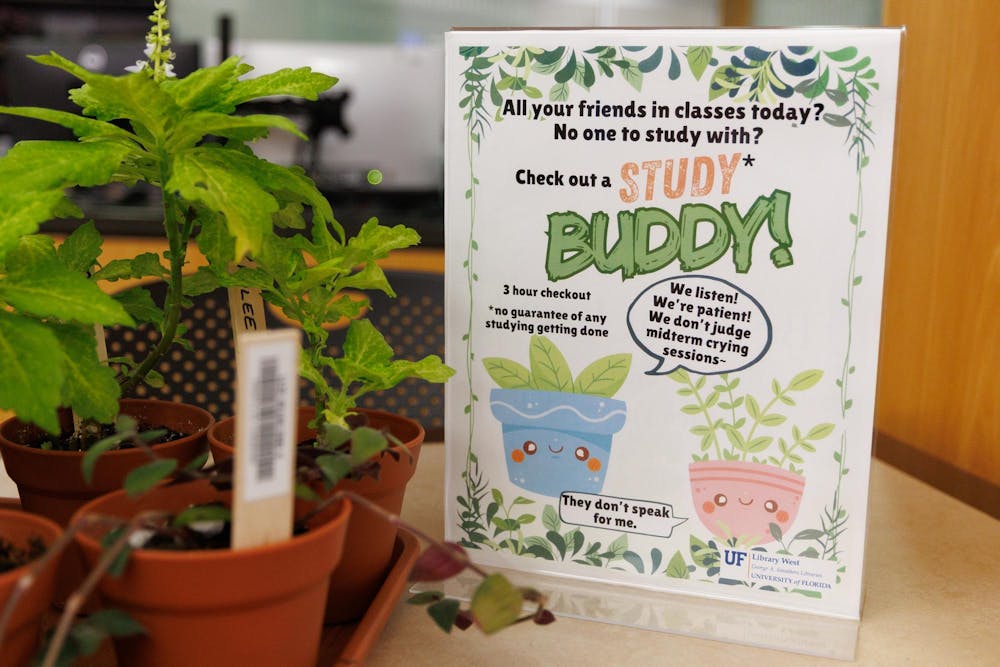
When Alex Segelnick studies at Library West, Malcom’s company helps him focus.
Malcom, a bright green coleus plant in a tiny pot, is one of over a dozen plants Library West offers for librarygoers to rent while they study. With names from Simon to Zoë, these study buddies have been rented over 2,300 times since their debut at the library in 2022, according to Library West Chair Stacey Ewing.
Segelnick, a 21-year-old UF microbiology junior, said having a study buddy helps him focus on his work, rather than scrolling through social media like TikTok.
“My attention span has been degraded,” Segelnick said. “I’d rather be distracted looking at the plant for a few seconds, rather than getting caught for minutes on that scrolling.”
The study buddy program started as an undergraduate fellowship program and has now turned into a popular trend, Ewing said.
Each plant has a wooden stick in its soil showing off its name. Students ask for the plants by name, Ewing said, and some even receive permission to take their favorite home when they graduate.
“Students really took to that,” she said. “There’s something about being able to study with this cute little plant on your desk with you.”
When someone is accompanied by plants, their memory, concentration and morale are boosted, said Holland Hall, a 33-year-old Gainesville licensed mental health counselor with a background in therapeutic horticulture.
Nature engages the senses and generates curiosity, Hall said.
“Creating an aesthetic experience in a library with the use of plants could make it a more attractive and relaxing environment,” they said.
Attributing human-like qualities to a plant, such as by naming it, may also create a “body doubling” effect for students, said Elisha Lepine, a 25-year-old UF psychology doctoral student. Body doubling refers to using another’s presence as motivation, helping people, especially those who are neurodivergent, stay focused and on task, Lepine said.
Lepine personally tries to surround themself with plants when doing mentally demanding work, they said, because they believe plants can relax our brains.
“I absolutely find it plausible that the presence of plants can inspire, calm and provoke awe,” they said.
In 2025, a little over one-third of undergraduate students experienced anxiety, according to the Healthy Minds Network data interface. Increased stress and anxiety levels negatively affect a person’s memory, sending them into "survival mode,” said Joy Steiner, a 48-year-old licensed Gainesville therapist with a background working with plants.
Working around and caring for plants can calm the nervous system, she said. Students can also focus their attention on the plants instead of internalizing their anxiety, Steiner said.
“Externalizing your attention and getting out your head is essentially the key to well-being,” she said. “Suddenly, we’re not just stuck in our heads anymore.”
Studying inside can be hard for Daniel Ohana, a 23-year-old UF horticulture science senior, and the plant helps him, he said.
Ohana regularly rents out study buddies, he said, and the study buddies turn the library into a more enjoyable environment, which makes it easier to study.
“I don't like being inside, so this helps me cope,” he said. “It makes it easier to just be inside and be more comfortable staring at a screen for a couple hours.”
Contact Alabama Weninegar at aweninegar@alligator.org. Follow her on X at @AlabamaW40513.
Alabama Weninegar is a first-year journalism major and The Alligator's Spring 2026 University General Assignment Reporter. She also works a part-time job at Wyatt's Coffee downtown. In her free time, she enjoys watching her favorite shows on a rainy day or re-reading the Twilight series.