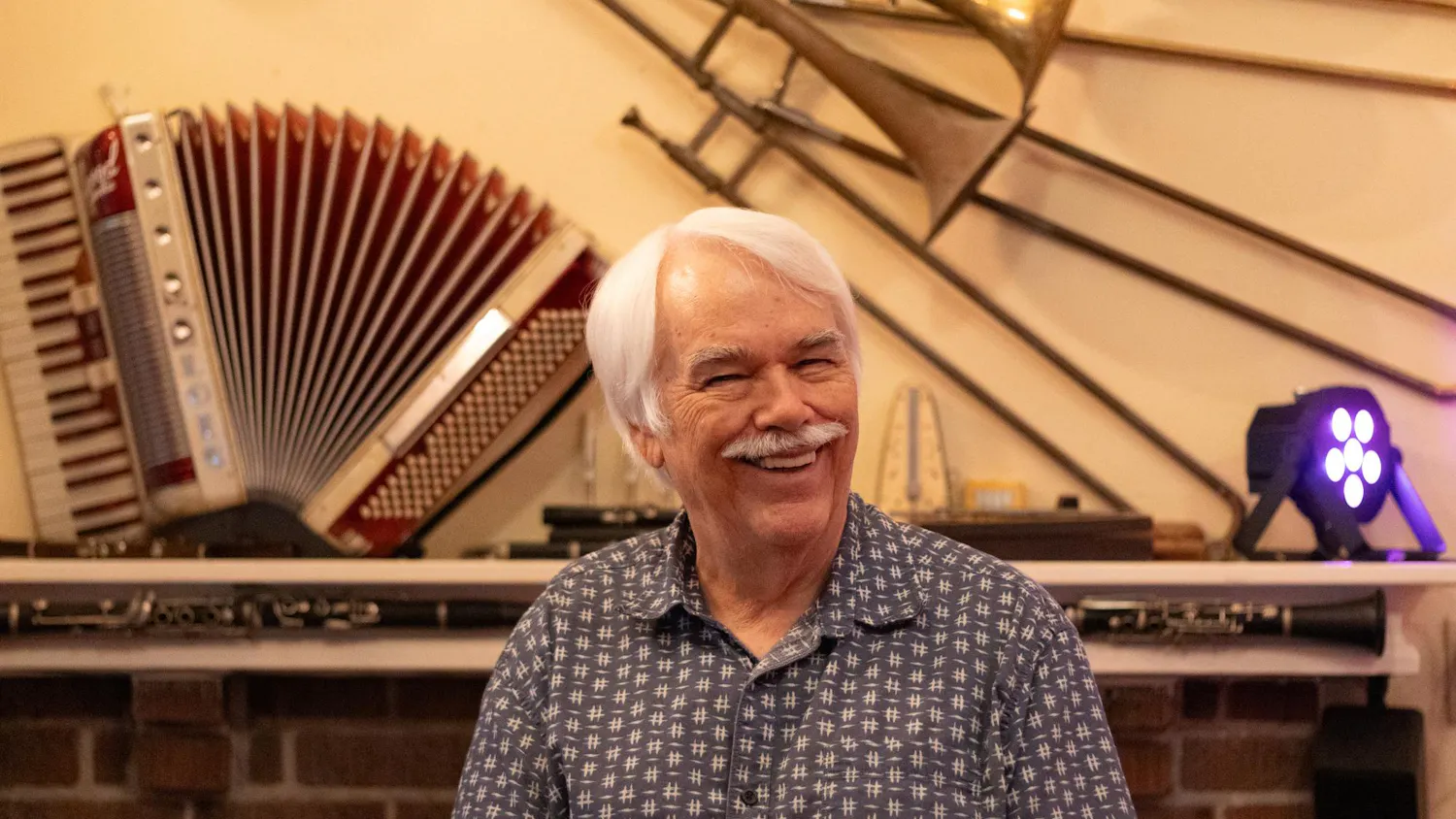

Oskar Garcia’s love for birds predates his oldest memories.
“Since day one, I’ve been birding,” he said.
But there’s one moment the 22-year-old UF graphic design alumnus still vividly recalls: an American pygmy kingfisher colliding with his sliding glass door. It survived the strike, Garcia said, so he and his parents took it inside to recover overnight before releasing it the next morning.
When birds strike windows, most die upon impact sustain injuries only a fortunate four in 10 will recover from, according to research published by the American Bird Conservancy.
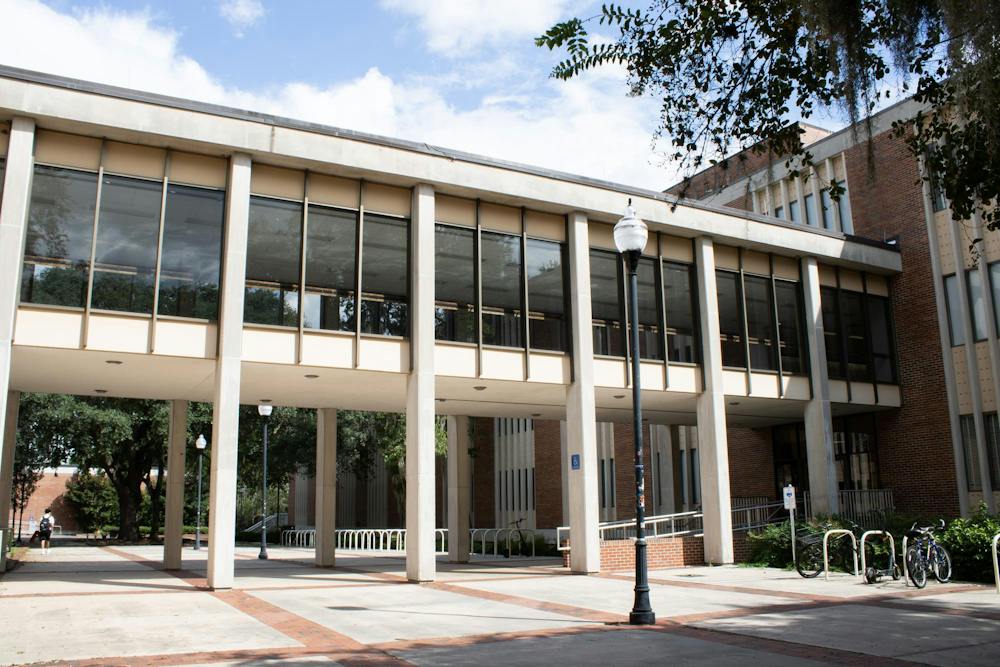
Garcia’s childhood passion for birds endured through his time as a UF student — as did his observation of bird-window fatalities. While studying graphic design, Garcia said he witnessed frequent strikes against the Fine Arts buildings’ windows.
Garcia recalled finding a bird that hit the Fine Arts catwalk, which he noted is ill-designed for birds because of its large, reflective winds and nearby vegetation.
He picked the bird up, he said, and it breathed heavily before dying in his hands.
“I could just feel its last few heartbeats or last few breaths,” he said. “To have this thing that you care about so much die in your hands.”
Garcia brought the bird to an administrative office, he said, where he spoke with multiple staff who told him they were sorry, but there was nothing they could do to address the bird collision problems on campus.
He suggested solutions, including spiderweb decals, to the staff but was told they didn’t know how to implement them. After that experience, he connected with the Bird Window Collision Project, joining over 100 students to spread awareness and report strikes.
The Bird Window Collision Project
While some may travel campus without ever considering bird safety, one group of students and faculty has made creating a bird-safe campus environment a mission.
Founded by UF wildlife and ecology professor Mark Hostetler in 2016, the Bird Window Collision Project hopes to confront the thousands of preventable deaths caused by campus windows every year.
The project aims to monitor when and where birds strike windows across UF’s campus, which helps determine how many birds are killed, which species are most vulnerable and what buildings are most problematic. The measurements allow students and researchers to figure out which windows most need bird-safety modifications.
The Bird Window Collision Project’s iNaturalist website allows anyone to track observed bird strikes. According to its map, UF’s Newins-Ziegler Hall and the College of Pharmacy and Fine Arts buildings are hot spots.
But bird fatalities at Newins-Ziegler could decrease soon, after modifications including bird-friendly decals were applied to the building’s windows Sept. 22. The installation’s effectiveness will be monitored by the collision project’s leaders over the next eight months to determine if similar changes should be made to other buildings across campus.
Carrie Bush, the assistant vice president of UF’s Planning, Design and Construction department, wrote in an email to The Alligator that the university works to support and promote ecological health. Bird-strike mitigation strategies are evaluated on all new construction and major renovation projects at UF, she wrote.
The university is evaluating bird friendly design features on multiple buildings across campus, including UV window film at the Florida Museum of Natural History, which is currently undergoing a $30 million renovation and is slated to reopen Nov. 23, according to a Sept. 30 press release.
Newins-Ziegler Hall used Acopian BirdSavers for about eight years. They are cheap, effective fixtures made of paracords and small polyvinyl chloride pipes that are applied to the exterior of windows, but they lack the durability necessary to endure over time, according to Hostetler. But a new solution was installed just in time for bird migration season, when window strikes pick up significantly as hundreds of millions of birds migrate to Florida.
Members of the Bird Window Collision Project estimate thousands of those birds die after colliding with UF’s buildings each year, Hostetler said. Exact totals are hard to measure because other animals often eat dead birds or they’re thrown away by groundskeepers before they can be tracked on the iNaturalist app, he added.
To solve this problem, two student researchers with the Bird Window Collision Project installed camera traps under windows at the College of Pharmacy and the surrounding UF health buildings Sept. 25 to monitor how and when strikes go unobserved.
Elle Henson, a 21-year-old UF wildlife ecology and conservation senior who has led efforts to create a bird-safe campus, said birds often collide with windows after mistaking them for more forest. Windows reflect nearby vegetation, which tricks birds into thinking they’re flying toward gaps between branches or open skies beyond a forest.
Regardless of how fast the bird is flying, Henson said, it’s almost guaranteed to suffer a traumatic brain injury or die when it strikes a window. The few fortunate survivors become easy targets for predators because of injuries that hinder their flying, she added.
And birds don’t always strike windows individually, either. Henson recalled one student witnessing about 20 cedar waxwings collide as a flock.
“A friend of mine sent me a video of just all the birds scattered on the ground,” Henson said. “I went the next day, and there was basically just a pile of dead cedar waxwings outside Newins-Ziegler Hall, which was pretty striking."
A new and improved solution
Motivated by sustainability and her love for birds, Henson joined the Bird-Friendly Building Initiative, which intends to make UF’s campus safer for both migrating and resident birds.
The initiative acquired nearly $17,000. The National Audubon Society granted the initiative $9,900, with the Alachua branch donating an additional $5,500 and a GoFundMe raising over $1,000.
The initiative's first goal was birdproofing Newins-Ziegler Hall; materials, installation and outreach cost roughly $11,000 and the project was completed Sept. 22. The decals are applied using large plastic sheets that are designed to deter bird collisions to a window’s exterior, leaving behind transparent dots that mimic spiderwebs, according to Henson
The dots stick to windows in patterns that disrupt the reflections birds confuse for open space, allowing them to distinguish between the forest and a building to avoid fatal window collisions.
If the initiative receives more funding, Henson said, her group may be able to add the decals to more buildings across campus.
Contact Christian Haas at chaas@alligator.org. Follow him on X @ChristianH58745.
Christian is an environmental reporter with The Alligator, and studies journalism at the University of Florida. He is a fourth-year student who prefers to spend his free time trying new and random things, cooking, reading, watching TV, or hiking.