

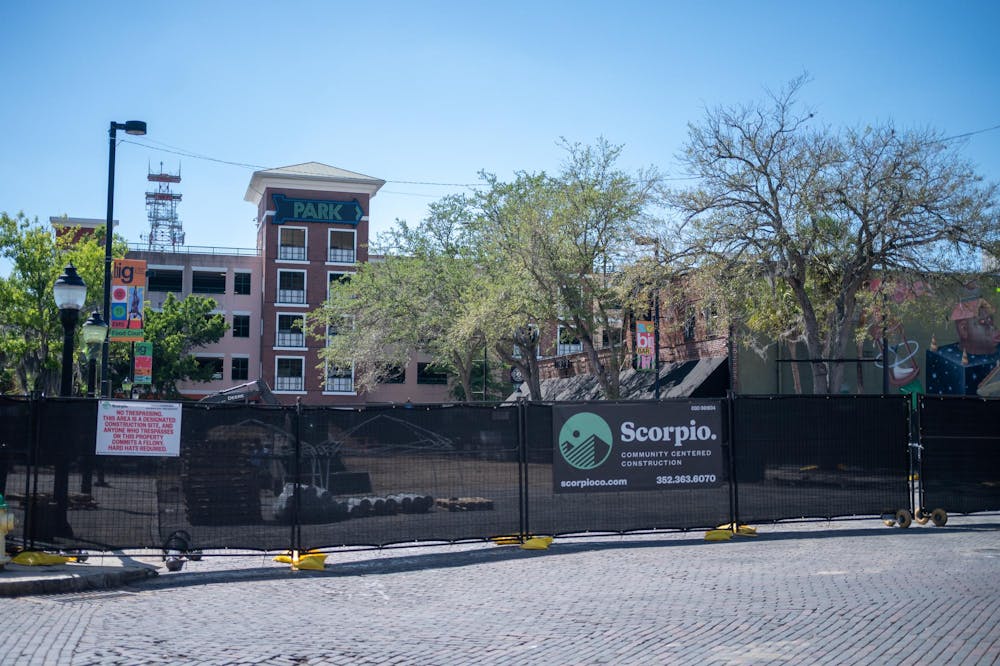
The fences and barriers around The Streatery came down Sept. 4, opening downtown Gainesville's new pedestrian corridor to the public after six years of votes and delays and months of construction that cut into neighboring businesses' sales.
Mayor Harvey Ward stopped short of calling the project finished when he spoke at the site during a Sept. 4 press conference.
"This is not a grand opening. We have a ways to go," Ward said, pointing to plans to add overhead lights and street furniture, with an official ribbon cutting planned for early November.
But "the fences are gone, and the barriers are gone, and it is open for business," he said.
The improved corridor opened stronger than it started, he added. Every storefront along The Streatery is leased and open.
Following the construction, two more businesses are opening in the area. Brewing Thoughts, a student-owned coffee truck, is moving into a storefront facing the corridor. It was "beneath a layer of dust and construction" at the time. Owners Titan Wojciak and Sofia Ortiz timed their opening to the corridor’s completion.
Nest + Nibble, a mobile charcuterie business, has also soft-opened now that major construction has ended.
Much of the infrastructure replaced through the project was more than a century old, he said. Two hours after a downpour, he noted the lack of standing water in the street.
“That in itself is a win,” he said.
Six years in the making
The Streatery began as an emergency, not a plan.
In September 2020, the city closed Southwest First Avenue between South Main Street and Southwest Second Street so restaurants could spread tables into the street during the coronavirus pandemic. The Sept. 4 celebration marked almost six years to the day, Ward noted.
The city commission voted 4-2 in August 2022 to make the two blocks permanently pedestrian-only.
The price grew as the plans did. A city architect estimated in 2022 it would cost about $1 million per block to convert the street into a curbless "festival street." By the time the commission approved a concept plan in October 2024, the estimate for the full two-block project had grown to $2.4 million.
It was up to $3.2 million in March 2025, and the commission finally approved a construction contract with city contractor D.E. Scorpio Corp. in March 2026, capped at $4.5 million. The Gainesville Community Reinvestment Area program and gas tax dollars funded the multimillion-dollar project. The money will go toward rebuilding the roadway as a curbless brick plaza. It will also repair the 125-year-old stormwater drainage and electrical systems and add trees, lighting and outlets for food trucks, according to an announcement from the city.
The schedule slipped, too. Construction was originally expected to begin in late 2025, but crews didn’t break ground until this April. The city aimed to finish before UF’s first home football game Sept. 5 or by October as a fallback. Ensuring the area would be open before the start of FEST, Gainesville’s annual punk music festival, on Oct. 23, said Bryan Singleton, the city’s interim chief operating officer, at a March 5 meeting.
The soft opening beat the football deadline by a day, with Gators fans arriving in Gainesville for the home opener the same weekend the barriers came down.
The finished corridor is curbless and built for outdoor dining, festivals, markets and community events. Laid with brick, it features decorative lighting, landscaping, seating and rebuilt underground infrastructure.
It arrives in a downtown that might need the help. A city count this spring found 28 vacant storefronts across roughly 20 core downtown blocks, a 22% vacancy rate.
A city project primarily paid for by the county
The GCRA, which runs the project, is a redevelopment partnership between the city and Alachua County, with the county as the bigger funder.
The 10-year program runs from 2019 to 2029, covering downtown and much of East Gainesville, said Mark Sexton, Alachua County’s communications director.
The program is funded with about $70 million, roughly $40 million from the county and $30 million from the city. It is administered by city staff because the redevelopment area sits inside city limits, Sexton said. The county provides the larger share of the money. The 2019 agreement that created the program puts the combined commitment closer to $77 million.
"The county overall is the majority funder of these projects," Sexton said.
The county's most visible role during construction of The Streatery was marketing. Its social media accounts, which Sexton said reach about 200,000 followers, posted lists of the businesses that stayed open behind the fences. All made it through construction without closing, he said.
"I think it's going to be another really good attraction and reason for people to come downtown,” Sexton said.
Half a million dollars for the storefronts next door
The city is also putting money behind the block's recovery. On Aug. 13, the city's General Policy Committee approved the Streatery Improvement Grant program. A $500,000 fund offering up to $50,000 per business for public-facing improvements. Such as storefronts, signage, awnings, outdoor dining furniture, lighting and accessibility features — in the blocks surrounding The Streatery.
The program pays for a project's first $15,000 in eligible costs and half of every dollar after that, up to a maximum of $50,000. A cap a business would reach by spending about $85,000 on improvements. Improvements made since this March may qualify for reimbursement. Applications are expected to open this fall.
A costly year for the businesses behind the fences
For businesses that lived through the construction, the reopening ends a costly stretch.
Johnny Conti of Capone's, a nightclub on the corner of the construction zone, estimated business dropped about 15% to 20% after the fences went up because foot traffic made up much of the crowd, he said.
Capone's lights and lasers were visible from across the street before construction, he said, which would entice people walking by.
The disruption of construction created real problems, he said. When crews blocked off the side of the street Capone’s sits on, a customer with a disability who normally had a 50-foot path to the accessible entrance had to travel around the entire block.
A crosswalk on First Avenue near the club was also closed, he added, so more Uber and Lyft riders were dropped off on the road. He faulted the city for not providing a safe rideshare zone.
Conti said the city kept in near-constant contact through a project manager who checked in weekly and rescheduled work near the club's entrance so it would finish before weekend events.
"Everybody involved in the project has been very, very on top of it and very resourceful and helpful," Conti said. "It really does look like The Streatery is going to be really nice, brand new, beautiful."
Other businesses on the block told similar stories. Jacob Larson, who owns The Bull, a bar and music venue on the corridor, told WUFT in March that the construction would wipe out revenue from events the bar hosted on the street.
He estimated about a third of The Bull's income came from free events held on the street. But he predicted the new corridor could help raise sales by as much as 25%.
Daniel Hughes, the owner of Loosey's Downtown, told WCJB in May the fencing blocking his storefront was the hardest part of construction. But it didn’t stop regulars from coming by, he added.
Gainesville isn’t the only city expanding outdoor venues in its downtown area. West Palm Beach, Florida, rebuilt seven blocks of Clematis Street between 2018 and 2020 to create a curbless "flex street," a project credited with reviving its downtown. College towns from Iowa City, Iowa, to Ithaca, New York, have run pedestrian downtown blocks for decades.
Conti said Capone's plans to make the most of Gainesville's version. The club recently opened a kitchen, he said, and the city has allowed businesses to set up tables, chairs, fencing and flower beds up to 27 feet from their buildings. He plans to add an outdoor seating area with a large TV for game days.
"The Streatery being finished helps us out a lot in our next chapter," Conti said. "Without a doubt in my mind, it's going to positively impact our business."
Contact Jessie Yang at jyang@alligator.org. Follow her on X @jessie_yang_22.

Jessie Yang is a sophomore studying statistics. She's interested in business, technology, and finance, and is a member of the Caimanes Student-Managed Hedge Fund, where she researches companies and develops investment theses. She's currently exploring a career in investment banking. Outside of The Alligator, she enjoys playing tennis, golfing, and pretending not to struggle on hikes in pretty places.