

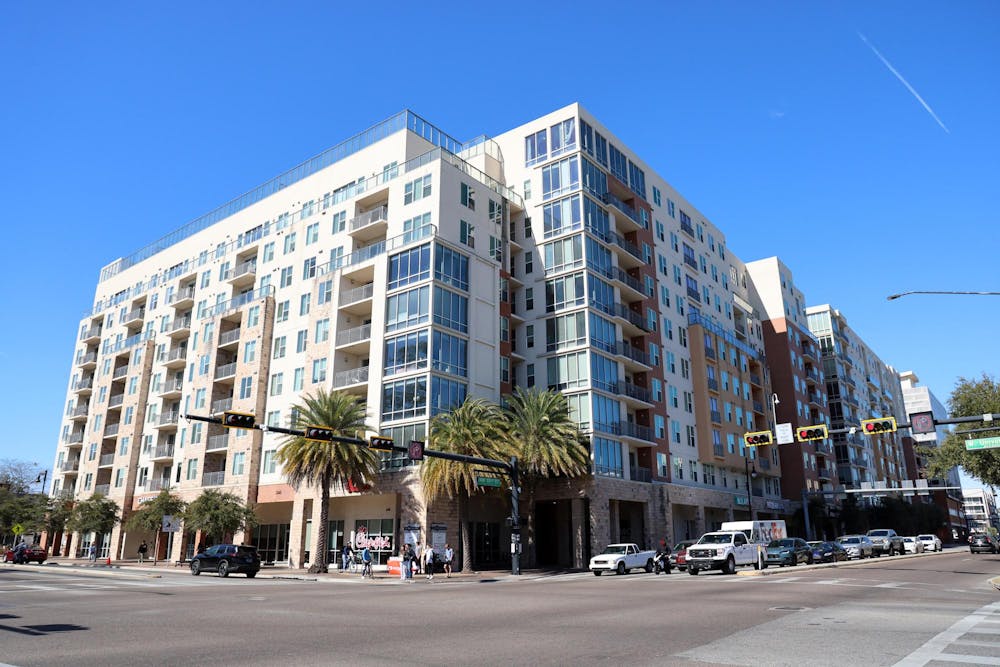
The Standard celebrated its 10-year anniversary of the start of its construction, marking a decade of luxury high-rise living in Gainesville.
Construction began Summer 2015, and the development celebrated its grand opening Fall 2017. It was among the first luxury high-rise student living projects in Gainesville, setting a model for later developments. Others, like Hub On Campus, Sweetwater and Nine 31, were built in the following years — 2020, 2023 and 2024.
As the popularity of luxury apartments continues to grow in Gainesville, local residents and students question affordability and the need for high-rise living in a college town.
Born and raised in Gainesville, 54-year-old Betsy Peterson has watched the city change dramatically over the years. She said she feels the rapid development is hurting locals.
“I’ve seen Gainesville be small, and I’ve seen it grow big,” Peterson said. “I think they’re almost doing it an injustice. Every time you turn around, they’re building, building, building.”
Peterson takes Southwest 20th Avenue to work daily and said traffic congestion is worsening between it and Archer Road, especially during rush hour. It makes daily commutes more difficult, she added.
“It’s just getting to be ridiculous,” Peterson said.
Southwest 20th Avenue supported an average of 19,000 commuters daily in 2024 — up about 3,000 from 2020, according to the Florida Department of Transportation.
Despite many housing developments catering primarily to students, Peterson said rising rent prices make it difficult for working residents and students to afford housing. She works two jobs to afford the two-bedroom, two-bathroom apartment she shares with her brother.
“Regular, hardworking people can’t afford to live anymore,” she said. “I know people who have to work two jobs trying to go to school and struggle because they’ve got to keep the rent paid.”
The median rent for a two-bedroom, two-bathroom apartment in Gainesville was $1,443 in 2024, a $360 increase since 2020, according to the United States Census Bureau.
Iaroslav Kasianov, a 22-year-old UF accounting junior, said rent prices were a big factor when looking for housing in Gainesville. He said apartments further from campus seem to be within his budget. Kasianov lives at Gainesville Place Apartments a few miles from the center of campus. He pays $689 a month without utilities for a private room and bathroom in a 4-x-4 unit.
“I think it’s very affordable,” Kasianov said. “They [developers] understand that there’s a lot of college students here.”
Gainesville Place Apartments has 30 buildings. Each building has three floors and remains one of the more affordable off-campus housing options for students.
There’s always a luxury aspect when it comes to student housing, Kasianov added. While there’s a balance between luxurious and affordable options, he said, student housing developments should focus more on affordability than lavishness.
“Not a lot of people are going to choose the luxury,” he said. “There’s more demand for people who are in my situation who cannot pay $1,200 a month."
Developers constructing 50 or more units in certain urban zoning districts in the city’s core are required to designate at least 10% of those units for residents earning 80% or less of the Area Median Income, the midpoint income of a certain geographic area, according to the Inclusionary Zoning Ordinance. The city passed the ordinance in 2024 to provide affordable housing.
The cost of these units cannot exceed 30% of the household’s income to remain affordable for eligible residents — this requirement must be met for a period of 30 years, according to the same ordinance.
With the increase in apartments, residents are experiencing cost burdens where 30% of their income goes toward housing. Inclusionary zoning requires developers to set aside a portion of new units at accessible prices. The policy aims to support sustainable and equitable growth while reducing economic displacement, according to the ordinance.
Anne Ray, the interim director of the UF Shimberg Center for Housing Studies, said there has been an expansion of student housing — on and off campus — in college towns nationwide. When universities invest in on-campus housing, students don’t have to worry about the difficulties of finding housing off-campus, she said.
Among those difficulties are roommate problems, she said.
“If you’re having problems with your roommate group, if somebody moves out, then the other people in the apartment are stuck with the lease,” Ray said.
But college populations often increase without a corresponding increase in campus housing, she said.
That may not be the case in Gainesville, according to a UF housing data and analysis report, which shows the capacity of undergraduate residence halls has increased alongside student population.
A lack of housing options near campus can increase pressure on bus systems and parking at UF, Ray added. The community needs housing options available at all affordability levels.
“I am concerned about the extent to which student housing has become luxury housing, and that prices students out,” she said.
Contact Lily Hartzema at lhartzema@alligator.org. Follow her on X @lilyhartzema.
Lily Hartzema is a senior journalism student at UF with a minor in geography. This is her third consecutive semester at The Alligator. She previously served as a copy editor in Summer 2026 and is a returning metro reporter. In her past-time, she enjoys reading, exploring new trails and photographing anything that catches her eye.