

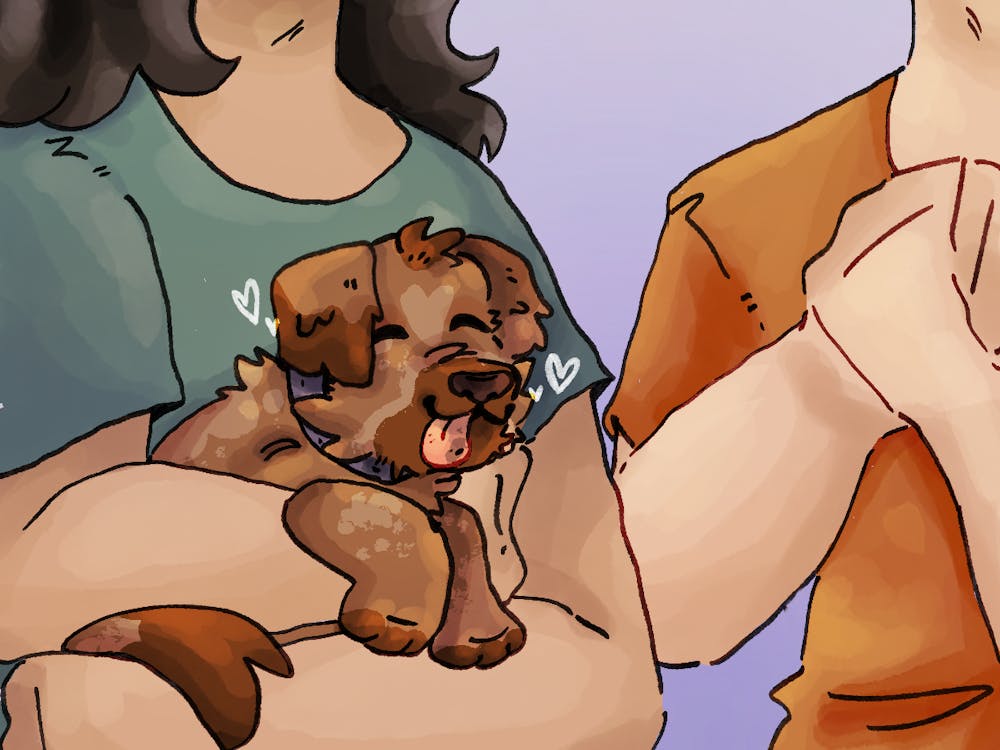
Despite wavering community opinions, the Alachua County Commission voted Tuesday to partner with UF on the location for a new animal shelter in Gainesville.
“It seemed to me that most of this meeting was about UF and not about our shelter,” said Phil Singer, a concerned community member.
The decision was between two sites. One, an area of UF-owned land on Archer Road, which currently houses the Institute of Food and Agricultural Sciences Swine Unit. Another, located on Northwest Waldo Road, is owned by the county and is known as the Weseman Tract. UF and the county have come to a $1 million sublease agreement under which UF will demolish the existing Swine Unit to build the animal shelter. Construction of the shelter is estimated to take two years.
The debate over the two sites has become controversial. Community members preferred the county-owned Weseman site, but the majority of the board agreed the UF site was the better option. The final vote was 3-1, with Commissioner Marihelen Wheeler in dissent and Commissioner Chuck Chestnut out of the room.
The UF property
The board cited proximity — under 2 miles from Butler Plaza — as its leading reason for choosing the UF site. The central location will make the shelter accessible for people to adopt and find care for their pets, said Commissioner Anna Prizzia.
“If what you want is for people to shop for animals and get their pets at our shelter instead of at PetSmart and at puppy mills, then this is the better location, because it will be down where everybody is shopping,” she said.
Over 80% of the dogs in Florida pet stores are shipped from puppy mills in midwestern states, according to a 2021 report from the American Society for the Prevention of Cruelty to Animals.
Associating the incoming animal shelter with UF could bring its own benefits, Prizzia added, including getting students more involved in volunteering and adoption.
“ I know very much what proximity does for student engagement,” said Prizzia.
According to a January 2025 report, about 56% of undergraduates participated in volunteering or community service activities during their time at UF.
Commissioner Chair Ken Cornell agreed partnering with UF could be a great advantage. The county has allocated $30 million to build the facility and deliberated its construction for the last 12 years, he said, a period of time he called “too damn long.”
“With UF and with our community and with this board, we can create something that this community has deserved for more than two decades,” he said.
The county-owned property
Community members largely supported the Weseman Tract; however, commissioners at the meeting argued its cons outweighed its pros.
The Weseman Tract is near an area of Alachua County called the EcoLoop, a 30-acre area of county-owned land that was originally developed to house a recycling or sustainable waste center. However, the lot has been vacant since its development in 2022.
Commissioner Mary Alford was concerned the tract is inaccessible for people without private transportation. The nearest bus route goes to the Gainesville Regional Airport, which is still about an hour-long walk from the Weseman Tract.
“I also know that one of our goals is to provide more care to animals that belong to some of our lower-income residents, and those are people that don't have the privilege sometimes of being able to get into a car and drive to a remote location,” Alford said.
Building an animal shelter on the property might hinder other prospective businesses that want to expand into the area, commissioners said.
Commission disagreement
When the commission voted to move forward with the negotiations with UF, Wheeler was the only dissenting vote. She said the board was focusing too much on the student population and not the community that spends the most time working with the animals.
“I don’t think that catering to the university community is as strong as catering to our county community,” she said.
While the commission spoke about the potential benefit of new student volunteers at the UF location, Wheeler disagreed. Students aren’t often the volunteers who perform the more intense upkeep of the shelter, like mucking stalls or cages, she said. Instead, they prefer doing more of the “fun” work.
The proximity to the university could be a potential downside, she added, encouraging unprepared pet owners to make impulsive decisions.
”I know that we have students who come in, adopt animals and then leave them or turn them back to the shelter when they leave,” she said. “People who really want to adopt are willing to drive to the shelter to get there to do it, and those are the ones who are most seriously
invested in adopting animals.”
According to data collected by UF, 395 dogs and 491 cats were surrendered to Alachua County Animal Resources, the Humane Society of North Central Florida and Operation Catnip of Gainesville by their owners in 2024.
Community concern
Ten community members attended Tuesday’s meeting to give public comment, voicing concerns about the UF site.
Patricia Antonucci, a 43-year-old Gainesville resident, agreed with Wheeler, saying it is more productive to market the shelter location to committed pet owners than casual passersby.
“If somebody wants to adopt, the incentive has to be for the adoption, and not because it's on a whim, because they're passing by the building and it's convenient,” Antonucci said.
Other speakers had similar sentiments, including Phil Singer, a 70-year-old Gainesville resident.
“I think that putting it in the center of Gainesville, behind the university, targets the wrong type of people to be adopters,” Singer said.
Singer also said the Weseman Tract is a better choice because it is a larger location with more room to build. It would also save the county $1 million, which could go toward facility resources.
Bryan Buescher, a 66-year-old High Springs resident and owner of Vet Coach, a company to help aspiring vet practices, said the specifics of the UF contract remain uncertain.
“I don't think we actually have an operating agreement with the University of Florida, so we don't even know what that picture is going to look like,” he said.
Wheeler said she has a similar fear.
“Experience with the university in the past has made me a little skeptical about trying to partner with them in terms of how we run our shelter,” she said.
Contact Kaitlyn McCormack at kmccormack@alligator.org. Follow her on X @kaitmccormack20.
Kaitlyn McCormack is a senior journalism student serving as the County Commission Reporter for The Alligator's Spring 2026 metro desk. In her free time she enjoys journaling and drinking too much coffee


