
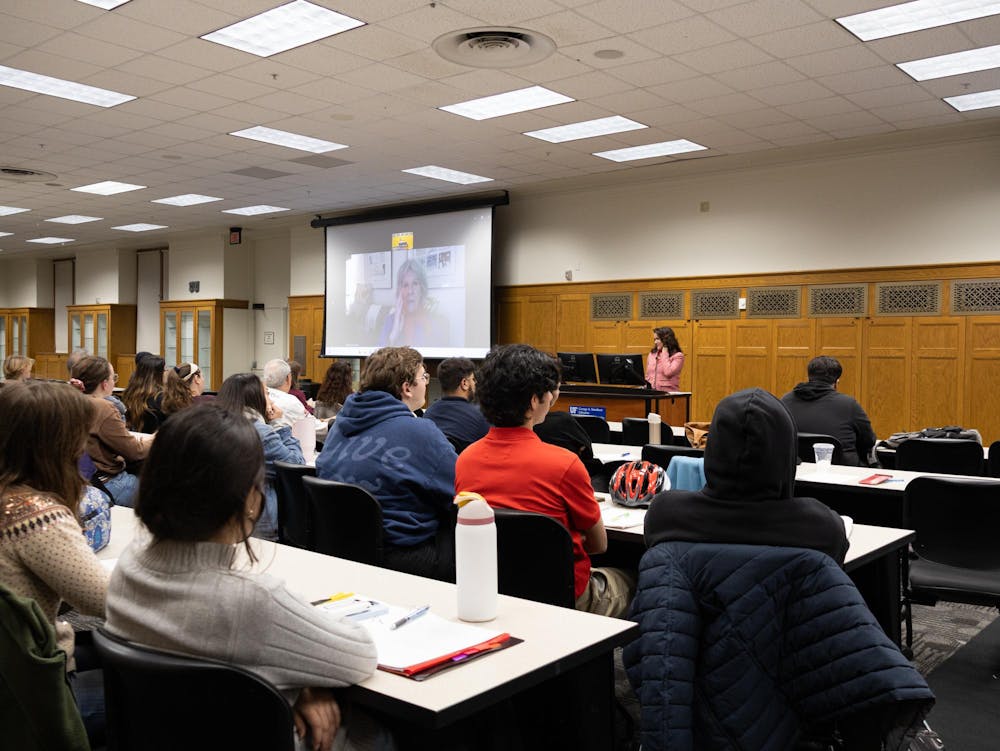
Students, faculty and community members gathered at Smathers Library Wednesday night for a screening of the “Walking the Cuban Tightrope,” which connects Cuba’s national ideals to the realities of life on the island.
The documentary was the second film screened in UF’s Cuba film series “Envisioning Cuban Freedom: History & Its Legacies,” a program that pairs film screenings with public discussion.
The film follows four protagonists who guide audiences through a powerful and unsettling examination of Cuba’s past and present challenges.
Sofia Marriaga, 19-year-old UF history freshman who attended the screening, said firsthand perspectives help create more authentic narratives and are essential to history. Marriaga added the film evoked her own pride for Cuba, her people and culture.
“I feel like showing like the real, lived experiences of people, and then people like actually being spoken to and being interviewed is so, so important,” Marriaga said.
During the film, Cuban history is told through stories by historian Lillian Guerra. Human rights struggles are shown through the work of lawyer Laritza Diversent and Cuban activist rappers – who both risk their safety to speak out.
Lillian Guerra, a UF professor of modern Latin American history who specializes in Cuba and Caribbean history, moderated a discussion after the film screening.
Guerra said she wanted to bring Cuban films to UF because so much has occurred over the last decade in the country that escapes mainstream consciousness in the U.S.
“We're finding out that 2 million Cubans left between 2023 and 2025, and nobody really understands why,” Guerra said. “That was the largest exodus in the entire history of the post ‘59 revolution and communist era.”
Cuba’s mass migration wave needs reflection and deeper understanding, she said.
Guerra said she didn't hesitate to start this film series because of a mentor of hers, Adriana Bosch, a veteran PBS documentary filmmaker. Bosch directed “Letters to Eloisa,” the first film UF presented in the series, and she attended the screening as a guest speaker in October 2025.
Guerra highlighted Bosch as a pioneering Cuban American woman filmmaker from the 1980s, noting that featuring her film and bringing her to the event added valuable context and made the audience engagement especially successful.
“So I thought automatically, we have to start with Adriana Bosch,” said Guerra. “ … Bringing her here added another dimension to the viewing of the film.”
Wednesday’s event also featured a Zoom appearance from its director. Margaux Ouimet, who was born in Montreal, Canada, directed, produced and edited “Walking the Cuban Tightrope.”
From an early age, Ouimet has had personal ties to Cuba through family friends. Ouimet said she hopes audiences have some renewed sympathy for what's happening in Cuba after watching her film. She also wants them to leave with an appreciation for Cuban culture, she said.
“There's a richness of the culture that I'm just in love with in terms of Cuba and the people,” said Ouimet. “And then the tragedy, the tragedy of the fact that there's no freedom there.”
Sofi-Nicole Barreiro, a 27-year-old UF Latin American Studies graduate alumna, attended the screening as a supporter of Cuban history and of programming and academic institutions that center around Cuba, Latin America and the Caribbean.
Barreiro said what stood out to her the most was how the film connected historical context with more recent events.
Because the earlier part of the documentary focused on moments around 2016, she said she expected the film to remain centered in that period.
Instead, it took a shift toward more contemporary movements.
“It was very surprising to see these more modern movements, especially in relation to Patria Y Vida and the role of artists and dissidents in that movement,” Barreiro said.
Barreiro said this film helped her solidify the idea that interest in Cuba is not limited to people who have a direct background in Cuba or who are Cuban American.
“There's clearly an interest beyond Cubans and the diaspora about Cuba and what happens there and what ultimately will happen on the island,” Barreiro said.
Contact Ornella Moreno at omoreno@alligator.org. Follow her on X @ornellamorenom.

Ornella Moreno is a senior journalism student with a concentration in psychology in her second semester at The Alligator. She covers El Caiman. Previously, she worked as a radio anchor for WUFT Noticias. In her free time, Ornella enjoys doing yoga, reading and going to the movies.