

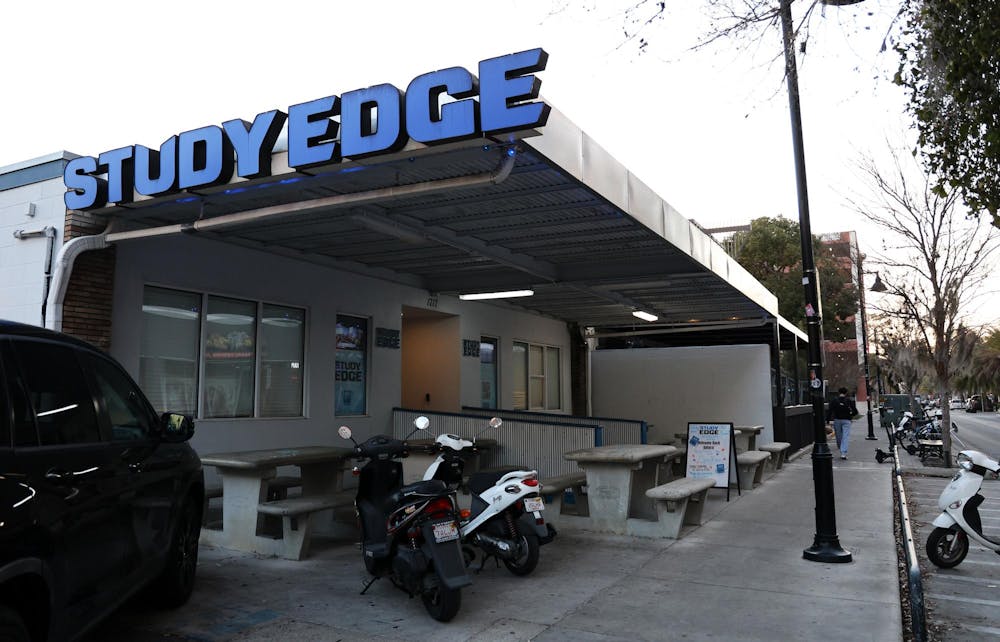
For many UF students, succeeding in some of the university’s most demanding courses comes with a monthly subscription.
Thousands of students budget between $50 and $90 a month for Study Edge, a third-party tutoring service near UF’s campus that offers course-specific exam preparation.
According to Isabella Duarte, the assistant marketing coordinator at Study Edge, about 7,000 UF students currently subscribe to the service, which many see as an unofficial requirement to keep up in large-enrollment, high-difficulty science and business classes.
Duarte said Study Edge tailors its materials closely to how professors teach and test.
“We’ve had tutors, especially in chemistry, who have been with us 10 to 15 years,” Duarte said. “They’ve known how exams look for around 15 semesters.”
Study Edge also employs students, known as course contacts, who attend lectures and provide notes used to build course packets.
“They’re basically students that get paid to go to class,” Duarte said. “They’re our most valuable resource since they're the ones that are actually sitting in the class, and then they give us the notes, and then we can tailor the packets exactly to that.”
Abigail Michnowicz, a 20-year-old UF animal science sophomore, said she first used Study Edge while taking Chemistry 2 and now spends about four to five hours a week using the service’s materials.
“In the very beginning, I was so against getting it, just because of the cost,” Michnowicz said.
In one of her classes, she said an ineffective professor led her to use Study Edge despite the cost. Michnowicz added she doesn’t think she would have performed as well without it, although she does not believe the service is a necessity.
Other students said the service feels less optional. Daniela Suarez, a 18-year-old UF health science freshman, said she started using Study Edge during her first month at UF for extra reinforcement in physics.
Suarez said she would not feel confident passing some courses without it and described Study Edge as something she probably needed to succeed in certain classes.
She said the service’s cost was not a burden, and it tracks the professors' lectures and exams relatively closely.
For some students, the cost is justified by how much they rely on the service.
Violet Collins, a 19-year-old UF exploratory freshman, pays $75 a month for the service, and she said she would have to “rework her ways” without Study Edge. She said her parents help cover the cost because they view it as an academic resource and worthwhile investment.
Collins said she could take a different approach to the class and succeed, but it’s easier to have the service organize notes for her.
“If it doesn’t reflect the class, you can always quit,” Collins said.
Collins said her reliance on Study Edge often depends on the professor. When instruction is less effective, she said, learning the material becomes more difficult without outside support.
Professor Thomas Knight, who has taught at UF for 14 years, currently teaches Principles of Macroeconomics, a hybrid course with about 1,000 students across various majors.
Knight said faculty opinions on Study Edge are divided. Some professors view it as a helpful supplement, while others worry it encourages students to cut corners by replacing lectures and coursework.
Knight said he sits “somewhere in the middle” — Study Edge can be a valuable resource when used alongside strong study habits, but harmful if used as a substitute for class.
“If you are using it to skip lectures or because you’re not reading the textbook, then I think you are cutting corners,” he said. “You’re probably not going to learn that class’ material as well as you could.”
Knight said students often turn to Study Edge when they feel instructors do not provide enough resources to succeed, a response he understands. However, he expressed concern that the platform may encourage short-term memorization rather than deep learning by breaking material into simplified study snippets.
Another issue Knight raised is affordability and access. While he does not discourage students from using Study Edge if they find it helpful and can afford it, he emphasized his course is designed so paid services are not necessary.
“I have built my class such that you should not need it,” Knight said.
John Banko, a UF professor since 2007, teaches a 1,400-student online business finance course — the most popular Study Edge subscription at UF. Banko said he is largely indifferent to how students choose to succeed in his class.
Managing such a large, virtual class presents unique challenges, Banko noted. He said it is impossible to meet with each of the 1,400 students individually, which he considers an unfortunate but unavoidable reality of high-enrollment online education. He added that only about 10% of students watched his online lecture videos from recent data.
Despite this, Banko said he does not take offense when students rely on third-party resources like Study Edge because the material covered is the same. Outside tutoring services often offer more flexibility than the structured lecture format he must follow, he said.
Banko acknowledged the wide range of student experiences with the service.
“I’ve heard every version of it,” he said. “I’ve had students come in here and say, ‘Study Edge is garbage. You didn’t need that.’ Someone else would say, ‘Oh my gosh. Without Study Edge, I would have had no hope.’”
Ultimately, Banko said he supports the use of outside tutoring, acknowledging different perspectives are often necessary for learning.
“Sometimes you just kind of need a different angle or perspective to help make something make sense. And I think that’s great,” Banko said. “I’m never going to have a problem with someone offering a tip or trick.”
Mia Giannicchi is a contributing writer for The Alligator.

