

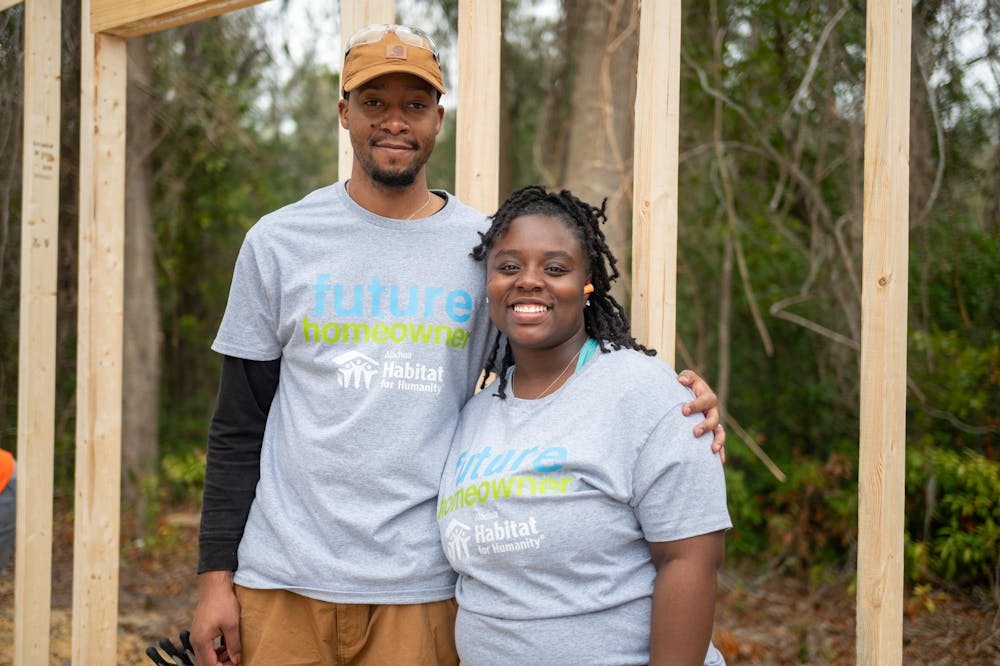
Nine months after high school sweethearts Tameria and Xavier Filer rekindled their romance, they were ready for all the commitments: marriage, children and homeownership.
The Filers began looking to buy a house in 2022 after the birth of their first son. After four years, they’ve finally found their forever home through Habitat for Humanity’s homeownership program.
The program helps low- to moderate-income families achieve homeownership by building their homes from the ground up. Participants learn about home-buying and contribute to the construction process of their own home, which helps reduce building costs and results in a more affordable mortgage.
Tameria said yearly rent increases in their shared apartment motivated her and Xavier to apply for a mortgage.
“We can pay rent all we want, but why not invest that into something that’s ours?” she asked.
Tameria and Xavier tried to use funds from the Alachua County State Housing Initiatives Partnership in 2023 and 2024, but the assistance wasn’t enough to reduce housing costs, Xavier said. Then, the couple discovered Habitat for Humanity when two of Tameria’s friends — both past participants in the program — informed them about its upcoming deadline.
The Filers immediately applied, and three months later, they were accepted.
“I believe that was nothing but God having his hand,” Tameria said. “Knowing that we’ve been seeking for homeownership, and I just believe it was our time.”
‘Takes a lot off of our shoulders’
Through Habitat for Humanity, an international nonprofit organization with several local branches, first-time home buyers can build credit and home equity even if they do not qualify for traditional mortgages.
Mortgages are long-term loans people pay to own a house, like paying off monthly car payments or credit cards. These loans can build credit but tend to have interest rates, meaning the cost of the mortgage increases with time. To qualify for a loan, people must provide proof of income and maintain a good credit score.
Prospective owners may get expensive mortgages or not even qualify for one if their credit score is too low or if they are unable to prove sufficient income.
But despite high costs and difficulty in qualifying for a mortgage, many, like the Filers, choose to purchase a home rather than rent, recognizing it as an investment to build credit and home equity.
Home equity is the steady increase in the property value of the home as it is continuously paid off and lived in, increasing the owner’s assets. Essentially, the house is worth more the longer it’s owned.
Habitat still requires proof of income and good credit but has less strict guidelines. For example, the Filers only need to maintain a 510 credit score, while most loans require a “good to exceptional” score, typically 670 or higher.
Creating opportunities for first-time home buyers is more than just housing for Kristine Thompson, the family services director for the Alachua Habitat chapter. She described the homeownership program as a culmination of “hope, stability, and opportunity” for participants.
Besides the ability to build and customize their first home, buyers are drawn to the homeownership program due to 0% interest rates for mortgages, which Xavier called a once-in-a-lifetime opportunity for his family.
“With any other mortgage, the interest rates are like 6 to 7% on the homes,” he said. “But with Habitat, there’s 0% interest, so everything’s going towards the principal, so that takes a lot off of our shoulders.”
It was a competitive program to join. The Filers were one of seven applicants selected for the program out of a pool of 200. The qualifications for the program mirror a traditional mortgage: a good credit score and steady income. Other qualifications include maintaining a certain monthly income margin, depending on their household size.
What makes Habitat’s program different, besides its affordability, is its focus on “sweat equity” and financial education.
Habitat defines sweat equity as the time and effort applicants contribute toward the purchase of their homes through the construction of other applicants' homes and their own home. The program requires families to complete 50 hours of work on others’ homes and 200 hours on their own home.
Volunteers also work on Habitat applicants’ homes. Albert Lorié, a 22-year-old UF mechanical engineering senior, is the vice president of builds for the UF chapter of Habitat for Humanity, and he helps out homeowners in the sweat equity process.
His job is to correspond with the Alachua chapter to get UF students a house to build during the school year. He said he primarily serves in his role to make a lasting impact on the community.
“I know that me volunteering and doing that made the house cheaper, much cheaper and affordable for someone who otherwise would not be able to have a home,” he said.
Sweat equity
On Jan. 31, the Filers spent six hours constructing wall and window framework, using nail guns and saws to cut wood.
Applicants are also required to participate in 12 educational workshops and attend an eight-hour home buyer's education class.
The classes are designed to teach buyers financial terms and strategies, such as homeowner’s insurance, budgeting and maintaining good credit. Through Habitat’s workshops and class, families like the Filers can receive the necessary financial education before buying a home.
The Filers are now starting the sweat equity hours in their own home and envisioning how they'll customize it. The couple hopes to incorporate good ventilation, as their son tends to experience intense seasonal sinus and allergy symptoms and often struggles with breathing.
The Filers also want to add a fence and porch. The outdoors are important to the couple, whose current apartment in Gainesville does not have a yard or even a balcony. Tameria hopes to add a lounge set on the porch as well.
“Definitely looking forward to just being outside and having access to outside more easily,” she said.
The entire experience not only provides the Filers with a home, they said, but also lessons and knowledge they can take away about the buying process.
“It’s kind of helped with us learning the whole process of what actually goes into preparing to purchase your first home,” Xavier said. “Understanding … what it really takes to build a home is educating us on what actually is going to be a part of these homes.”
As they advance in the program, Tameria said she is continuing to grow more appreciative of the opportunity she feels God has presented them and of the work they are putting in.
The Filers picked a lot for their home on Feb. 24, where they will be closer to family and resources for them and their son to grow as the years progress. The couple said they hope this house creates and holds generational memories.
“As much work we’re going to put into it, and especially as we’ve been, I think that it’s definitely in our best interest to keep it to make sure that we always have something to remain proud of,” Xavier said.
The Filers estimate that it will take around 10 months to complete the program, weather permitting.
Jasmine Valcin is a contributing writer for The Alligator.


