

Janice Garry, a retired Gainesville resident of 19 years, writes a grassroots, biweekly email newsletter addressing national, state and local political issues.
If there’s one topic that consistently appears in the newsletter, Garry said, it’s the ongoing fight for control of Gainesville Regional Utilities.
“We have a long history here in Gainesville of saying we don’t want the state running our utility,” she said. “It is incredibly offensive that the state keeps taking away our utility.”
The City Commission used to administer Gainesville utilities, but upon the passing of a 2023 legislative bill, Gov. Ron DeSantis appointed a five-member authority board to take control.
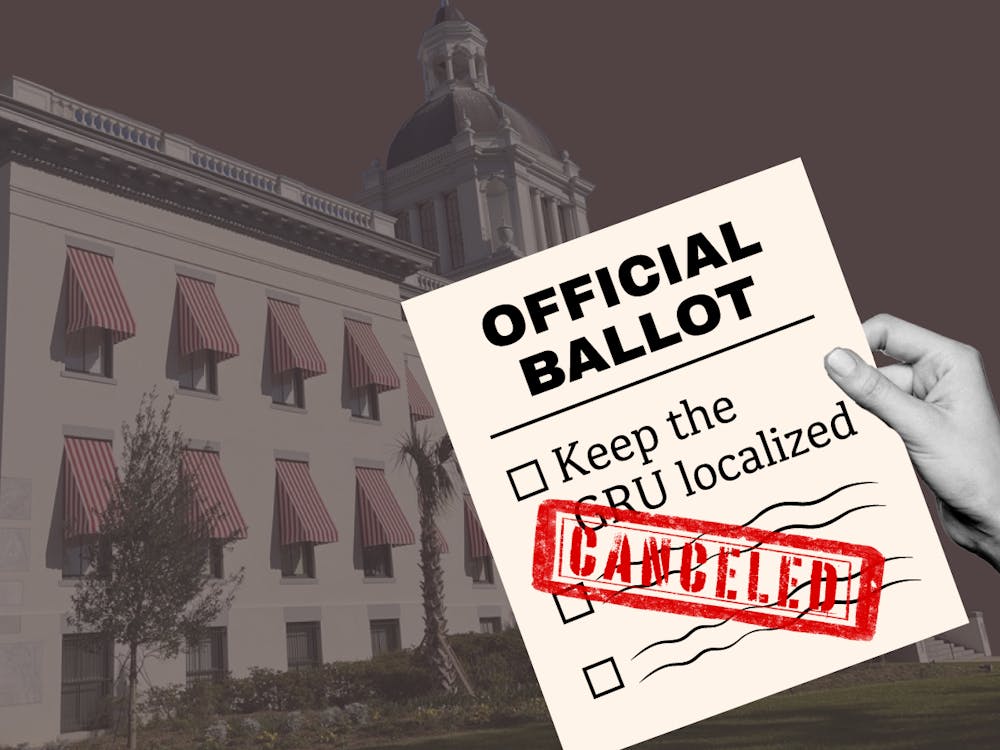
Residents have voted twice to return utility control to the city. However, results are still pending until an ongoing lawsuit between the authority and the city over the legality of the election ends.
But a recent bill passed by the state Legislature would nullify the election results — regardless of whether the city wins the lawsuit.
The bill, written by Rep. Demi Busatta Cabrera, a Republican from Coral Gables, aims to prevent the unfair taxing of people living outside a city’s municipal boundaries. A last-minute amendment to the bill proposes utility control of any regional authority created after Jan. 1, 2023, be handed to the state.
Among all the city utilities in Florida, GRU would be the only one impacted. It’s the only authority board created since Jan. 1, 2023, which is a requirement to fall under the bill’s impact.
Grassroots opinions
When the GRU Authority was created in June 2023, Garry served as president of the League of Women Voters of Alachua County. Across the following few years, she’s watched the fight for control shift from mere grievances to active litigation.
Though no longer president, Garry remains a strong opposing voice against the authority board.
The new bill adds an extra level of complexity. Garry said she does not oppose the main purpose of the bill — keeping rates fair for residents outside the city — but opposes the last-minute amendment because of its partisan nature. The amendment was added before bipartisan discussions could take place, she said, and it is targeted toward Gainesville.
Garry’s friend, retired UF Health Shands Hospital employee Beth Smith, said she wants to see utility control back in the city’s hands — even though she doesn’t live within city boundaries. Smith can’t participate in Gainesville city elections, so she said it’s even more important for control to be as local as possible.
“I am more confident in the decision-making [of the city] to a large degree, because it is under the purview of people that I know are elected by people I trust,” she said.
In reaction to the new bill, Smith said she felt frustrated at the possibility of the referendum results being nullified.
Smith’s primary concern since the board’s creation has been the scale-back on the search for environmentally friendly electricity sources, she said. Under state control, she’s afraid the reality may worsen.
At a 2024 meeting, the GRU Authority voted to adjust solar rates to avoid giving solar-owning customers a monetary advantage over non-solar-owning customers. The lower credit rate for solar electricity spurred concerns from GRU customers and solar company employees that the change would disincentivize people to install solar systems.
“I don’t know that this governor and legislature have been as forward-thinking in terms of environmental issues when it comes to utilities as they could or should be,” Smith said.
Political insights
Before the bill passed the Senate, City Commissioner Bryan Eastman told The Alligator it’s possible the city will take legal action if the governor signs it into law.
“We would fight for the 75% of the ratepayers of GRU who voted to make a change,” he said.
Under the bill’s specifications, Gainesville would be the only city in the country to have a major department controlled by its governor, Eastman said, arguing there’s no way the move can be “anything other than targeted toward Gainesville.”
A law only affecting one city invites constitutional concerns, he added, and there are protections against such a move.
The Florida Constitution states the Legislature can only pass a “special law” affecting only one city under specific circumstances. The Legislature must have first published a notice of intention, or the law must allow for a local referendum to ensue.
In a statement made after the Senate’s approval, Eastman said, the bill moves in the wrong direction if its priorities are to keep rates low and utilities accountable.
“I think our residents have stated very clearly why they think that the status quo is not good,” he said. “They’ve seen lots of spending within the GRU Authority, and they disagree with the direction that it’s going in.”
Rep. Yvonne Hayes Hinson, whose legislative district encompasses Gainesville, emphasized in a statement the increase of GRU rates the past year “is what happens when the voices of ratepayers are ignored and taken away.”
Hinson said utility prices have increased by between $10 and $25 the past year. Ratepayers are suffering the consequences of a lack of authority board expertise, she added.
“Now working families in Gainesville are paying the price,” she said.
The GRU communications director, David Warm, declined requests for comment, and the authority board members did not respond by the time of publication. DeSantis is expected to review the bill in the coming weeks.
Contact Maria Arruda at marruda@alligator.org. Follow her on X at @mariazalfarruda.

Maria Arruda is a second-year journalism and political science student, currently working as the City Commission reporter for The Alligator. Previously, she reported on Student Government under The Alligator's University desk. She enjoys running, reading and going to movie theaters!