

Read other stories from the "These stories were not AI-generated" special edition here.
Last year, Alachua County announced a new job position: artificial intelligence analyst.
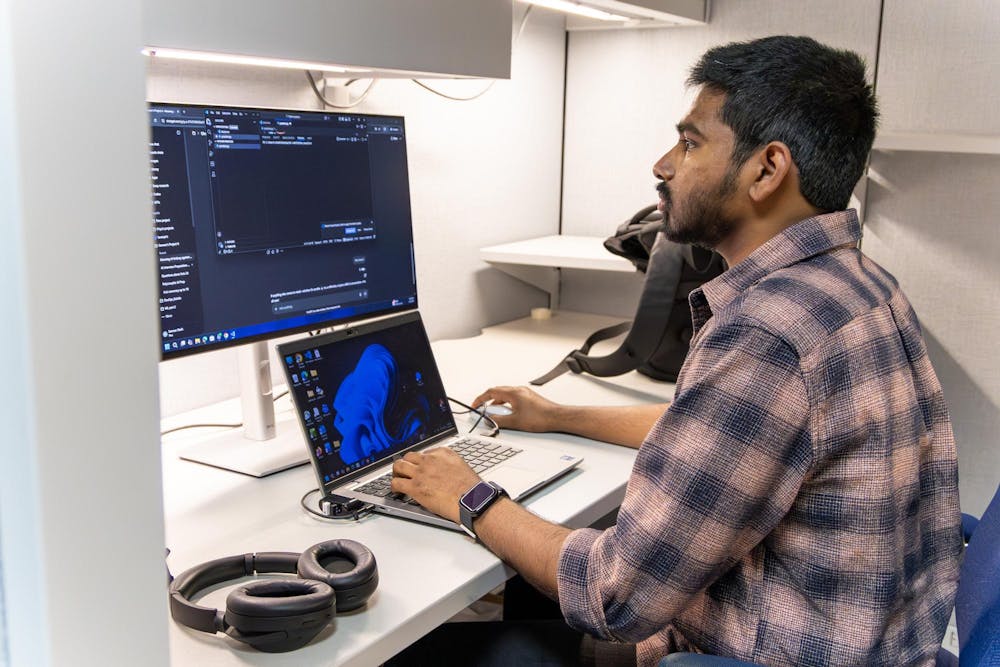
Sameer Shaik, an AI researcher and expert from Hyderabad, India, filled the role. As part of the job, Shaik advises county leadership on how to implement AI in everyday operations.
Shaik’s role fits into the county’s larger mission to use AI to increase productivity, streamline internal operations and create faster, more efficient responses to community inquiries. It’s a goal shared by local governments across the country, with experts describing the most common uses as marketing tactics and internal organization.
The county is working with different vendors to integrate AI systems for internal and external uses. Right now, it’s only in the beginning stages, finding systems that best fit the county’s needs. Still, Shaik doesn’t predict much delay.
“As long as our leadership works out the details with all these vendors, I think it's gonna move really, really fast,” he said.
The county’s first large AI venture so far: Copilot. Microsoft Copilot is an AI assistant integrated into all Microsoft 365 apps.
The county eventually wants to use Copilot to aid staff in their everyday work. Copilot will help staff save time navigating, summarizing and analyzing long, complex government documents and staff emails.
The county is working to obtain a Microsoft Copilot license, which costs about $30 per month and grants all county staff access to Copilot features. Right now, the program is in its pilot phase of testing.
“There are a lot of areas where we can integrate AI, but right now, it's mostly about researching our internal efficiency tools for that and also on the side of resident facing tools as well,” Shaik said.
His biggest concern with integrating AI systems for a government client like Alachua County, he said, is privacy. Privacy is a large factor because AI systems will often interact with sensitive information related to residents, like personal, financial or service related data, Shaik said.
“Any day, I would pick the privacy and the security over accuracy,” Shaik said. “We cannot afford to give out data or have any leakages in terms of data, so we have been very, very cautious.”
The county meets with AI vendors at least once a month, he said, and privacy and accuracy are the biggest things he looks for in any company.
“There will always be room for improvement, and we're always exploring products,” he said.
Shaik is now building security and privacy guardrails for the Copilot project. The pilot phase is setting a good precedent for work with future vendors, he said, which makes him optimistic.
“We're in a very strong position in terms of data governance and security,” Shaik said. “So that will enable us, going forward, to have more smooth adaptations with the rest of the AI.”
AI introduction in Alachua County
Gee Chow, Alachua County’s information technology specialist director, said the county is making strides toward artificial intelligence integration.
“If we become more efficient, we can serve our customers better,” Chow said.
Last month, more than 100 county staff members participated in a four-week AI introduction course provided by Miami Dade College, Chow said. The course taught the basic concepts and uses of AI.
Chow said he thinks the training was well-received by staff.
“People appreciate the fact that the county has some kind of training offer[ed] in this topic, which is very relevant for us right now,” he said.
Chow noted the county is also considering internal AI systems like ChatGPT and Google’s Gemini. However, developing external, customer-facing AI systems is also a county priority down the road.
In the future, Chow hopes to integrate a CRM, or customer relations manager, into the county’s website. CRMs have many functions, he said, including creating a centralized database for county information to help streamline and track progress of specific projects.
A chatbot would be an important aspect of the county’s CRM, Chow said. The tool could give community members immediate answers.
Because the county’s only in the beginning stages of AI implementation, Chow said they’ve run into hurdles and anticipate more.
“Challenges will be … understanding what the business needs are and making sure we interpret that correctly and provide the proper technology solution,” he said.
Funds aren’t yet allocated to AI operations in the county’s budget, Chow said — but this might change as operations grow.
“We will have to ask for proper allocations, but we're not at that stage yet,” he said.
Expert opinion
Anthony Coman, a UF instructional associate professor, teaches professional writing in the Management Communication Center. Coman researches the impressions people have of AI communication.
He said using AI for external communication has pros and cons.
“If you've ever tried using the county website or looking up information, it can often be either intimidating or hard to navigate the system and hard to find a clear answer,” Coman said.
He said an advantage of using AI chatbots on government websites is that they can sift through information quickly and deliver unique answers to narrow questions.
However, Coman said issues can arise when businesses rely on AI systems to communicate with constituents.
"It's important to remember that communication is a fundamentally human process, and people prefer to be communicated with by other humans,” Coman said.
Especially when communicating with concerned or upset constituents, Coman said businesses and governments should remember human responses go a long way.
“My research suggests that AI-powered chatbots will not be good at responding to complaints, and the impact may in fact be negative,” Coman said. “The county would be wise to have a strategy for pivoting to human responses when the chatbot receives complaints or angry messages.”
Coman also said governments using AI systems should be particularly careful due to the potential sensitivity of information shared.
“I think that the most important things to remember are that AI is not infallible,” Coman said. “Accidentally having wrong information get out there or misinforming a constituent would be problematic.”
Integration around north central Florida
AI integration isn’t unique to the county. Ryan Morales, owner of the Delpuma AI consulting firm, has worked with 150 clients in north central Florida to integrate AI into their business models over the past two years.
Morales advises companies on how AI can fill potential gaps in their workflows. He holds seminars to teach businesses how to use AI productively without feeling overwhelmed.
Marketing tactics and internal organization systems, such as CRMs, are the most common uses implemented, he said. Leaders in AI integration are often law and medical offices, Morales said, because they have the money to stay at the forefront of the development.
However, he said he’s seen a sharp increase in small businesses and solo entrepreneurs seeking AI consulting and services in the past couple of years — primarily for making advertisements and promotional content with generative photo and video technology.
“Now it's basically everybody and anybody, because the cost has come down so much,” he said. “What used to cost thousands of dollars just for five seconds of video is now being done for maybe $20 to $40 on a tool online.”
Seven out of 10 of Morales’ clients are small businesses looking to elevate their practices, he said. He expects AI to be an integral part of many companies in the near future, helping them deliver better products and services.
“I always tell business owners, ‘It's best you embrace it now, learn about it now, because if you don't, your competitors are the ones that are going to outpace you,’” he said.
Contact Kaitlyn McCormack at kmccormack@alligator.org. Follow her on X @kaitmccormack20.
Kaitlyn McCormack is a senior journalism student serving as the County Commission Reporter for The Alligator's Spring 2026 metro desk. In her free time she enjoys journaling and drinking too much coffee


