

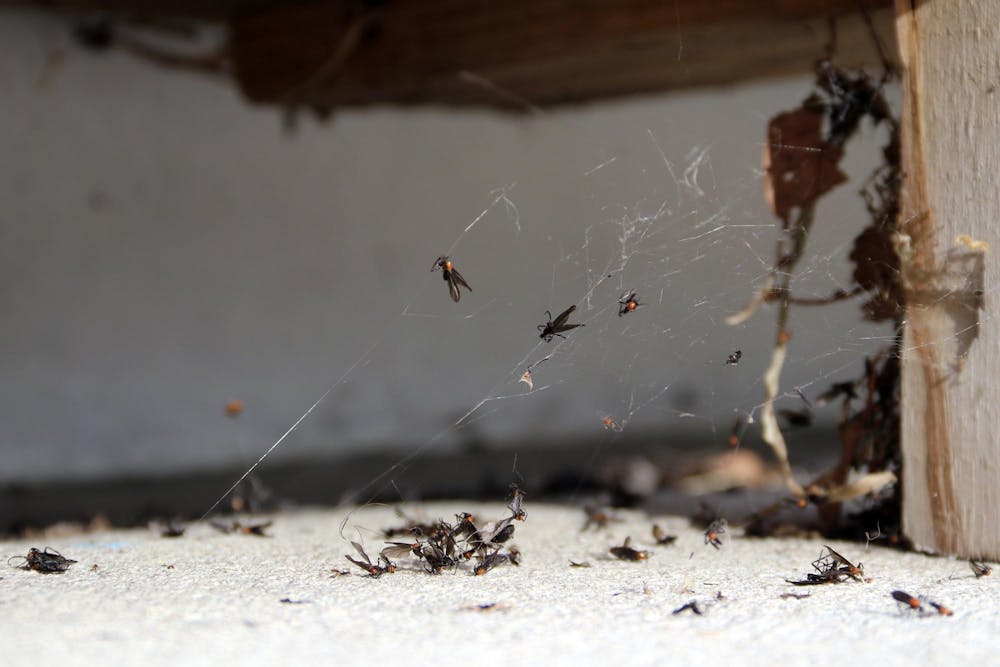
Every year, Gainesville residents are welcomed into summer by bug-splattered windshields and black-speckled walls — a sign of one of Florida’s most notorious seasonal occurrences: lovebugs.
This year, the insects seem a little more prevalent, with clusters concentrated from Celebration Pointe to the windows of businesses across University Avenue.
For experts like Norman Leppla, a professor who studies pest management in the UF’s entomology and nematology department, their return is puzzling.
“In the recent past, they’ve been declining, so this current outbreak is unexpected,” Leppla said. “It’s a result of larvae surviving over the winter, but why they were able to survive this year and not in recent previous years is anyone’s guess.”
Despite their quick, unexpected spike, the swarm will be short-lived, Leppla said.
Lovebugs live just three to five days, and swarms typically last around four weeks. The bugs commonly appear in North Florida twice a year, at the end of the spring and summer seasons.
Though they’re often considered a nuisance to Gainesville residents, Leppla said they aren’t dangerous.
Lovebugs don’t bite, sting or spread disease — they actually provide ecological benefits. As critical decomposers, lovebugs consume decaying plant matter, which helps new plants grow by adding nutrients back into the soil.
Those looking to spray the insects away won’t be in luck, either, Leppla said. While they may die from the products, new lovebugs will replace them almost immediately due to their rapid mating and short lifespans, providing little value in the usage of the products.
However, residents can find relief at night because the bugs are only active in the daytime. During the day, residents can monitor doors and windows, keep their air conditioning on and use fans as repellents.
Despite folklore insisting lovebugs are the result of a UF lab experiment gone wrong, the flies actually buzzed their way to Florida the old-fashioned way.
They found their place in the Sunshine State when they migrated from Central America to Texas. From there, the bugs moved to Florida, where they thrived in the state’s warm climate.
Their population peaked in Florida in the 1970s, Leppla said, and it’s steadily declined ever since — especially in the past four years.
For residents, this year's uptick has been noticeable.
Anecio Torres, a 24-year-old who has lived in Gainesville since 2018, has seen lovebugs annually — but this year’s swarm feels different, he said.
“It’s crazy,” Torres said. “Your whole door is covered. I wasn't able to sit outside to smoke a cigarette because there was so many.”
Torres said he hasn’t been able to cook outside, either — a struggle that was especially noticeable on Memorial Day. When his family attempted to grill, they were forced to place multiple fans around the grill to turn away the pests.
Klarel Lamothe, a 31-year-old Ocala resident, commutes to Gainesville for work. The lovebugs have created issues during his drive, he said.
“From just Archer Road to Newberry, the front of my car is covered,” Lamothe said. “The thing about it, it doesn’t last; it varies. One week you’ll have thousands of them.”
The insects are commonly found around interstates and parking lots because the bugs are attracted to exhaust fumes and light colors.
Lovebugs often mistake vehicle fumes for decaying plant matter because they contain the same chemicals. At the same time, light colors resemble the colors of flowers they feed on.
Lamothe only recently moved to Ocala after living in Gainesville from 2012 to 2024. He said the prevalence of lovebugs had never been as bad as this year. At times, he feels like he can’t sit outside to eat, he added.
Earlier that day, lovebugs circled his drink while he ate lunch, he said. Later, some fell into it, forcing him to buy a new one.
Until the end of the swarm, Gainesville residents should keep their fans running, roll up their windows and consider a trip to the car wash.
Contact Logan McBride at lmcbride@alligator.org. Follow him on X @logandmcbride.

Logan is a senior journalism student and the Alligator's Fall 2026 Enterprise Politics reporter. He previously served as a reporter on the Alligator's Metro Desk, covering K-12 Education and the City/County Commissions. In his free time, he enjoys watching sports, movies, or spending time with his cat and girlfriend.