

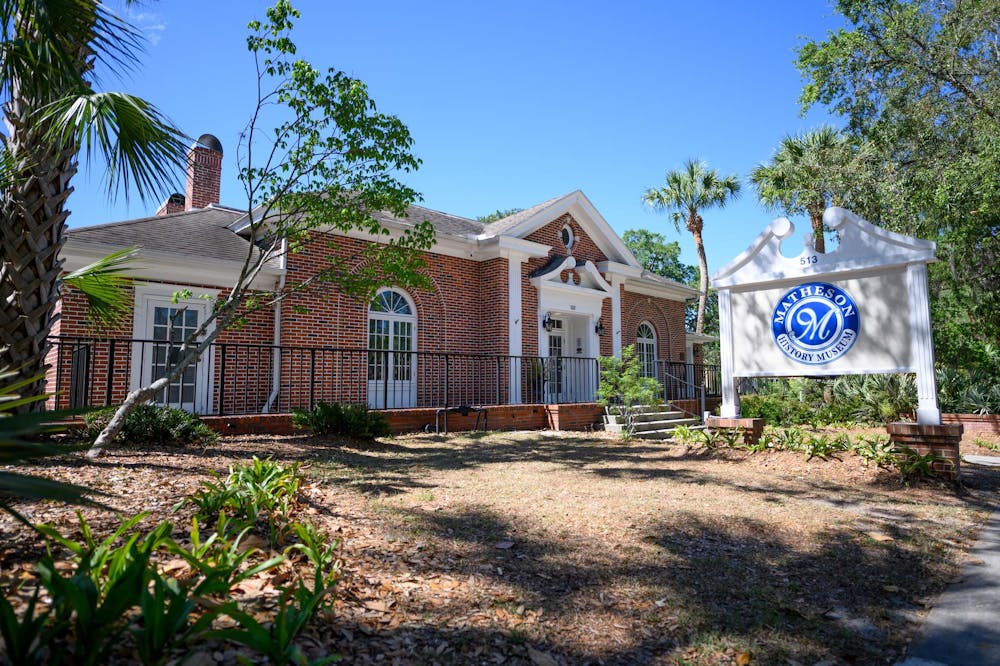
From the books to the podium, Rik Stevenson, a UF assistant instructional professor in African American studies, brought the history of Black faith communities and resistance to life in the final “The Other Book Part 2” lecture.
About 70 attendees gathered at the Matheson History Museum on Saturday to hear Stevenson speak about the use of faith and community as sustaining forces of African American life. The event marked the end of a four-part series on Black history this spring, a continuation of the program that first launched in 2025.
Stevenson discussed how Black faith communities created spaces of resistance and autonomy, using the example of “hush harbors” — secret gatherings where enslaved people worshipped beyond the surveillance of slaveholders.
“In these hidden spaces,” he explained, “enslaved Africans were able to worship on their own terms.”
The lectures aimed to address gaps in understanding of Black history and connect those histories to the present.
“History is not simply data collected,” Stevenson said. “The role of history is to assist in remembering the past, so we can make good decisions about the future, and to prevent the atrocities and mistakes of the past.”
He connected the idea to the role of faith, saying it “opens doors for collaboration and new experiences” and that it can “help communities engage with difficult histories.”
The idea for “The Other Book” lecture series grew out of a conversation Stevenson, a pastor of 40 years, had while preaching at the United Church of Gainesville.
During one session, he shared a piece of unspoken Black history: In the 1800s, teachers in the South used two sets of books — the office materials provided by school districts and another used to teach students Black history and culture. He called the seemingly hidden curriculum “The Other Book.”
The response was immediate. Stevenson said audience members wanted to know more, and colleagues later contacted him about expanding the idea into a larger public program. He launched “The Other Book Part 1” at the Harn Museum of Art last year, with the help of Ron Nutter and Jackie Davis, members of the United Church of Gainesville’s Racial Justice Committee.
For Stevenson, the series is about more than history lessons. He said it is designed to create a space where people of different backgrounds can gather, ask questions and think critically about the past and present.
“Community does not have to be of the same type of people,” he said. “There is community in shared humanity.”
For him, societal change is rooted in building bridges between communities that are often separated by history, education and lived experience. Stevenson hopes “The Other Book” can be “an instrument to societal change overall.”
Jacqueline Collins, a Gainesville native, attended the event with her husband Clarence Collins, a New Orleans native who moved to Gainesville in 1971. She said events like these are “great, but it’s underserved.” She suggested bringing discussions into more public spaces like Depot Park could help “reach the masses.”
Clarence Collins said the issue runs deeper than access. Even growing up in a city as culturally rich as New Orleans, he said he learned little about Black history beyond surface-level lessons.
“History, or the lack of it, has taught me a lot,” he said.
That disconnect, he said, is why conversations like “The Other Book” series matter.
Ron Hicks, a special event organizer at the United Church of Gainesville, said one of the ongoing goals of the series is to bring more people into these conversations. He noted the level of expertise represented by speakers from the community.
“Each one was just amazing because there’s so much talent in us, but we’re trying to figure out a way to get some more students involved with this stuff,” Hicks said.
Organizers hope to continue the series with a “Part 3” and are exploring ways to bring this project to other communities as well.
Haylie Sangiovanni and Lawrence Jackson are contributing writers for The Alligator.


