

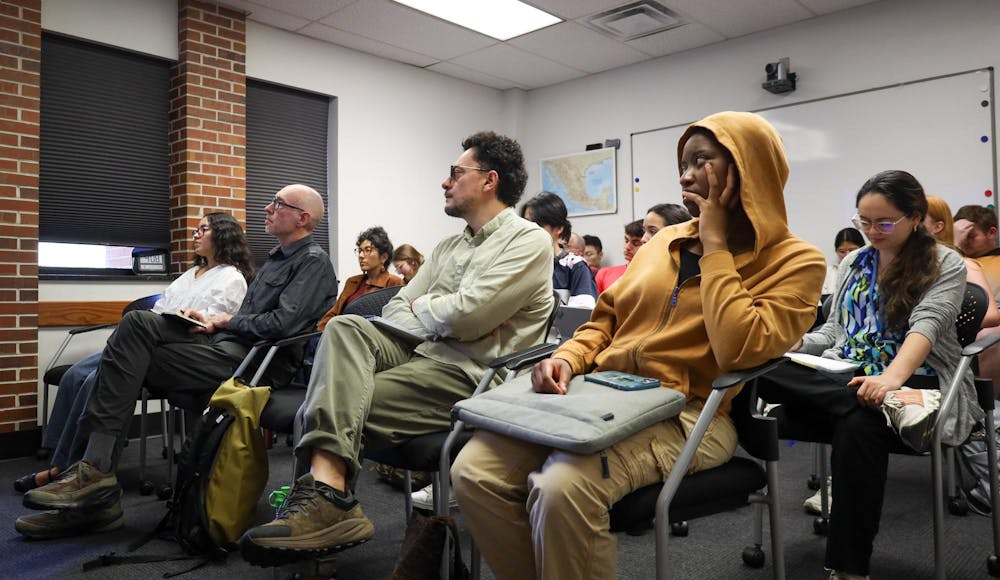
College students spend anywhere from 12 to 18 hours per week in a lecture hall.
Their eyes wander across their computer. They sort their to-do list, complete the Wordle and text their friends. In the next period, they re-sort their to-do list, complete the Connections and reply to their friends again. And so begins the cycle.
The only time they pay attention is when the professor switches the slide; now they must take down the notes in hopes they will be of use in the next exam.
The professor reads, often verbatim, from the slideshow they likely haven’t looked at since creating it when first teaching the course a few semesters ago. It’s riddled with elementary mistakes: capitalized words that ought not to be capitalized, random commas, sentences that really don’t make any sense.
Is it the students’ fault they don’t pay attention in class? In some cases, maybe. But more often, something is missing.
The art of teaching, once central to the university experience, has disappeared.
College lectures were not always like this. At their best, they were performances demanding both energy and craft. A good lecturer can turn even the most boring of topics into a blockbuster performance. Attending class was not merely for an attendance grade; it actually gave you crucial information the textbook could not provide. Teaching was in supplement to, not in replacement of, the readings.
I’ve experienced these lectures a few times — everyone has. These are the professors you consistently return to, the ones you take semester after semester.
But today, most lectures feel like obligations. For professors, they are a box to check between research deadlines and publication quotas. For students, they are something to loathe, groan through and — on those days you just can’t bear the bore — skip.
For some reason, we’ve accepted this.
In trying to mass-produce education, universities have stripped away what made it meaningful. To teach dozens of students at once requires abandoning those connections professors once made. The modern lecture has been optimized for convenience, not impact. It is easier to upload slides than to craft an argument, easier to read than to teach.
I’m not claiming all professors do not care. Some do. Those are the professors who put extra time into preparing for their lectures, like an actor who practices his lines in the dressing room.
The problem is the structure which enables lecturers who do not value the art of teaching to continue practicing their tried and untrue ways. In the world of academia, benefits such as hiring, tenure and prestige are overwhelmingly tied to research output. While research is an important duty of both a professor and the university, it has left teaching as an afterthought.
When teaching is treated as routine, students begin to treat learning the same way.
Students disengage, not because they are incapable of curiosity, but because the environment does not demand it. A monotonous, unenthused lecture invites distraction.
Everyone involved seems to recognize the issue.
Students complain about boring lectures. Professors lament low attendance. Universities invest in new technologies and new platforms. But the solutions miss the point. The problem is not a lack of tools; it is a lack of emphasis on teaching itself.
Good teaching is difficult. It requires preparation, energy and a willingness to adapt. It asks professors to think not just about what they know, but how they communicate it.
Teaching is an art.
And like any art, it deteriorates when it is not appreciated.
For some students, the decline is merely inconvenient. We teach ourselves the material anyway, through textbooks or YouTube videos. Yet for others, it is a lost opportunity. A great lecture can change how a student sees a subject.
Those moments are becoming rarer.
Universities often speak of fostering innovation, critical thinking and intellectual curiosity. But these ideals are not cultivated through passive exposure to information. They are sparked through engagement, through moments when a professor makes something click.
That cannot be uploaded as a PDF.
If colleges want to preserve the value of in-person education, they must reconsider what happens in the classroom. Not every lecture needs to be a performance, but it should be intentional. It should be something that cannot be replicated by simply reading slides alone.
Otherwise, the lecture hall risks becoming what many students already believe it is: optional.
When teaching becomes optional in spirit, even if not in policy, the university loses something far more important than attendance.
It loses the art that once defined it.
Contact Timothy Dillehay at tdillehay@alligator.org. Follow him on X @timothydilleh.
Timothy Dillehay is a political science and history sophomore and a Spring 2026 Opinions Columnist for The Alligator. He writes on issues related to university administration and student government. In his free time, Timothy enjoys journaling, reading comics and classics, and reviewing films on his Letterboxd.


