
Read other stories from the "These stories were not AI-generated" special edition here.
No disputes with umpires over bad line calls. No resounding boos reverberating across a packed stadium after a controversial call. No one standing up to shout, “Hey Ref, you forgot your glasses!” (Because we’ve all done that, right?) No iconic eruptions of emotion from players that glue you to your seat like you’re watching a James Bond action scene.
It sounds clean. It sounds responsible. It sounds … boring.
Electronic line-calling and automated umpire systems are quietly stripping away a part of sports we love: the messy stuff. Who’s the overzealous fan supposed to yell at now?
Recently, Major League Baseball introduced its Automated Ball-Strike Challenge System for the 2026 season, allowing players to appeal the home plate umpire’s ball and strike calls.
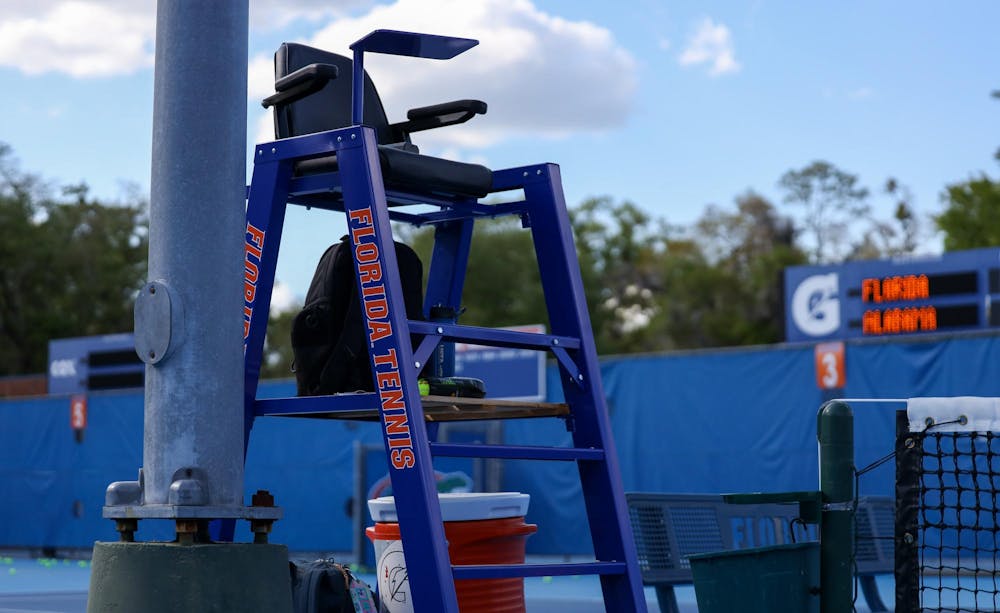
Tennis already took a headfirst plunge into automated line-calling when the U.S. Open removed line judges entirely in 2022. Today, nearly all top-level matches are played without human line judges.
The technology doesn’t argue back. It doesn’t have a bias you can blame or eyesight you can poke fun at. It’s unquestionable.
But it isn’t perfect, even though it’s supposed to be.
Last year at Wimbledon, the automated system glitched and stopped working mid-match. When it’s wrong, it's a quieter, less debatable version of error — one you can’t argue with, one you just have to accept.
And where’s the fun in that?
Watching a tennis match without line judges feels like something is missing. It’s like an ice cream cone without sprinkles or Rafa Nadal without his headband.
Everything is technically still there. But it doesn’t feel complete.
“There’s a little bit of life missing from the court,” said Scarlett Nicholson, junior Gators women’s tennis player. “If you just make it [the game] too perfect, it’s not as enjoyable anymore.”
One of tennis’s greatest legends, John McEnroe, built part of his identity on his fiery reactions to line calls. People didn’t just come to watch great tennis; they came to hear him shout, “You cannot be serious!” whenever a line call inevitably upset him.
People come for the drama. The characters.
In college tennis, electronic line-calling systems are slowly being phased in. I’ve played a few matches with it, which have generally consisted of fewer disputes and less unpredictability. But also, fewer moments you remember.
As a player, I’m all for reducing errors. You never want to have to worry about being cheated out of a match because of a bad call. Nobody wants a championship decided by something obviously wrong.
But there’s a difference between correcting the worst mistakes and eliminating imperfection entirely. Imperfection is where emotion lives. A nebulous call can flip momentum, wake up a crowd and turn a forgettable match into something people talk about for days.
Stripping sports of human umpires in the name of optimization is a fragile decision. It might be “better,” but it also might be flatter. Linespeople are a historic part of the fabric of the game.
Maybe that’s the trade-off we’re making: fewer errors, fewer arguments, fewer spikes in blood pressure.
But also, fewer reasons to care just a little bit more.
Sports don’t need to be perfectly efficient. They’re not airport security lines. They need friction. They need unpredictability. They need, occasionally, something to go a little wrong.
Because once the arguments disappear, once the tension fades, once there’s no one left to question or blame or challenge, you don’t just lose the bad calls. You lose a piece of the game.
Contact India Houghton at ihoughton@alligator.org. Follow her on X @indiahoughton16.
India Houghton is a graduate student studying Business Management and a member of the UF women’s tennis team. She is the sports opinion columnist for The Alligator. A Northern California native, India completed her undergraduate studies at Stanford University in Science, Technology and Society, competing for the Cardinal women’s tennis team. She enjoys playing the piano, taking ice baths, and rooting for her hometown 49ers.