
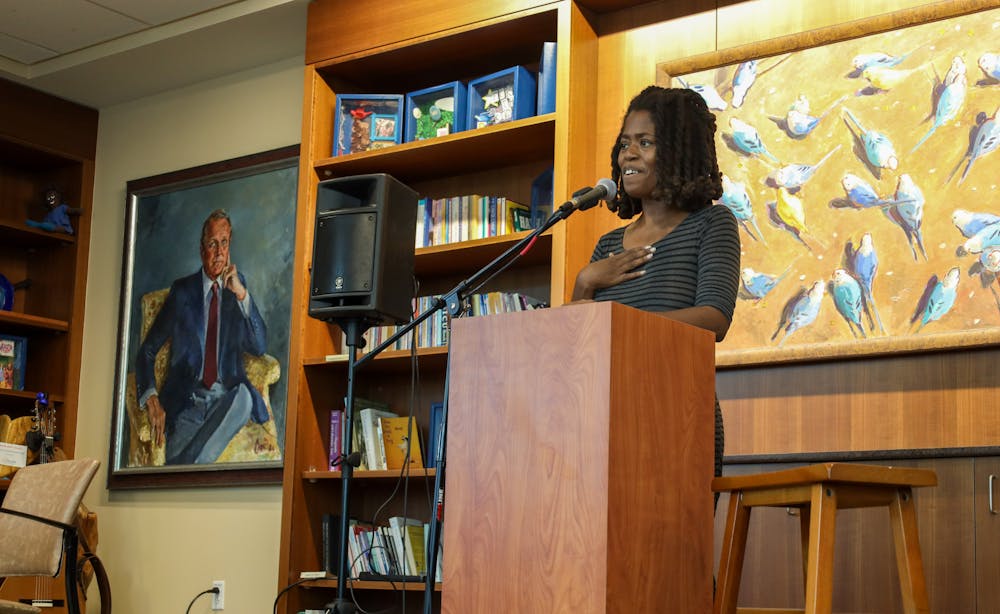
One by one, they took the mic — not as hospital patients, but as poets. Their words carried stories of pain, strength and identity, transforming a hospital space into a stage.
More than 50 people gathered Thursday afternoon in the UF Health Criser Cancer Resource Center for a slam poetry event, “I Am Warrior,” centered on sickle cell disease. Patients from across north central Florida wrote and performed poems, compiled into a book available at the event and online.
Hosted by UF Health Shands Arts in Medicine, the event brought together patients, families, volunteers and students in a space typically associated with treatment rather than expression. For many in attendance, it was an opportunity to hear directly from patients about their experiences with a disease that is often misunderstood.
Sickle cell disease is a genetic blood disorder that causes red blood cells to become rigid and crescent-shaped, blocking blood flow and leading to severe pain and other complications. It affects about 100,000 people in the United States and about 8 million worldwide. Because the condition is not always visible, patients often face misunderstanding and a lack of awareness.
Each year, AIM partners with Streetlight, a UF organization connecting volunteers to patients ages 13 to 30 living with chronic conditions. Volunteers regularly visit patients in the hospital, offering companionship, conversation and creative outlets during long-term stays.
Emily Marchi, a former Streetlight volunteer who now directs the program, said the project has evolved over the years to better center patient voices. After past collaborations produced a quilt and a music album, this year’s focus on poetry allows patients to share their experiences in their own words.
“They have really meaningful things to say,” she said.
Marchi said the goal is not only to showcase patient creativity, but also to validate their experiences and create a sense of community. She credited the collaboration between Streetlight and AIM for making the event possible.
“You find other teams that are passionate about doing good, and you can maximize your impact when you find those people,” she said.
Sarah Hinds, an arts and health practitioner, said the mission of AIM is to “humanize the health care experience” by giving patients access to creative expression. Many participants already use poetry and journaling to process their experiences, making spoken word a natural extension of their coping mechanisms, she said.
What the patients didn’t know was that they would be performing in front of artwork inspired by their poems. The pieces were created by student volunteers from pre-health organizations, including Alpha Epsilon Delta, Hearts for the Homeless and Phi Delta Epsilon. More than 20 students contributed paintings, drawings and other visual pieces, interpreting the themes and emotions expressed in the poems.
The artwork was revealed as a surprise during the event, reinforcing the connection between the patients’ words and the broader community.
The first patient to take the stage was 19-year-old Ja’Mya Woodard, who described the writing process as emotional and deeply personal. She said it took about a month to complete her poem.
“I wanted to not just make it about myself,” she said. “I wanted to think about other people so that everybody in the sickle cell community can feel where I'm coming from.”
Woodard said managing the disease can feel isolating, especially when it pulls her away from family during treatments, but she hopes her words help others feel less alone.
“I try my best to keep going, because that's the only option I have,” she said. “I have to keep my family happy.”
Despite the challenges, she said the event was a positive experience, especially when she received artwork inspired by her poem.
“I felt so loved,” Woodard said. “It makes me know that people are actually listening, that there are people out here who actually care.”
For 37-year-old LaQuinda Parson, a mother of three, the event helped her reflect on her journey and hear from others living with the same condition. She began writing poetry as a teenager and said her work now reflects a shift in perspective shaped by her experiences with the disease.
“I feel like I'm in a different headspace now,” she said. “There’s always some good in everything.”
Parson said managing sickle cell while raising children can be difficult, but support systems make a difference in navigating both responsibilities.
“You got to have a good, strong support system,” she said.
Volunteers and student leaders said the event also highlighted the sense of community built through the program and the relationships formed long before the performances.
Nishant Mehta, a 21-year-old UF biology senior and Streetlight captain, said volunteers work with patients throughout the year, often visiting them weekly and helping them develop their poems over time.
“As a community, it's kind of rare to see them all in one space,” he said. “I think just having them here together is super nice to see.”
Reagan Bresnahan is a contributing writer for The Alligator.
Reagan is a videographer for the Alligator. She is a freshman majoring in journalism and this is her first year with the paper. In her spare time she loves music, reading, and spending time with friends.