

Read other stories from the "These stories were not AI-generated" special edition here.
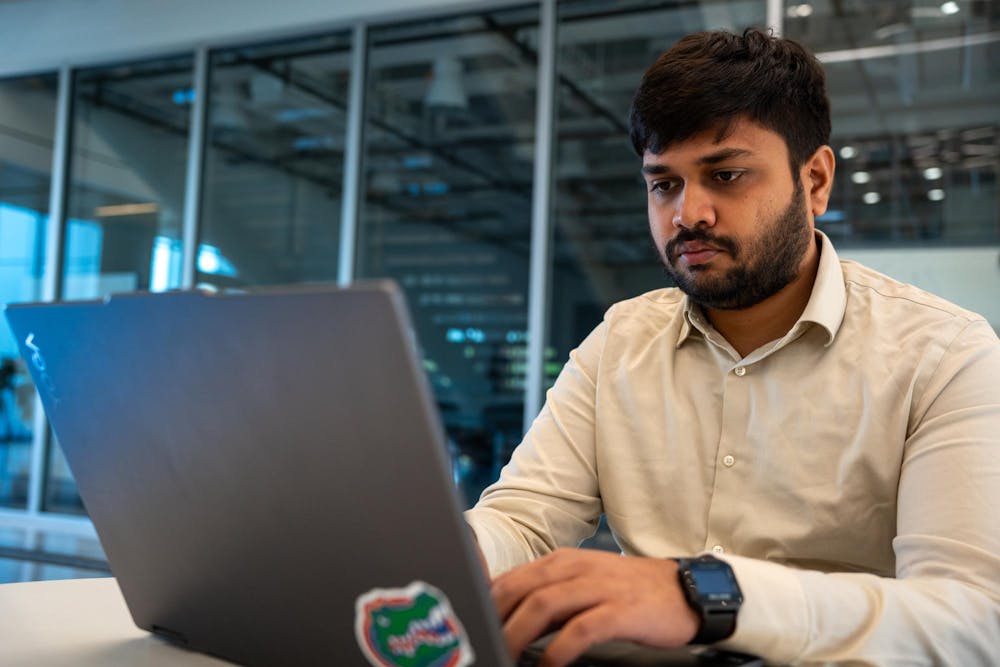
Nikhil Reddy Sareddy will soon become the first-ever UF College of Engineering student to get a Master of Science degree in artificial intelligence systems. Going into the program, though, he had his reservations.
“To be honest, I was a bit worried, because we are the first batch in the entire University of Florida to get admitted into artificial intelligence systems,” said Sareddy, who’s now in his final semester of the program.
The 24-year-old UF student said worries subsided after an opening meeting with the students, administration staff and professors, where all of his questions were answered.
Within the program, which launched in Fall 2024, each student must take 18 credits of core courses in 6 subjects: machine learning, AI systems, sensing and analysis, security, ethics and deep learning. During the program’s two years, students are also required to take nine elective credits and complete a capstone project.
Sareddy said he studied computer and data science for his undergraduate degree, and combining those studies with his AI master’s will help his career path. The program’s electives are hands-on rather than theoretical, he added.
“It’s a completely hands-on experience, even from the first semester,” Sareddy said.
In launching the program, UF joined a growing tide in higher education toward AI-forward degrees. In addition to the AI systems program, UF’s engineering college also offers a master’s degree in applied data science. According to UF’s catalog, the university teaches more than 200 AI courses, and there are multiple AI certificates for undergraduate students to earn.
According to Stanford University’s 2025 Artificial Intelligence Index Report, there were 45 institutions offering AI master’s degrees in the U.S. as of 2023, and 935 students graduated from these programs the same year — a figure that’s grown steadily over the past decade.
UF’s program has hosted two cohorts of students. According to the program coordinator, Catia Silva, each cohort has around 30 students.
Silva said the curriculum development was guided by a committee composed of faculty across the engineering college’s departments. The committee members gave their different perspectives on AI systems in their fields, so students can be trained on AI systems no matter their engineering interest, she said.
“We're hoping to grow more as the program grows and we start advertising it more and more across conferences and other places,” Silva said.
Ivan Ruchkin, an assistant professor in the Department of Electrical & Computer Engineering, is on the curriculum committee and teaches the Safe Autonomous Systems course, which studies how to make autonomy more reliable, safe and trustworthy.
Ruchkin said the world needs experts on AI, and this program is useful because it is creating interdisciplinary AI experts.
“There's a lot of emphasis on interdisciplinary — kind of crossing backgrounds and different expertise,” Ruchkin said. “It's not just computing; it's not just statistics. There is room for humanities, for AI ethics. There is room for project-based work, a variety of other disciplines.”
Students can take courses on AI in medicine, aerospace, material science and more, according to Ruchkin.
“It's not just the kind of a stand-alone thing, but it's also a glue between many engineering departments and between the College of Engineering and the variety of other units and opportunities on campus,” he said.
Students of the AI master’s program will have an edge in the job market, wrote Ryan Morales of Delpuma Consulting Group, an AI integration and consulting service, in an email to The Alligator.
Employers, he wrote, are seeking people who know how to “apply AI effectively in real-world scenarios.” They will especially be advantaged when applying for jobs in high-level engineering or research, he said.
Morales believes AI jobs will not become obsolete but will evolve over time.
“In my own work, I encourage professionals and business owners to embrace AI as a way to multiply their capabilities,” Morales said.
Contact Cameron Countryman at ccountryman@alligator.org. Follow her on X @cpcountryman.
Cameron Countryman is a second-year journalism major and The Alligator's Spring 2026 Graduate School reporter. In her free time, she enjoys reading, paddle boarding and researching her next travel destination.


