

Read other stories from the "These stories were not AI-generated" special edition here.
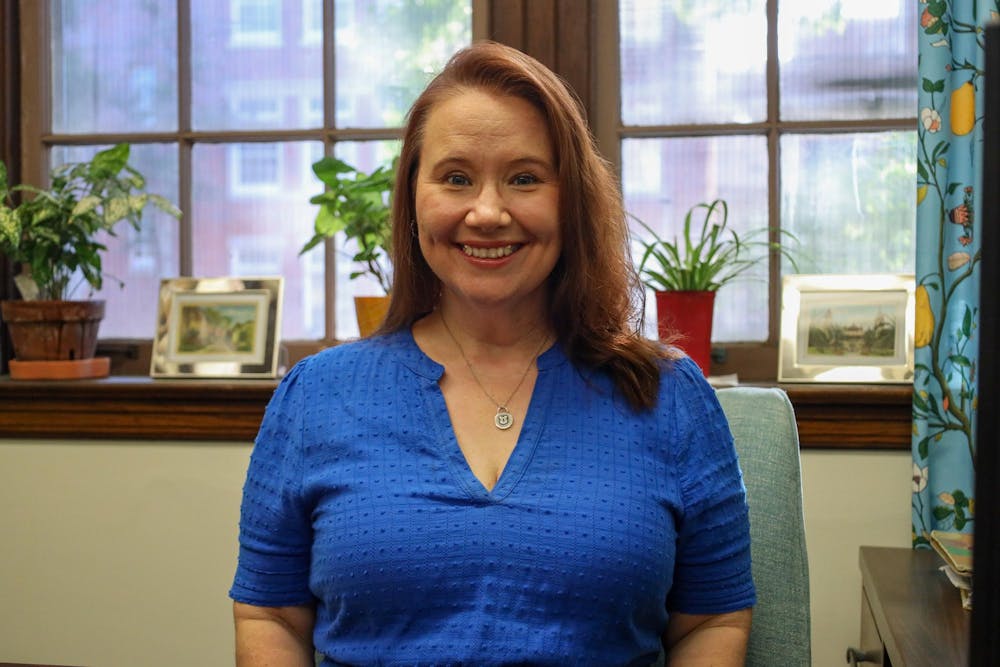
Laura Jervis knows speaking in a new language can be “really scary.” That’s why the UF instructional designer was eager to help add artificial intelligence to a new curriculum for UF Spanish students.
“AI is not going to judge you,” Jervis said.
Alongside UF Spanish professor Jennifer Wooten, Jervis developed assignments allowing students to build their conversation skills and develop familiarity with AI for two beginning Spanish classes.
The two faculty members won an AI Teaching Integration Award for their work in February.
AI assignments didn’t replace existing course elements, Jervis said. Instead, it filled a gap where online learners struggled to produce enough language and receive interaction through conversations. Technology, she said, should always serve pedagogy, not the other way around.
The idea
Wooten said she has always been interested in how to integrate technology into her Spanish classes. When ChatGPT came around, she started playing with it, she said.
In Spring 2024, she decided to start integrating AI informally in the conversational Spanish class, SPN 2240. She encouraged students to use AI for an assignment in which they had to create a podcast episode, and the “experiment” went well. At that point, Wooten thought AI could be supplemental to her original class material.
“It kind of helps decorate what we're already doing,” Wooten said.
When the department decided Wooten would be teaching Beginning Spanish I and Beginning Spanish II asynchronously online, she started working with Jervis to fill a gap they saw in the curriculum.
In an asynchronous setting, students miss the guided practice and back-and-forth communication that typically helps build confidence before speaking. That’s where AI came in.
For each unit, students completed an AI-based activity, sometimes involving speaking, guided writing or vocabulary practice, with a strong focus on interaction.
At times, the tools did not perform as expected, raising concerns about whether the approach was ready and whether students might feel stressed or anxious about learning Spanish and using AI.
They wanted the language to feel authentic, focusing on real speaking and writing tasks, but they got inconsistent results. For instance, they would ask AI to hold a conversation, and it would work as intended. But after trying again the next day, the program generated both sides of the dialogue in Spanish.
To address this, Wooten and Jervis redesigned activities to focus on the learning process rather than a final product. In the current version of the class, students complete an activity and then reflect on the process, prompts and what they learned.
Grading is based on these reflections rather than the outcome of the AI activity, reducing pressure if the technology does not work perfectly.
Grace McOrmond, an 18-year-old UF music business and entrepreneurship freshman, took SPN 2240 for her soon-to-be-declared Spanish minor. McOrmond found the class helpful, describing it as “a nice way” to become comfortable communicating in Spanish. She thought using AI was a nice addition, she said.
AI should enhance learning but not do the work for the user, she said, a belief that the course emulated. She found AI helpful in giving grammar and vocabulary tips and also enjoyed an assignment involving recording pronunciation of texts.
“It’s really important that it is involved in classes that aren't necessarily tech classes,” McOrmond said of AI. “To teach us how to manage it, handle it and use it to enhance ourselves and further our knowledge and further our education rather than letting it take over.”
Luis Alvarez-Castro, director of the Department of Spanish and Portuguese, described the arrival of AI as rapid and transformative, especially in language education.
“AI is only going to improve; it’s here to stay,” Alvarez-Castro said.
Faculty are now focusing on teaching students how to use AI ethically and effectively as a support tool, he said. Students are allowed to use AI for certain assignments, but exams and graded assessments must reflect their own independent work.
The syllabus for Summer 2026 SPN 1130 classes states 12.5% of assessments are AI activities. All graded work in SPN 1130 must be the student’s. They cannot use internet tools or apps like Google Translate, browser extensions or AI such as ChatGPT on any graded assignments unless permitted. In the classroom, Alvarez-Castro found creative uses of AI, particularly through image generation, explaining how students learn by refining their instructions in Spanish, because “the first time you give a prompt, you never get exactly what you want,” he said.
“We want our students to use AI not to cheat, but to learn how to use it properly,” Alvarez-Castro said.
Contact Ornella Moreno at omoreno@alligator.org. Follow her on X @ornellamorenom.

Ornella Moreno is a senior journalism student with a concentration in psychology in her second semester at The Alligator. She covers El Caiman. Previously, she worked as a radio anchor for WUFT Noticias. In her free time, Ornella enjoys doing yoga, reading and going to the movies.

