

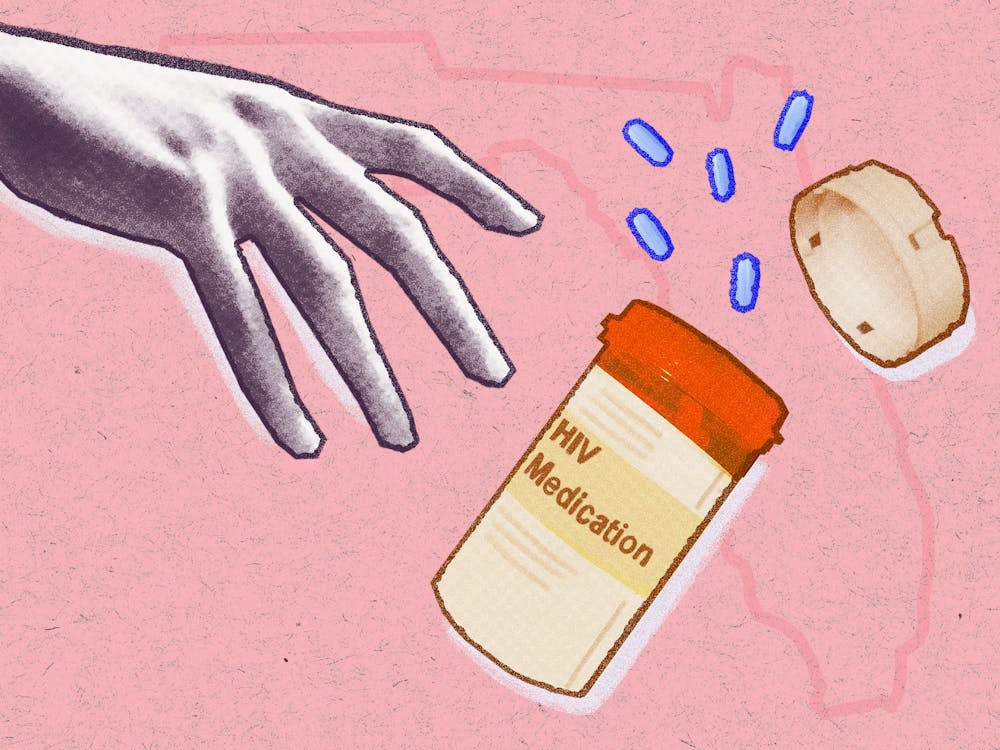
Over 132,000 people in Florida live with HIV, according to 2024 state health data. In Alachua County, approximately 370 of every 100,000 residents live with the virus.
This spring, many of them were forced to ask whether they would still be able to afford the medication needed to suppress it.
Earlier this year, the state abruptly scaled back parts of Florida’s AIDS Drug Assistance Program, also known as ADAP. The program helps low-income Floridians living with HIV pay for medication and health insurance. The changes would have reduced aimed eligibility to only cover patients around the federal poverty level. Previously, patients with incomes up to four times the poverty guideline could qualify. The program would have also eliminated access to insurance premiums for many enrollees starting March 1, leaving people who previously qualified for the program without assistance.
After pressure and protests led by the AIDS Healthcare Foundation, lawmakers temporarily reversed course in March. Gov. Ron DeSantis signed emergency legislation restoring roughly $31 million in funding, reinstating eligibility through June 30 for over 12,000 Floridians who lost access during the cuts.
Still, the emergency funding doesn’t fully restore the program’s previous structure. Insurance premium access remains limited, and some medication restrictions are in place.
In an email statement to The Alligator, the Florida Department of Health wrote the changes were driven by rising healthcare costs and insufficient federal funding.
“Due to the rising health care insurance premiums nationwide and lack of additional Ryan White Grant funding, adjustments had to be made to ensure resources to the greatest number of individuals within the Department’s funding constraints,” the department wrote.
Ryan White Grant funding backs cities, states and local community-based organizations to provide HIV care and treatment to over half the people diagnosed with HIV in the U.S.
State Sen. Carlos Guillermo Smith, D-Orlando, wrote in an email interview to The Alligator that the restored funding was lifesaving for more than 12,000 Floridians. He said he’s working to extend the funding for a year while lawmakers search for a better long-term solution.
“While this emergency relief was absolutely necessary, it was never intended to be a permanent solution,” he wrote.
Smith said lawmakers still have unanswered questions about how the state arrived at the funding shortfall that prompted the reductions. Premium assistance programs not only helped patients maintain access to care, he wrote, but also generated millions in revenue, allowing ADAP to largely sustain itself.
ADAP helps uninsured and underinsured residents living with HIV afford medication and treatment. Before the proposed cuts, the program also helped many patients cover insurance premiums and medication co-pays.
Those insurance payments often determine whether patients remain consistently connected to care.
Tristan Shuckraft, the CEO of telemedicine platform MISTR, said the company has already seen increased demand from patients in Florida seeking alternatives after losing premium assistance or facing challenges to medication coverage.
MISTR provides HIV prevention and treatment services through telehealth. It offers free consultations, at-home testing and medication delivery services.
“We’re concerned about rural patients, people without employer-sponsored insurance and individuals who may already face barriers accessing consistent healthcare,” Shuckraft said.
Even small increases in out-of-pocket costs can destabilize treatment for patients working paycheck to paycheck, he added. Without assistance, HIV medications can cost thousands of dollars a month.
“If someone loses insurance coverage, premium assistance or access to their prescribed medication, interruptions in treatment can happen within days or weeks,” he stated.
Those interruptions can have broader public health consequences.
Constant treatment lowers the amount of HIV in the body to undetectable levels, reducing health complications. Patients living with HIV who maintain viral suppression through consistent treatment can no longer sexually transmit the virus to someone else.
According to the federal Health Resources and Services Administration, more than 90% of patients receiving care through the Ryan White HIV/AIDS program achieved viral suppression as of 2024.
Michael Rajner, an HIV activist who has lived with the virus since 1995 and previously served on Florida’s ADAP advisory workgroup, said Florida’s earlier system maintained even higher suppression rates.
“The model that the Department of Health just went to takes away the remarkable 97% viral suppression rate,” Rajner said.
He criticized the Department of Health for implementing the changes without public discussion. Rajner explained that the sudden changes created panic among patients.
“People have been so traumatized and wondering where they’re going to get their medications from,” he said.
The controversy has also drawn attention from healthcare and student advocacy organizations at UF.
Amanda Hiatt, a 22-year-old UF alum who served as the Spring 2026 president of Planned Parenthood Generation Action at UF, said the proposed cuts could create additional barriers for patients already struggling to access HIV treatment and sexual healthcare.
“I think this is outrageous, and it’s very clear to me that it is an attack on a certain population because of who this impacts most,” she said.
Hiatt explained how the cuts disproportionately affect communities already more vulnerable to HIV infection and who face increased barriers to healthcare access.
Black Americans and Hispanic Americans continue to be unequally affected by HIV nationwide, according to the Centers for Disease Control and Prevention.
“Communities of color, especially Black communities, are impacted by AIDS at a much higher rate,” Hiatt said. “Also, people who are queer are impacted by AIDS at a much higher rate.”
Financial barriers can make long-term treatment inaccessible for students and younger patients without government assistance, she added.
Hiatt also spoke about how some college students may avoid seeking treatment in fear their family members will discover HIV or STI-related care through insurance records, and she believes there is a need for more HIV education and awareness in Florida.
Contact Swasthi Maharaj at smaharaj@alligator.org. Follow her on X @s_maharaj1611.

Swasthi Maharaj is a political science and politics, philosophy, economics and law (PPEL) junior at UF. This is Swasthi's fourth semester at The Alligator, and her third semester on the university desk. She's also reported on the enterprise desk. Swasthi loves coffee, reading, going to concerts, baking and taking long walks.