
Growing up, Jean Kiner spent her summers working the muck fields in Zellwood, saving up money to ride the city bus into Orlando.
She would shop along Orange Avenue before stopping at the Five and Dime for a Coke and a hot dog. But Kiner was not allowed to sit at the counter to eat.
“I had to get it and leave,” she said, “or I could go over in the corner of the counter.”
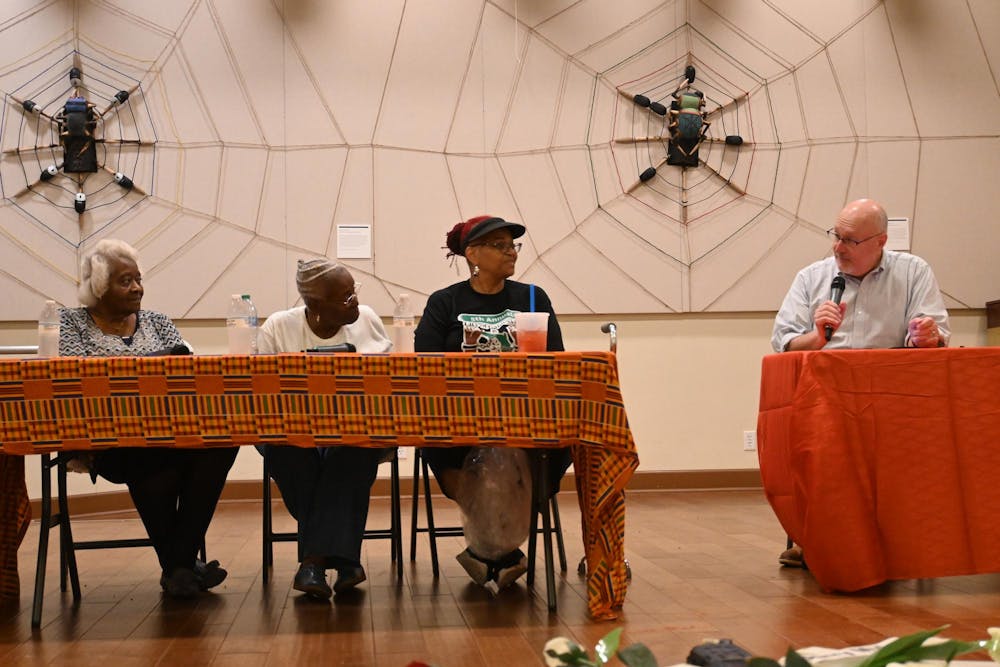
Kiner, an 80-year-old retired educator, was one of three Black women who spoke during a panel discussion at Gainesville’s Emancipation Day celebration Saturday. The panel focused on the Black experience during the Jim Crow era.
The celebration was held at the historic Cotton Club Museum and Cultural Center. A Black entertainment venue during segregation, the building now preserves Gainesville’s African American history and culture.
The Emancipation Day event, part of Gainesville’s sixth annual “Journey to Juneteenth” series commemorating Black history and emancipation, featured musical performances, a documentary screening, a memorial ceremony honoring Black soldiers and a panel discussion.
During the event, speakers thanked parents in the audience for bringing their children to the celebration and panel.
“A lot of the younger people really don’t know our stories, how we were brought up and what it was like to live in the ‘50s and ‘60s during segregation,” Kiner said after the panel.
Kiner spoke alongside two other panelists: Sarah Brown and Caroline Barber.
Brown, an 83-year-old Gainesville resident, spoke about segregation. She is a member of the Gainesville Washington Sisters, an a cappella group consisting of her and her two sisters, Vivian Filer and Karen Johnson.
Brown said she could never make sense of the “Black” labels stamped onto segregated water fountains.
“The water wasn’t black,” she said. “It was the same color as the water everybody else drank.”
Barber, the third panelist, grew up in public housing in Pennsylvania during the 1960s. She tried to shield her children from many of the hardships and realities she experienced growing up, she said.
“I’m proud of the fact that I sheltered them and kept them from being exposed to a lot of stuff,” Barber said. “They were too young.”
Roughly 30 attendees gathered to listen to the hourlong discussion, which was moderated by Mayor Harvey Ward. But the panel wasn’t all the celebration had to offer.
Beneath rows of tents outside the museum, community organizations and vendors promoted local businesses and sold merch like cards and UF-themed bucket hats.
Jacob Gordon, who founded the Alachua County African and African American Historical Society, was among representatives from roughly 20 groups participating in the celebration.
Gordon, a historian originally from Nigeria, has written several books on Black history and a memoir. He is the author of “The African Presence in Black America.” He said preserving stories of segregation is essential for future generations.
“It’s our jobs as historians to guide our history and give the proper historical materials to our young people,” he said. “Everybody should know the truth of America.”
Contact Julianna Bendeck at jbendeck@alligator.org
Julianna Bendeck is a first-year journalism student and the Summer 2026 criminal justice reporter. She previously worked as a contributing writer and race and equity reporter at The Alligator. Outside the newsroom, she enjoys reading, surfing the web and playing video games.