

Bradford County residents and local activist groups have grappled with the question of legacy for months.
Hundreds have spoken out against proposals for a U.S. Immigration and Customs Enforcement detention center in Starke, a city in Bradford County that hosts a population of just under 6,000.
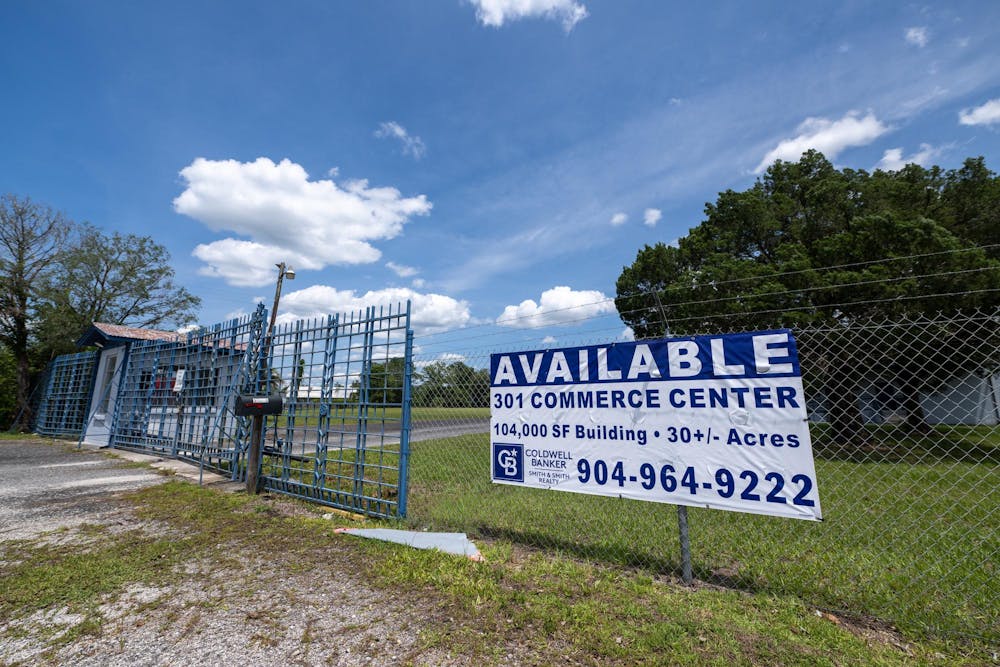
In January, Sabot Consulting, a self-described “plug-and-play” office of ICE integration, pitched a multi-phase project to convert an unused 100,000-square-foot warehouse facility and its surrounding area into a detention center capable of hosting 3,000 immigrants awaiting deportation processing.
The drive from Gainesville to Starke is under an hour. Entering from U.S. 301, the warehouse — commonly known as the Douglas Building — is the first thing many people see. The building lies just half a mile from the city’s only Walmart Supercenter.
The high visibility of the intended site has drawn criticism and widespread attention for the project, which comes at a time when ICE warehouse operations are winding down under new Department of Homeland Security Secretary Markwayne Mullin.
As of June 25, Gov. Ron DeSantis announced the official closure of the controversial Alligator Alcatraz in the Everglades after 11 months in operation. ICE detainees have brought light to the hazardous living conditions, difficulty accessing legal services and mistreatment that ran rampant in the facility, according to the Miami Herald.
In Bradford County, fears that detainees would be subjected to the same treatment in their hometown ran high. Some have expressed concerns about the damage a detention center would do to the city’s legacy. To others, the project’s lack of transparency bolstered frustration more than anything. At a county commission meeting on April 16, plans for a Starke ICE detention center were put on pause.
Sabot’s plan stated it would create jobs and work hand in hand with the Bradford County Sheriff’s Office, led by Sheriff Gordon Smith, to use an available county resource.
Activist groups and Bradford residents saw another side to the story.
Activists swarmed nearby Camp Blanding to protest when the site was announced as a potential detention center in July. Beneath blazing summer heat, over 250 people protested not just Camp Blanding but the ongoing expansion of Florida’s immigration enforcement policies.
Plans for a Camp Blanding facility were repurposed at the Baker Correctional Institute. Controversy around new ICE detention centers continues.
Jyoti Parmar directs North Central Florida Indivisible, a grassroots left-wing group advocating for immigration rights, political organizing and representative democracy. She and Indivisible previously organized a press conference to inform the public about Camp Blanding.
“It’s just wrong from all possible directions,” Parmar said. “Making money off the liberty of people should not be a thing.”
Indivisible packed the Bradford County Commission meetings alongside groups like the Sierra Club, the Bradford Environmental Forum and the Democratic Women’s Club of Alachua County. People hailing from as far as Jacksonville and St. Augustine spoke alongside Bradford residents.
“It was just word of mouth,” Parmar said. “We got the word out, and people came who cared.”
But the number of outside voices raised some questions about how much they should be allowed to weigh in on Bradford County affairs. At some meetings, the number of speakers from outside the county outnumbered residents 3-to-1.
County Commissioner Chris Dougherty, who attempted to move the board to vote on the lease, said no one seemed to care about their own community’s problems. He suggested some outside speakers’ priorities were misplaced.
“Somebody was concerned about how they’re going to get water and electricity to the [Douglas] building,” Dougherty said during the April 16 county meeting following public comment. “I’m concerned about how water and electricity get out into the [Gainesville] woods and how people live in squalor out there.”
But a detention center in Bradford County wouldn’t affect only the immediate community. Two bodies of water in Bradford County — the Sampson River and New River — feed into the Santa Fe River, which touches six counties before it empties into the Suwannee River: Bradford, Union, Alachua, Gilchrist, Columbia and Suwannee.
A chief concern among Bradford residents was the added stress of thousands of detainees on Starke’s sewage system. The system has a history of spills, and an influx could wreak havoc on an already fragile structure and cause overflow into neighboring counties.
Since 2018, Starke’s Wastewater Treatment Facility has had 11 pollution incidents ranging from overflowing manhole covers to thousands of gallons of wastewater spilling into Alligator Creek, a stream that empties into Starke’s lakes and eventually the Sampson River.
Paul Still, a 79-year-old Bradford resident and the president of the nonprofit Bradford Environmental Forum, contacted the Starke City Commission in late March. In an email with City Manager Drew Mullins, he discovered the sheriff’s office had yet to contact the city to see if it was willing to connect the proposed detention center to its wastewater system. The sheriff’s office also didn’t see how much it would cost to create new sewer and water lines.
The Douglas property’s lease agreement under the county sheriff's office explicitly mentions full integration with city water and sewage as a “non-negotiable priority.”
Possible chemical contamination at the project site was another major concern for Still, who first visited the Douglas Building in 1980 to buy lab equipment while working as a UF researcher.
When it operated as a surplus facility, the Douglas Building stored and sold extra, unneeded property donated by government agencies, ranging from screws and bolts to entire vehicles.
Still said it’s more than likely containers of volatile organic compounds, or VOCs, were also part of the warehouse’s inventory.
Typically used as industrial solvents, VOCs are chemicals that evaporate into the air and can cause long- and short-term health effects.
Trichloroethylene, a type of VOC linked to increased cancer risks, was first detected in Starke neighborhoods’ well water in 2001. The contamination was traced back to the warehouse property.
Over two decades later, the existence of the compounds still raises concerns.
“The nature of the compounds, they don’t easily break down,” Still said. “Elements that are included in the compounds are difficult to break down, so that’s why they hang around for a long time.”
As of September 2025, trichloroethylene exceeded target levels in multiple zones on the property, according to a groundwater monitoring report from the Florida Department of Environmental Protection.
VOCs like trichloroethylene have two paths once they enter contaminated soil: They can move with water into the aquifer, or they can evaporate and travel upwards, entering overlying buildings and polluting indoor air.
A 2018 report from the FDEP said any unventilated buildings constructed on the site could trap chemical vapors.
Still said extensive site work and soil disturbance, like that required of Sabot’s detention center proposal, could run these risks. Trichloroethylene vapors could enter new constructs through gaps and cracks in sewer lines or building foundations.
“You’d want to do a fairly aggressive environmental evaluation of the site before you house people in it 24 hours a day,” he said.
The U.S. Department of Homeland Security began converting warehouses like the Douglas Building into detention facilities earlier this year. Under the department’s Detention Reengineering Initiative, “non-traditional facilities” were bought to expand capacity for detained migrants awaiting transfer or deportation.
Joan Anderson, the program coordinator of ICE visitation group Baker Interfaith Friends, said the initiative is by design, allowing the day-to-day operations of detention centers to go largely unnoticed.
“These facilities are built for housing packages,” Anderson said. “They’re not built for warehousing people.”
Anderson and members of Baker Interfaith Friends regularly host virtual meetings with immigrants held at the Baker County Detention Facility in Macclenny. She’s kept in touch with several of the people she’s met. Some were deported back to their home countries, while others were allowed to stay with family members who became their sponsors.
For many detainees, the members of Baker Interfaith Friends are the only friendly faces they’ve seen in months.
“One man told me, ‘I was somebody before I came here,’” Anderson said. “‘Now I’m nobody.’”
For her and others against ICE detention policies, centers like Baker County Detention Facility and Alligator Alcatraz are only the fruits of a deeply rooted problem. When one closes, it’s rarely the end of the story, Anderson said.
Detainees are moved — sometimes across the country — and families are torn apart, she said. Attorneys hired for immigration cases suddenly find their clients hundreds of miles away, or they don’t find them at all.
DeSantis announced the official closure of Alligator Alcatraz June 25 after 11 months in operation. The facility had transferred all detainees in the weeks leading up to the announcement.
Detainees previously held there could end up at Baker Correctional Institute, also known as Deportation Depot, over 400 miles away in Sanderson.
Anderson continues to advocate for community-based alternatives to detention centers, like the Case Management Pilot Program. This program and others like it provide legal and social services to immigrants.
“[Immigrants] can stay with their jobs and their families while they’re awaiting their hearings,” she said. “When someone is taken to detention and they’re the breadwinner, the families are lost.”
The detention center project in Starke remains in its planning stages. The decision to vote on leasing the Douglas property to Sabot through the sheriff’s office was tabled, largely due to procedural issues — such as the lack of a formal, open bidding process and the desire of the commission to explore all options.
Hundreds of protesters put pressure on the board not to rush into the project. The sentiment was later echoed by four of the five commissioners, who chose not to move forward with a vote.
Carol Mosley, a 74-year-old Bradford resident, had come to every meeting about the detention center plans since they were announced. At the April 16 meeting, she gave public comment alongside 40 other speakers.
“They had wonderful things to say,” Mosley said. “Do I think it was a contributing factor in the decision-making of the county commission? I do.”
When Mosley saw the item on the meeting agenda — published only two days before — she put out the call to organized groups, who she said are essential for fast action.
Some, like Parmar, took a day off work to spread the word. In the end, a mix of over 150 Bradford residents and activists attended the April 16 meeting, which ran for almost four hours and stretched past 10 p.m.
Every chair was filled until the end, and some spilled into the hallways of the Bradford County Courthouse. Around 40 people gave public comments raising concerns about the center. Some proposed alternatives for using the property.
OM Imports, an importer and distributor in the granite- and stone-building industry, has also expressed interest in leasing the Douglas property and could be a prospect once the site goes to bids.
Bradford County Sheriff Gordon Smith emphasized in an email to The Alligator that the project is still being discussed.
“We recognize that much of the public concern surrounding this project stems from misunderstandings,” he wrote. “Some of the pushback is simply a reflection of differing viewpoints within the current political environment, rather than a matter of right or wrong.”
The county’s motto reads, “Everything is better in Bradford.”
With the ultimate decision on the detention center unknown, the question remains for whom.
Chloe Santiago is a contributing writer for The Alligator. Follow her on X @csant860.
Chloe Santiago is a second-year journalism major specializing in data journalism and coding. She is a first-time staffer at The Alligator. Between classes, interviews and editing she enjoys survival-horror video games and taking care of her extensive houseplant collection.


