
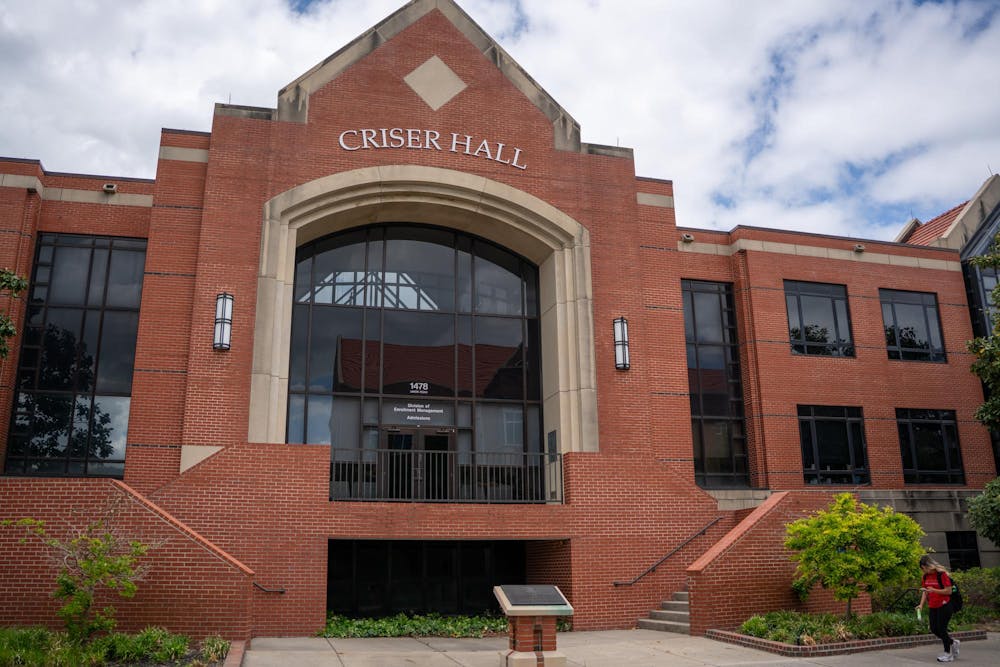
Last month, UF announced it will be joining academically competitive institutions nationwide in offering an early decision application to prospective students.
Mary Parker, UF’s vice president of enrollment management, said the decision was based on UF’s increasingly competitive academic trajectory and feedback from guidance counselors at a June 11 Board of Trustees meeting.
The early decision option will allow incoming students to commit as early as Dec. 11, 2026.
“So many of our counselors around the state of Florida and the nation called and said, ‘About time,’” she said.
Parker hopes the option will give students passionate about attending UF more flexibility and time to prepare for their future at the university.
Parker also reiterated UF’s commitment to driving Pell-eligible enrollment. She and her colleagues want to ensure high-achieving students know they are qualified and can succeed at UF as first-generation and low-income students, she said.
Michelle Duncan, an independent educational consultant at Reimagined Admissions in Niceville, Florida, had a similar reaction to the announcement.
“My initial thoughts were, ‘about time,’” she said. “It’s a great way for the admissions team at UF to sort through 96,000 applications and determine who’s serious … and it’s a way for students to demonstrate their interest in the university.”
Duncan urges interested students and families to do their research before committing to an ethically binding early decision contract.
“The major implication for seniors is they’re going to have to do their homework earlier in the process,” Duncan said.
One of the most common concerns with early decision commitments is not being able to compare financial aid packages from multiple institutions, as students are required to withdraw all other applications if admitted.
The UF Net Price Calculator is the first step for Duncan’s students considering early decision. UF has increasingly set itself apart from other institutions in the financial department since it ended early decision admissions in 2007.
“Most in-state students who qualify for admission to UF are eligible for a full-tuition scholarship through Bright Futures,” Duncan said. “And for out-of-state students, UF has maintained lower-than-average tuition costs.”
While financial pressures may not be as prevalent, students may be tempted to apply early rather than during the regular decision round, which has statistically lower acceptance rates at institutions that offer early decision.
“It’s a little bit like a game of musical chairs,” says Duncan. “If you start to take the chairs away, then there’s fewer chairs available for those who come in later.”
UF joins numerous highly selective public universities in implementing early decision, including the University of Virginia, the College of William & Mary and the University of Michigan.
The option may be a much-anticipated addition for guidance counselors and high school students set on attending UF next Fall, but early decision isn’t for everyone, said Rebecca Lewis, an independent educational consultant in Sarasota County.
Lewis said her concern isn’t just student anxiety, but families who misunderstand early decision and view it as a tactic to increase admission odds rather than a binding agreement.
“That’s not going to benefit anyone and can get very, very complicated,” she said. “If you absolutely know you want to be here … that’s why you should be applying early decision anywhere.”
For one of Lewis’ recently graduated clients, Daniel Kaiser, this was undoubtedly the case.
Kaiser, an 18-year-old incoming UF economics freshman, had his heart set on UF from the start of his application process. When Kaiser applied in Fall 2025, he didn’t have the option to apply early.
“UF was for sure my top school, so it definitely would have been something I would have been interested in,” Kaiser said. “It felt like we heard back from every other school and then had another month to wait for UF.”
However, early admissions can feel daunting for students less certain about their college decision. These students face the pressure of statistically lower regular admissions rates for universities that offer early decision.
Jenna Schebell is the founder of The College Navigators, an online community providing college counseling. She said admissions committees will often fill half or more of their incoming class through early decision applications alone.
Schebell, a former college admissions director and high school director of college counseling, has made her own predictions.
“We might see high deferrals coming out of early action for in-state residents,” she said.
The University of Michigan’s addition of early decision was characterized by a messy rollout, Schebell said.
Ruchi S. Kothari, a college admissions expert who founded IvyBound Consulting, said in an Instagram reel that the University of Michigan experienced a record high of over 109,000 applicants for Fall 2025. Despite being qualified, many early decision applicants were deferred to regular decision.
Schebell also noted the number of graduating high school students is declining, along with the number of enrolled college students.
However, Florida is not seeing a decline and is actually becoming an appealing option to out-of-state students.
“I think one thing that you hear repeatedly from Florida families is, ‘It’s not fair [that] out-of-state students are taking our place,’” she said. “Early decision is going to be a great thing for Florida students if this is where they really want to be.”
Despite the added pressure to solidify college plans earlier, Schebell affirms high school students should be wary when committing to early decision.
“I always say you’re going to end up where you’re meant to be, so if you’re not pulled in a direction for early decision, then just let it all play out the way that it’s supposed to,” she said.
Contact Kendall O’Connor at koconnor@alligator.org.
Kendall O'Connor is a journalism senior at UF and the Fall 2026 lifestyle reporter. This is her second semester at The Alligator and first semester on The Avenue desk. Kendall loves reading, practicing yoga, making playlists and going to the movies.