
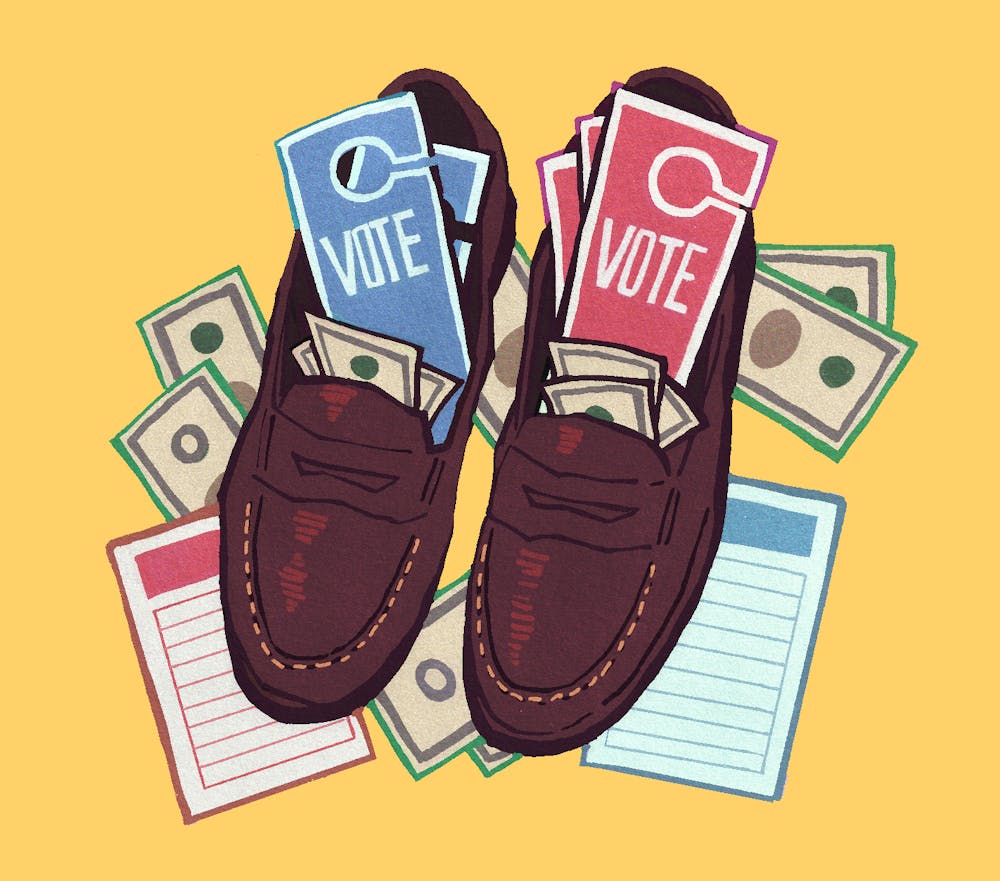
Money may keep a campaign alive, but local candidates say it can’t clinch a victory.
Candidates elected to the Gainesville City Commission and Alachua County Commission Aug. 18 said fundraising increasingly pays for targeted voter outreach through mail, text messaging and digital advertising. But face-to-face conversations with voters remain one of the most valuable parts of campaigning.
Campaign finance records show the three winning candidates raised significantly different amounts of money.
Alachua County Commissioner-elect Tina Certain raised over $41,000 and spent almost all of it during her campaign. Gainesville City Commissioner-elect Nathan Crabbe raised about $15,700 and spent $12,150, while incumbent Casey Willits raised $11,800 and spent $7,000.
But fundraising totals don’t always predict election outcomes — at least, they didn’t in the Alachua County Commission race.
Certain's opponent, Donna Bradbrook, raised just over $43,000 — more than any candidate in the four-way county commission race. But Certain won with 39% of the vote and an 8-percentage-point edge over Bradbrook's 31%.
According to some of the candidates, campaign money serves as a way for candidates to expand their voter outreach rather than a way to replace it.
Certain, who previously served on the Alachua County School Board, said she estimated about 350 individuals donated to her campaign, with only three contributions coming from political organizations.
Rising postage costs, advertising prices and inflation stretched campaign budgets.
"We spent the bulk of our money on direct mail," Certain said. "The mailers, the texting and the social media ads helped to do what I couldn't do."
In addition to those electronic and mail ads, Certain knocked on roughly 1,500 doors with the help of a few volunteers in an attempt to sway voters.
Certain entered the county commission race with greater name recognition because of her position on the school board, she said, so she relied less on canvassing than in past campaigns. Instead, she focused on reaching voters by mail, text and digital advertising.
Crabbe, a former Gainesville Sun journalist elected to the Gainesville City Commission, said individual donors largely built his campaign, too.
Campaign finance records show Crabbe received 116 individual contributions who donated an average of about $125 each. He also loaned $1,000 to his campaign, and $250 came from the Alachua County Stonewall PAC, a Gainesville-based LGBTQ political committee.
He won with about 60% of the nearly 7,600 votes cast, beating Marine veteran Wyatt Zintiz and housing advocate Nelida Jean-Baptiste Pellot, who each took about 20% of the vote.
Fundraising was unfamiliar territory when he entered the race, Crabbe said.
"I knew nothing about any of this going in," Crabbe said. "Fundraising has never been my forte."
He focused on gaining campaign contributions through house parties and personal conversations with supporters, he said, rather than relying on large institutional donors. Crabbe personally knocked on just over 3,000 doors throughout the campaign, he added.
While fundraising was needed to pay for campaign materials, Crabbe said, voter contact ultimately mattered more.
"I think the story of this campaign locally, more so than money raised, is who out-hustled who," he said.
Willits, the only incumbent among the three winners, said his campaign relied on a different strategy. He won with over half of the vote, passing DeJeon Cain, his nearest challenger. Cain took 28% of the votes while James Gardner took 17%.
Rather than emphasizing yard signs or expanding direct mail, Willits’ campaign prioritized social media videos, text messaging and phone calls. He estimated he received financial support from about 100 donors, around $100 and loaned $1,000 himself.
He intentionally reduced spending on yard signs because many residents in his apartment-heavy district can’t display them in front of their apartments, he said.
"Yard signs don't vote," Willits said.
He also knocked on fewer doors than he did four years ago, he added, citing the difficulty of canvassing apartment complexes. Instead, videos on Instagram and Facebook allowed voters to hear directly from him about issues affecting the city, he said.
Despite their different approaches, all three candidates agreed fundraising and voter outreach work in tandem rather than in competition.
Campaign money might pay for mail, digital advertisements, text messages and campaign staff, Willits said, but candidates still need to talk to voters directly to understand community concerns.
"You really can't have one without the other," Willits said. "Fundraising is often a show of the support you already have in the community, and then door knocking is how you learn what the average voter is thinking about."
Public records show there was no single formula for winning this year's local elections. The candidates who raised the most money weren’t guaranteed a win, while candidates with smaller fundraising totals won their races through combinations of name recognition, voter outreach and campaign strategy.
Contact Jessie Yang at jyang@alligator.org. Follow her on X @jessie_yang_22.

Jessie Yang is a sophomore studying statistics. She's interested in business, technology, and finance, and is a member of the Caimanes Student-Managed Hedge Fund, where she researches companies and develops investment theses. She's currently exploring a career in investment banking. Outside of The Alligator, she enjoys playing tennis, golfing, and pretending not to struggle on hikes in pretty places.