

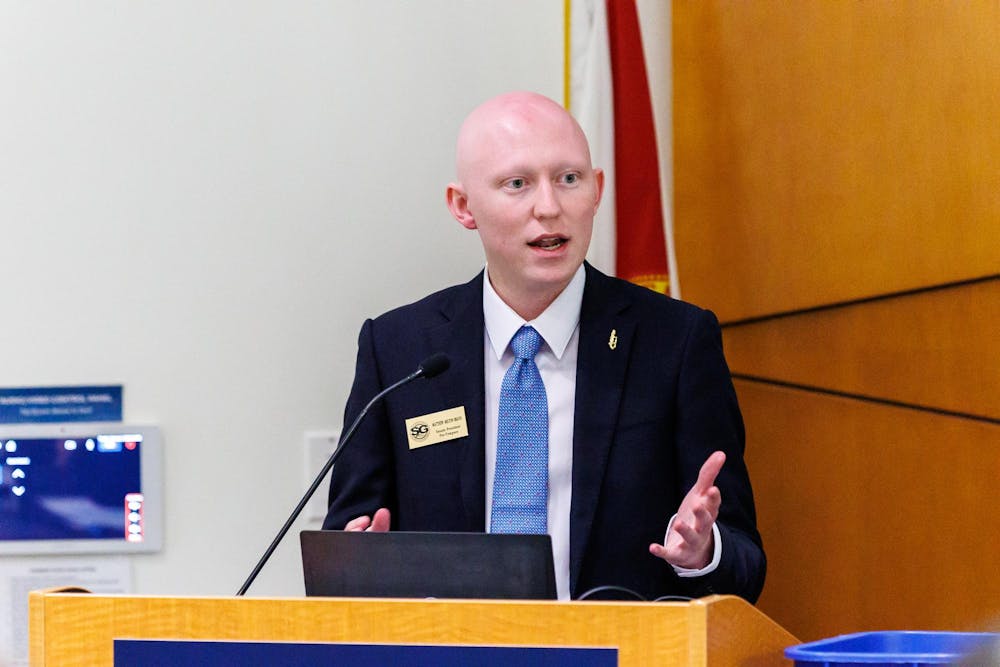
The Senate Chamber in the Reitz Union sprang back to life Aug. 25, packed with Student Government representatives returning to the chamber for the first time since Spring.
After laying out plans for elections and bidding farewell to its longest-serving senator, SG prepared for the coming months, prioritizing campus-wide health, safety and inter-organizational collaboration. Meanwhile, students look for more opportunities to interact with the chamber and its members.
Notable changes
In the past, SG focused its efforts on redistributing seats within the Senate by putting forth a reappropriation bill to remove seats from the Heavener School of Business, Fisher School of Accounting, Rinker School of Construction Management, the College of Liberal Arts and Sciences and one of two graduate student seats.
Beginning Spring 2027, seats have been rearranged to add four seats to the Warrington College of Business and one each to the Hamilton School, the Herbert Wertheim College of Engineering and the College of Journalism and Communications.
The reapportionments come from the Senate's desire to represent UF's growing class size and its new colleges. UF undergraduate numbers rose by just over 7,500 students between Fall 2014 and Fall 2024.
The legislation put forth by the judiciary committee also reapportioned seats starting this Fall for senators representing living areas — the most significant change being the removal of the recently demolished Graham Area seat. The seat is now part of the off-campus student representation.
Some senators, such as former Sen. Austin Britton (Vision-Graduate), tried to push for more seats to adjust for population growth at UF. The proposed amendment failed because most senators did not want to increase the consistent 50 senate seats per semester.
Vision Party has faced past accusations of gerrymandering elections by having off-campus students represented by 37 senators as one district. Former Sen. Andrew Larsen (Change-Arts) led the criticism, according to previous Alligator coverage, claiming that having one large district would discourage voters from voting for candidates from multiple parties and would lead to one-party domination.
Last Fall, SG also wrote legislation backing a UF-led proposal to raise athletic and health student fees by $1.56 and $0.27, respectively.
The revenue from the increased athletic fee goes toward improving athletics on campus and reducing student ticket prices for sporting events. The health fee revenue will go toward hiring more staff at the Disability Resource Center.
Looking forward
Continuing rollouts of the student medical amnesty policy and establishing a campus-wide swab drive for a bone marrow registry are two priorities headed into the upcoming SG cycle, President Matthew Milton Bravo wrote in a statement to The Alligator.
Medical amnesty is a conduct waiver for people who seek medical attention due to controlled substance or alcohol use, allowing students to be excused from disciplinary measures for violating student conduct codes.
The legislation aims to encourage students to call emergency services for drug- or alcohol-related emergencies without fear of disciplinary action.
Bravo also named the prioritization of campus-wide stem cell drives as a priority this year to raise awareness of blood cancer patients and treatments and give opportunities to other cancer patients looking for donors.
The goal follows the success of the “Swab for Bravo” drive last Fall, where students volunteered to be tested as a match for Bravo to receive a stem cell transplant after he was diagnosed with Hodgkin's Lymphoma.
"It'll be nice to start up a program that can actually help a lot of people, not even just outside of UF, but also a lot of students here fighting,” he said after his win in the Spring. “It’s a project close to my heart.”
The student side
Now, students are interested in seeing SG take more action this Fall.
Nicolas Fernandez, a 20-year-old UF pre-veterinary wildlife ecology conservation junior, said SG tended to keep a low profile during his underclassman years. Outside of events it hosted, he said members didn’t seem to do much to make themselves known to the larger student body.
“They do feel a little more in the background,” Fernandez said.
Fernandez was part of the cohort of students who petitioned for Marston Science Library to resume its previous operating hours, and he said he appreciates SG for responding to the request.
Marston stopped its 24/7 operations in Fall 2024 because of budget changes. After students protested the decision, SG passed a resolution at the end of last Fall to help fund a 24/5 operation schedule.
Many students new to campus might not be as aware of SG and its history. But some, like Emilio Navarro, an 18-year-old UF aerospace engineering freshman, are anticipating events to get to know SG members and their peers.
Navarro is hopeful SG members will make themselves known and available to students. He’s a fan of the organization’s social gatherings, he said, which give him and other students a chance to make friends outside of class.
“I think those kinds of events, like any communal things, are very interesting,” Navarro said. “It gives me an excuse to go out.”
Contact Sofia Garcia at sofiagarcia@alligator.org. Follow her on X at @sconsuelogarcia.

Sofia Garcia is a first-year journalism and political science double major at UF and serving as the student government reporter for Fall 2026. This is her first semester at The Alligator. In her free time, she enjoys listening to music, playing video games, or connecting with her friends and family back home in Miami.