

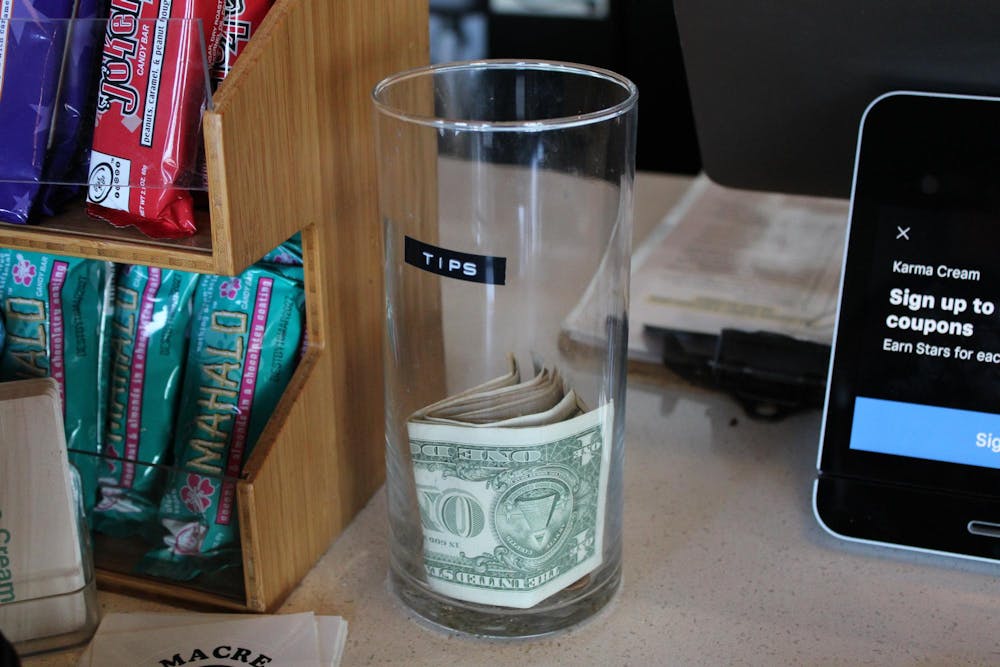
Here’s a tip: I’m already questioning yours.
Imagine this scenario. You’re ordering a coffee, sandwich, smoothie or whatever you like. Then the employee flips the tablet around.
18%? 20%? 25%?
They’re standing only a few feet away, staring into your soul. You suddenly feel like you’re publicly announcing whether you’re a good person.
Why am I being put in this position in the first place? Why do I feel guilty for pressing “no tip?”
Tipping itself isn’t the problem. The real issue is that America has blurred the line between workers who depend on tips as part of their wages and workers who are simply presented alongside a tip screen. As tipping prompts spread from sit-down restaurants to coffee shops, smoothie counters and takeout orders, customers are being asked to subsidize wages without knowing when gratuity is actually necessary. That confusion contributes to tipping fatigue — risking the livelihood of workers who depend on tips.
America’s tipping culture has expanded beyond what originally made tipping feel obligatory. When we're expected to tip for increasingly small interactions, when do we stop?
To answer this question, we must first ask: How did we get here?
Tipping wasn’t always a vital part of dining in the United States, according to Rachel E. Greenspan with TIME magazine. In fact, its history is linked to racial oppression after the Civil War. Wealthy Americans in the 1850s and ’60s initially used tips to flaunt their aristocratic status, a practice many Americans considered “condescending” and “classist.”
But after slavery ended, tipping took on a much darker purpose. Many formerly enslaved people were left with few employment opportunities, and some employers hired them without wages, expecting tips to make up their income. Eventually, what began as a bonus became embedded into U.S. labor practices as part of a worker’s pay.
More than a century later, we’re still operating under a version of that system. Federal law allows tipped workers to be paid differently than other employees, a practice that has existed in some form since 1938. Today, the federal minimum cash wage for tipped workers is just $2.13 an hour, compared with the $7.25 federal minimum wage. According to the U.S. Department of Labor, only seven states, none of which are Florida, require employers to pay tipped employees the full state minimum wage before tips. So, in most of the country, the tip you leave isn’t necessarily extra — it’s often part of the wage our system expects that worker to earn.
We’ve legally constructed a system where the customer’s voluntary payment can form part of one’s expected compensation. That's what makes American tipping so strange: We call the payment optional while building a compensation system that assumes someone will earn it.
Emma Harrington, a 19-year old UF biology junior who worked as both a host and server, agrees “tipping culture now is definitely excessive,” but she draws a clear distinction.
Customers should tip sit-down servers because their hourly wages are often “literally in the single digits,” she said. At businesses like smoothie shops or places like Starbucks, where employees receive a standard hourly wage, she considers a small tip generous.
Asking for tips everywhere may ultimately hurt the workers who rely on them by making customers increasingly resent tipping altogether, she added.
For Harrington, tips worked well in her roles because the job was part time and the money was supplemental. The system may feel very different for workers relying on tips to cover necessities, she said.
“For people who have rent to pay — I know my coworkers, if they had a big day where they made $600 in one shift, they would put that in an envelope and save it for rent,” she said. “If I had rent to pay, I would probably be more inclined toward a higher hourly wage.”
The difference isn’t necessarily the paycheck, but what is riding on it. An unpredictable income feels very different when a bad shift means skipping a new pair of shoes versus falling short on rent.
This is the fundamental difference between a sit-down restaurant and a fast food drive-thru. When employers build gratuity into the workers’ wages, customers are no longer rewarding good service — they’re helping determine if the worker earns enough that night. The problem isn’t that workers expect tips, but that their financial stability has become dependent on it.
I’m not saying tipping itself needs to disappear — exceptional service deserves recognition, and there’s nothing wrong with rewarding someone who made an experience memorable. However, we’ve blurred the line between gratuity and a wage. A tip should be extra. A wage should be guaranteed. A slow Tuesday shouldn’t determine whether someone can pay rent.
So, let’s pay everyone a higher wage and eliminate tips. Problem solved, right?
Not exactly.
Micheal Akey, a 27-year-old general manager at Piesano’s Stone Fired Pizza said he’s worked various positions in the restaurant industry and has found serving to be the most lucrative. He added that despite the variability of income, the good days outweigh the bad.
“I've worked numerous amount of jobs, but I served before, and I think that tipping was always the best thing money-wise,” he said. “There's good days and there's bad days, and it's almost gambling.”
Akey said replacing tipped income with a fixed wage is not as simple as raising an hourly rate and would require paying “upwards of $50 an hour.” His experience reveals one of the contradictions that keeps tipping alive: The same system that makes workers’ incomes unpredictable can also give them the opportunity to earn far more than a fixed hourly wage would provide.
Rose Dovel, a 20-year-old host and busser at Cheddar’s Scratch Kitchen, sees the tradeoff differently. As a host, Dovel does not receive tips. Alternatively, as a busser, she receives a share of servers’ credit card tips. She estimates servers can make between $100 and $300 in a night, meaning a modest increase in hourly wages may still leave employees earning less.
However, unlike Radcliffe, Dovel would prefer a system with a higher guaranteed wage and less reliance on gratuities. She said a tip should be a bonus on top of a base wage, and employees should “already be making a living wage.” As for growing customer frustration with tipping, Dovel said the blame may be displaced.
“The frustration should be directed at the company that enforces tipping rather than … at the people,” she said, “because the people are just trying to live, like you or I.”
I have come to see tipping culture as a cycle perpetuated by the difficulty of changing a deeply established system. Customers tip because workers depend on it. Workers depend on tips because they constitute a substantial portion of their income. Some workers resist eliminating tips because they can earn more through gratuities than they would through a fixed wage. Businesses risk losing those workers or raising prices if they replace that income themselves. The responsibility therefore falls back on customers.
That is why the “Just stop tipping” encouragement is a terrible solution. The first people harmed wouldn’t be restaurant owners, but the workers whose wages already assume customers will tip.
So, why am I paying your employees? Because the law allows businesses to build our generosity into their payroll. Until wages rise enough to replace what workers currently earn through tips, refusing to tip will not dismantle the system. It will only deny one worker the income the system expects us to provide.
Press “no tip” at the smoothie counter without guilt. But when someone’s ability to make rent depends on your gratuity, tip them — and direct your frustration toward the employers and laws that made their paycheck your responsibility in the first place.
Contact Shirin Khizzar at Skhizar@alligator.org. Follow her on X @Shirinkhizzar.

Shirin Khizzar is a sophmore studying Public Health. This is her first semster working on the Alligator staff. In her free time, she enjoys reading, listening to music, and watching movies.


