

Editor’s Note: This story has been updated to more accurately reflect the content of Melissa Bell’s letter to city and shelter officials. The format was changed to clarify that concerns Bell raised in her letter were intended to be questions to officials and not “claims,” as this story previously suggested. In addition to changing “claims” to “questions,” the article was updated to reflect that it is unclear whether GRACE Marketplace is one of two low-barrier shelters in Florida and confirm that people with criminal histories visit GRACE Marketplace.
UF parents are calling on local officials to examine GRACE Marketplace’s limited screening and whether publicly funded homelessness initiatives account for safety issues affecting students and nearby community members.
During the Sept. 17 Gainesville City Commission meeting, 17 parents voiced concerns about a rise in violent crime related to the city’s homeless population. Many shared encounters between students and homeless individuals that were often violent or dangerous.
City officials, however, have disputed a connection between GRACE’s low-barrier model and crime. At the meeting, they acknowledged concerns about public safety but said the city’s homelessness services are intended to house people while maintaining community safety.
Melissa Bell, a UF parent and attorney, sent a letter to local officials calling for greater transparency around GRACE Marketplace’s intake policies, including its lack of criminal background checks, drug screening and identification requirements.
While Bell’s letter consistently asks for data regarding the number of individuals who come to GRACE Marketplace from other counties or upon release from incarceration, she said she has yet to receive records. She has also requested the number of recent GRACE Marketplace guests who have felony convictions, sex-offense registration or active arrest warrants, but she has received no response.
Here’s what the evidence outlined in the email shows.
QUESTION: Is GRACE Marketplace a low-barrier shelter that does not require background checks or sobriety to use its services?
ANSWER: Yes.
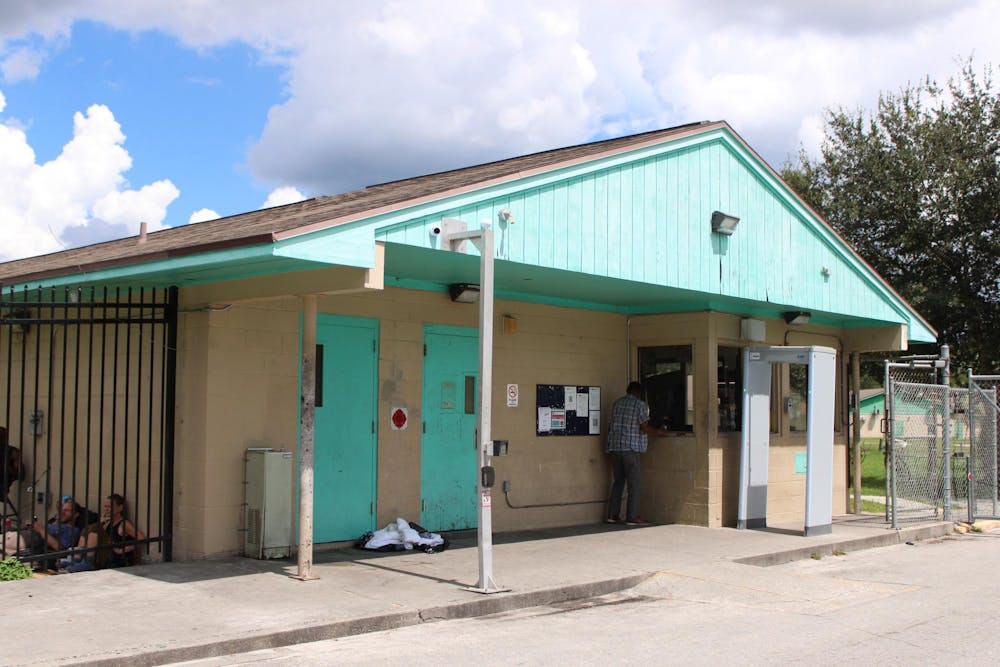
THE FACTS: Opened in 2014, GRACE Marketplace is a low-barrier homeless shelter housing just over 180 beds and providing outreach programs aimed to help people transition out of homelessness.
Upon entry for emergency shelter, GRACE does not require proof of identification, a criminal background check, a drug screening, evidence of sobriety or participation in mental health or substance use treatment.
In an email to The Alligator, interim CEO Mark Bonner said those requirements are intentionally excluded from GRACE’s emergency shelter intake process.
“Many people arrive without identification because it has been lost, stolen or destroyed while they were living outside,” Bonner wrote.
GRACE prohibits violence, threats, weapons, illegal drug use and other behavior that places people at risk, Bonner said. Staff can restrict someone’s access or prohibit them from returning to campus when their behavior creates a safety concern, he added.
QUESTION: Is GRACE one of only two primary low-barrier shelters in Florida?
ANSWER: Unclear.
THE FACTS: Apart from Gainesville, cities like Orlando and Fort Lauderdale also operate shelters with a low-barrier model, but it is unclear if they have as few screening requirements as GRACE Marketplace.
Intake forms at the Orlando shelter don’t include information about screenings or background checks. The Alligator called both shelters, which either didn’t respond in time for publication or referred to their website.
The websites do not clearly outline any screening requirements or background checks. There is no statewide list of shelters’ entry requirements.
Mayor Harvey Ward said the shelter’s low-barrier model isn’t unusual.
“We are not, as has been alleged, the one of two cities anywhere using low-barrier shelters. That's simply not true,” he said. “Low-barrier shelters are a best practice that are used in every major city in Florida.”
Bell said she’s reached out to officials to ask whether other low-barrier shelters screen for sexual-offense registration, but she hasn’t yet received a response.
QUESTION: Do people with criminal histories come to GRACE from elsewhere in Florida?
ANSWER: Yes.
THE FACTS: In her email, Bell questioned whether Gainesville’s low-barrier shelter system could attract formerly incarcerated people from across Florida.
“What percentage of the people that are coming to Gainesville for homeless services are from the area?” Bell wrote. “Did they come here because it's a low-barrier setting where they will take people with violent criminal records?”
Bell acknowledged she doesn’t have data showing how many people come to Gainesville specifically to access GRACE’s low-barrier shelter. Instead, she said she’s urging officials to explore these statistics and their relation to the safety of UF students.
Upon comparing the Florida Department of Corrections release records with GRACE enrollment records, interim CEO Bonner said that of roughly 25,000 released individuals, 81 later enrolled in GRACE programs between September 2025 and September 2026.
During the Sept. 17 Gainesville City Commission meeting, Commissioner Casey Willits said a small portion of inmates from the FDOC end up in Gainesville simply because of its proximity to I-75 and state and federal prisons condensed in northwestern rural Florida.
“I bristle at listening to people who don’t live close to prisons upset that maybe someone who’s released from a prison on their way home ends up in our community,” Willits said.
Bonner said the shelter's available intake information shows most of the people staying at GRACE are from Alachua County.
“Our shelter beds are prioritized for Alachua County residents,” he wrote. “From the information we collect on intake, it is clear that the majority of people who receive our services are from right here in Alachua County.”
Bonner said shelter services are intended for county residents and cannot be reserved remotely. People seeking emergency shelter must appear in person, meaning it provides shelter for those who need it locally.
Though Bonner said the shelter prioritizes beds for residents, enrollment records show a portion of shelter visitors come from prison. Therefore, it is true people with criminal records come to GRACE Marketplace from elsewhere in Florida.
QUESTION: Do arrest records show GRACE residents are significantly contributing to crime in Gainesville?
ANSWER: Unclear.
THE FACTS: In her email to local officials, Bell compiled 37 arrest reports of homeless individuals between April 2025 and August 2026, with 13 having addresses linked to GRACE Marketplace. Other reports did not have an address or were linked to the now-closed St. Francis House, which was located in downtown Gainesville.
She said the records were intended to demonstrate a broader pattern of repeat offenses and convictions rather than allege every person listed in the records was a GRACE resident. She also acknowledged some of the cases cited in her email involved individuals who were arrested but never prosecuted or convicted.
“I don’t think that any single arrest is demonstrative that they lived at GRACE,” Bell said.
According to Bonner, an arrest record listing GRACE as an address doesn’t mean the person was staying at the shelter when they were charged with a crime. Some people use the shelter as a mailing address if they don’t have a permanent residence, might have received day services there or stayed there in the past, he said.
“An arrest report that identifies someone as homeless or lists GRACE somewhere in that person’s history does not establish that the person was staying at GRACE when an incident occurred,” Bonner wrote.
The records provide evidence of individual arrests and allegations but do not establish that GRACE residents significantly contribute to Gainesville crime or that GRACE’s policies caused those offenses.
Gainesville Police Department spokesperson Art Forgey said he doesn’t think there’s a connection between GRACE Marketplace and crime rates.
“I don't know that you could correlate that once GRACE came about and concentrated a large portion of the homeless population that we saw a significant increase in crime,” he said.
QUESTION: Does GRACE’s low-barrier model contribute to crime around UF?
ANSWER: Not established.
THE FACTS: Bell’s letter connected GRACE’s policies to safety concerns affecting UF students. She cites interactions with people she said were homeless or associated with GRACE.
Some of the incidents she described came from arrest records, while others were accounts shared by parents or in social media posts.
“There's a lot of anecdotal information in the parents group,” Bell said. “While it's not the evidentiary standard I like as an attorney, you can't ignore these parents.”
During the Sept. 17 city commission meeting, Teresa White, a parent of three UF students, described an incident last Spring where a homeless individual followed one of her children and her friend to their apartment and tried to get in.
Anne Smith, another UF parent who called into the meeting, said her daughter waited over an hour for police to arrive after she reported a homeless individual sleeping outside her car in a parking garage. While she waited for officials to arrive, the individual “woke up and started pounding on her window,” Smith said.
Those reports don’t independently establish a relationship between GRACE and crime around campus. GRACE Marketplace is located more than 5 miles northeast of UF’s main campus.
Forgey said reports of incidents involving homeless individuals are often wrongly associated with GRACE.
“Immediately people's minds go to GRACE, and I think people just jump on that bandwagon,” he said. “I don't think that GRACE is the driver of the crime rate within the city.”
Ward similarly said the city has not seen evidence showing a correlation between Gainesville crime and GRACE’s operating model.
The city’s approach is based on the idea that providing shelter does not create the conditions that lead to crime. Instead, he said, removing low-barrier shelter options would result in more people experiencing homelessness.
“Unsheltered people can't just go somewhere else. If we don't offer a low-barrier shelter, then people will simply be unsheltered,” Ward said. “I don't think that providing a roof over someone's head creates crime.”
Ward added the city continues to enforce laws regardless of where someone lives.
“We will also always enforce the law when someone breaks the law, whether they live in Haile Plantation or Grace Marketplace,” he said.
IN SUMMARY: Overall, the available information confirms GRACE operates a low-barrier shelter and does not require traditional screening measures. It also suggests people with criminal histories come to GRACE Marketplace from elsewhere in Florida.
However, it remains unclear if GRACE guests are responsible for a particular share of Gainesville crime or if the shelter’s operating model has caused an increase in violent crime.
Ward said the city’s approach is based on maintaining shelter access while continuing to enforce laws against dangerous or illegal behavior.
“I think what we should do is focus on helping people, and that is where the city of Gainesville consistently is,” Ward said. “We want to make sure that laws are enforced and that we are doing everything we can to help folks.”
Ray Garcia contributed to this report.
Contact Hailey Kon at hkon@alligator.org.

Hailey Kon is a senior public relations and psychology double major serving as this fall's city and county commission reporter. This is her second semester on staff at The Alligator, having previously worked as The Alligator's student government reporter and a contributing writer for The Gainesville Sun. When she's not on campus, she can be found in the Dutch Bros drive-thru or a Ticketmaster queue trying to buy concert tickets.


