
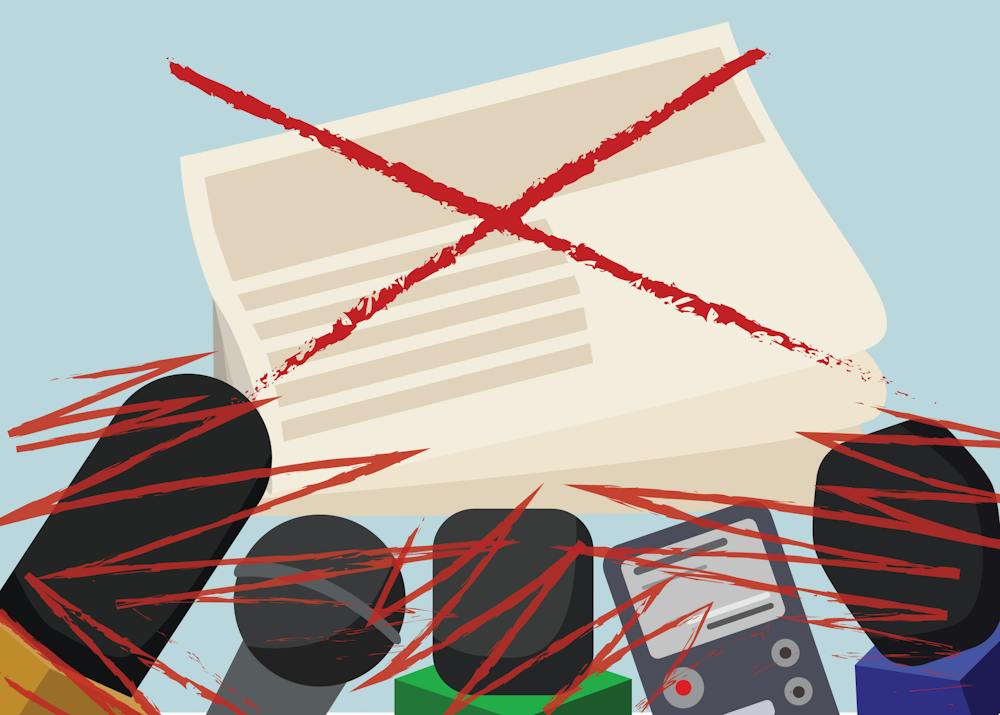
President Donald Trump's attempt to bar CNN; MS NOW, formerly MSNBC; and Politico from the White House hit another legal roadblock Oct. 13 when a federal judge extended the outlets’ protections, reinstating access to the White House. The judge found the news outlets were likely to succeed in arguing the administration violated their constitutional rights.
But the judge’s decision raises a larger question: Is the president allowed to ban reporters from the White House if he doesn’t like their reporting?
On Oct. 13, U.S. District Judge Timothy Kelly expanded his previous temporary ruling to say the Trump administration’s ban likely violated the press’ First Amendment and Fifth Amendment rights. Kelly ruled the news outlets were likely to succeed in their lawsuit against the administration and rejected Trump’s argument that the ban was made out of concern for national security.
The decision came after the expiration of Kelly’s temporary order to block the ban. Trump originally announced the ban Sept. 18 with a Truth Social post. News outlets immediately sued the administration.
The constitutional elements impacting this decision are outlined in Kelly’s opinion, where he details the specific precedent that makes it likely the press will succeed in their lawsuit.
Fifth Amendment concerns
The 1977 Sherrill v. Knight sets the precedent to argue the ban violated the press’ Fifth Amendment rights. In this case, Robert Sherrill, a journalist from The Nation, was denied a press pass to access the White House without specific reason or ample time to respond. The court ruled journalists must be given a specific explanation and meaningful opportunity to respond if their request for a press place is to be rejected.
The argument for due process was further supported by the 2020 Karem v. Trump, in which a journalist’s press pass was suspended in 2019 for violating professional journalistic norms with the then-former Trump administration official Sebastian Gorka. The court reaffirmed that journalists have a right to access the White House, and specific reasons must be given if that right is revoked.
The Trump administration failed to provide a sufficient explanation for the September ban or establish specific standards that resulted in the ban in the first place. Additionally, the administration only provided this explanation via a letter sent by the White House Press Office to the news outlets Sept. 22, after the ban was announced, which didn’t allow the reporters the time or ability to respond, according to Kelly’s opinion.
First Amendment concerns
News outlets also claimed the Trump administration violated their First Amendment rights through viewpoint discrimination and retaliation.
Under the First Amendment, government agents can’t block ideologies or opinions while allowing perspectives from an opposing side. This is a form of speech regulation based on the content of the speech and therefore unconstitutional.
Retaliation occurs when the government takes negative action against a person or group because they participated in constitutionally protected speech.
Trump made three social media posts accusing the banned news outlets of reporting “FAKE NEWS” and intentionally painting the administration in a negative light, justifying the ban. While the government is free to criticize journalists and their coverage, it can’t take action against protected speech.
One of the few exceptions to this rule is if the issue poses a legitimate threat to national security, which is what the administration claimed in this case.
Kelly ruled there wasn’t much evidence to prove such a threat.
The remaining pool of television news organizations allowed access to the White House, including ABC, CBS, CNN, NBC and Fox News, took part in a rare unified protest by refusing to cover the White House.
Due to space constraints and ease of content distribution, coverage is regularly rotated within a small pool of five television news organizations. This system ensures events are covered without complicating communication among outlets.
CNN, one of the banned outlets, was scheduled to cover presidential events and movements Sept. 21. In a show of solidarity, other networks refused to step in as a replacement. As a result, presidential coverage went dark for several days, meaning Trump received no television coverage of events such as his meeting with Xi Jinping, the president of China.
Trump openly criticized major news networks, including CNN and MS NOW, on Truth Social and started an antitrust investigation through the U.S. Department of Justice. The investigation, which treats the press’ protest as an anti-competitive corporate decision, launched Oct. 9 to determine whether the actions of the other news outlets constituted an illegal boycott under the Sherman Antitrust Act.
The DOJ investigation is still in the early stages, and formal findings or conclusions haven’t been released as of Oct. 17.
While the president is allowed to restrict press access to the White House by taking neutral action to enforce the president’s physical safety or protect classified information, the legal issue goes beyond those limitations.
The letter of the law
The Constitution gives the press due process and free speech rights. Previous cases have established that while the White House can limit press access, it can’t do so without a legitimate reason. When the government attempts to restrict speech in targeted discrimination or as a retaliatory action rather than an established security concern, the question of constitutionality comes into play.
Kelly’s ruling indicates the president’s actions have constitutional limits based on precedent and the letter of the law. By ruling the news stations’ First and Fifth Amendment violation claims are likely to succeed in court, Kelly’s decision strengthens the idea that the government can’t revoke press access without good reason.
The Oct. 13 ruling isn’t the court’s final decision, and the Trump administration has already appealed.
While the lawsuit plays out in court, the news outlets involved in the lawsuit will be allowed access to the White House. But CNN, MS NOW and Politico can still be banned from certain events because the injunction doesn’t specifically include access to restricted spaces like the inside of the Oval Office or aboard Air Force One.
Unlike the previous temporary restraining order granted by Kelly, this preliminary injunction has no expiration date and will continue to uphold the status quo until a formal ruling is reached.
Contact Kaysheri Haffner at khaffner@alligator.org. Follow her on X @kaysheri_h.

Kaysheri is a senior journalism student and the Alligator's First Amendment reporter. When she isn't working on stories, she can be found at the gym or reading and drawing in a patch of sunlight.


