

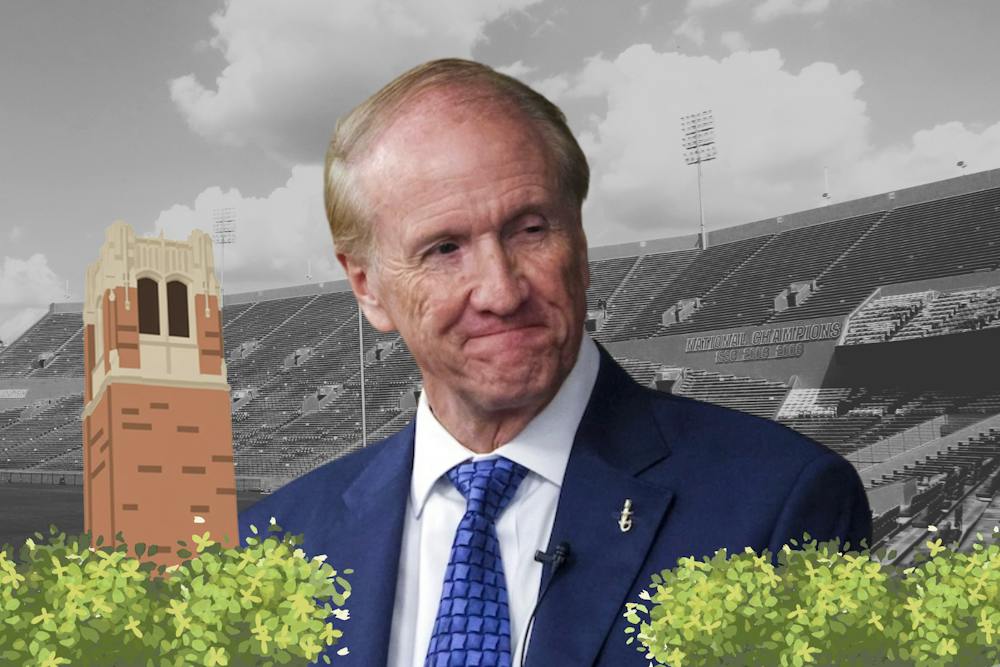
Leaders of the UF chapter of the United Faculty of Florida say UF President Stuart Bell failed to credit the union for its role in negotiating a record faculty merit raise pool.
In an Aug. 20 email to employees, Bell announced UF would set aside $40.7 million for merit raises for the 2026–2027 academic year. The decision would give UF employees the opportunity to earn a portion of the funds set aside based on individual performance reviews.
According to the email, eligible faculty members will receive a 5% merit raise pool — “the largest in UF history,” Bell wrote. That marks a 2-percentage-point increase from the previous academic year. UF staff will receive a 3% merit raise pool.
Bell characterized the increase as the administration’s way of thanking faculty and staff for their work.
“This decision was made to let you know just how much we value you and all the incredible things you do every day to move the university forward,” Bell wrote in the email.
UFF-UF union leaders, however, said the announcement left out the union’s role in negotiating the faculty raise pool.
Marilyn Wende, a union vice president and its membership chair, said the administration “tried to create the impression that was something that they were always willing to put on the table.”
In the email, Bell thanked the UF Board of Trustees and Mori Hosseini, the board’s current president, for “their tireless efforts in elevating the university and ensuring we have the resources we need to keep reaching ever greater heights.”
Bell didn’t mention the union’s role in negotiating the raise pool increase in the email. He did write raises for P.K. Yonge Developmental Research School would “need to be bargained.”
“When we go to the bargaining table, the UF administration is unwilling to give across-the-board raises, they're unwilling to give cost of living wage adjustments and they have forced us to stay at a stagnant 3% merit raise pool for years,” Wende said.
According to union documentation dating back to the 2013–14 academic year, the percent merit raise pool for union-represented faculty has fluctuated sharply, reaching its lowest point during the 2020–21 academic year due to the COVID-19 pandemic. Prior to the president’s announcement, it sat at about 3%.
Michelle Nolan, a UFF-UF co-president, said she and her colleagues want a productive relationship with the new administration, but the lack of communication has made them question whether their concerns are being taken seriously.
“At other institutions, the union president and the faculty senate chair give joint addresses. The president and the unions will release joint statements,” she said. “Here there is an intense non-acknowledgement of our union except for when we're at the table.”
Union organizers have responded by informing faculty members of their role in securing the increase.
In an online newsletter sent the day after Bellt’s email, the union said its bargaining team had finalized the agreement with the UF Board of Trustees Aug. 19, securing the 5% merit raise pool for union-represented faculty.
“Raises like this one don’t just happen; they’re not a gift from the boss. They’re the direct result of years of tough fights and difficult, painstaking negotiations!” union leadership wrote.
Kiera Robbins, a second grade teacher at P.K. Yonge Elementary School, recently began the process of joining the union. She said unions such as UFF-UF give teachers a greater voice in decisions that affect them.
“I almost feel like if we don't have a union, it's kind of like when you only have one grocery store,” she said. “It turns into a monopoly, and then you don't really get to hear a lot of other voices or a lot of other opinions.”
Ever since Gov. Ron DeSantis signed Florida Senate Bill 1296 into law May 1, International Workers’ Day, teachers' unions statewide have faced a flurry of new requirements to keep their collective bargaining contracts in place. For the UFF-UF, that means reaching a 60% dues-paying membership among the faculty it represents to avoid continuous make-or-break recertification elections.
While signing the bill, DeSantis said it would "provide once and for all for the decertification of partisan teacher unions."
Sponsored by Sen. Jonathan Martin, R-Fort Myers, the bill faced strong opposition from a broad coalition of Democratic lawmakers and public sector workers. The sticking point for its opponents: the bill’s changes to union recertification elections.
Those elections, overseen by the Florida Public Employee Relations Commission, now require both a majority vote in favor of the union and participation by at least 50% of the employees the union represents, according to the bill.
Sean Trainor, UFF-UF’s first vice president, said rhetoric surrounding legislation such as SB 1296 has contributed to what he described as an erosion of trust between faculty and the UF administration.
“There has been a concerted effort in the state by state lawmakers to paint educators as lazy, as sort of indoctrinators, as enemies of the state,” he said. “What has fundamentally eroded trust is the enthusiasm with which elements of the administration have gone along with that characterization.”
Co-President Michelle Nolan tracked the bill as it moved through the Legislature earlier this year.
“I felt just completely hopeless,” she said. “I shed a lot of tears over that while it was happening.”
Still, Nolan said increased engagement from UF faculty in recent months has made her more hopeful about the union’s future.
“In the past six months, I've seen a very significant shift in the fighting spirit, in the belief that we can win,” she said. “I've seen more people stepping up than I ever have.”
Blake Trauschke, UF's assistant director of public relations, said that beyond the email released by Bell, UF had nothing to add.
The new merit raise pools took effect Oct. 1.
Michael Briseño is a contributing writer for The Alligator.