

There is a common stereotype that the average American tourist can’t identify countries on a map, assumes everyone speaks English and knows very little about the world outside the U.S. It's an easy assumption to make especially because there's enough truth behind it to make it real. Yet instead of asking how the average American knows so little, I think the more interesting question is how one of the most educated nations in the world can get away with it.
In a 2022 Pew Research Center survey, Americans only managed to correctly answer about half of questions on international affairs. These findings reveal gaps in international knowledge, but they also raise questions about the circumstances in which that knowledge develops.
Consider geography. An American can travel across states and communities without leaving the country. In much of Europe, traveling the same distance might involve crossing national borders, encountering different languages and navigating unfamiliar political and cultural environments. The U.S. is culturally diverse, but encountering diversity within a country isn't necessarily the same as engaging with the experiences and political circumstances of people living under different flags.
The relationship between international exposure and knowledge is reflected in Pew's findings. Americans who had traveled internationally answered about 60% of questions correctly, while those who hadn't only managed to get a third of them right. This doesn't mean traveling automatically makes someone more informed, but it suggests there’s a positive correlation between exposure to other countries and greater international awareness.
Of course, international travel isn't equally accessible to everyone, and it shouldn’t be a prerequisite for understanding the world. The point is that our physical surroundings influence what we unintentionally encounter each day. Someone who regularly crosses national borders may become familiar with neighboring countries through daily experiences, while Americans can spend years traveling extensively without having those same encounters. While this can also apply to other large countries, America’s cultural dominance in media can make international perspectives easier to overlook.
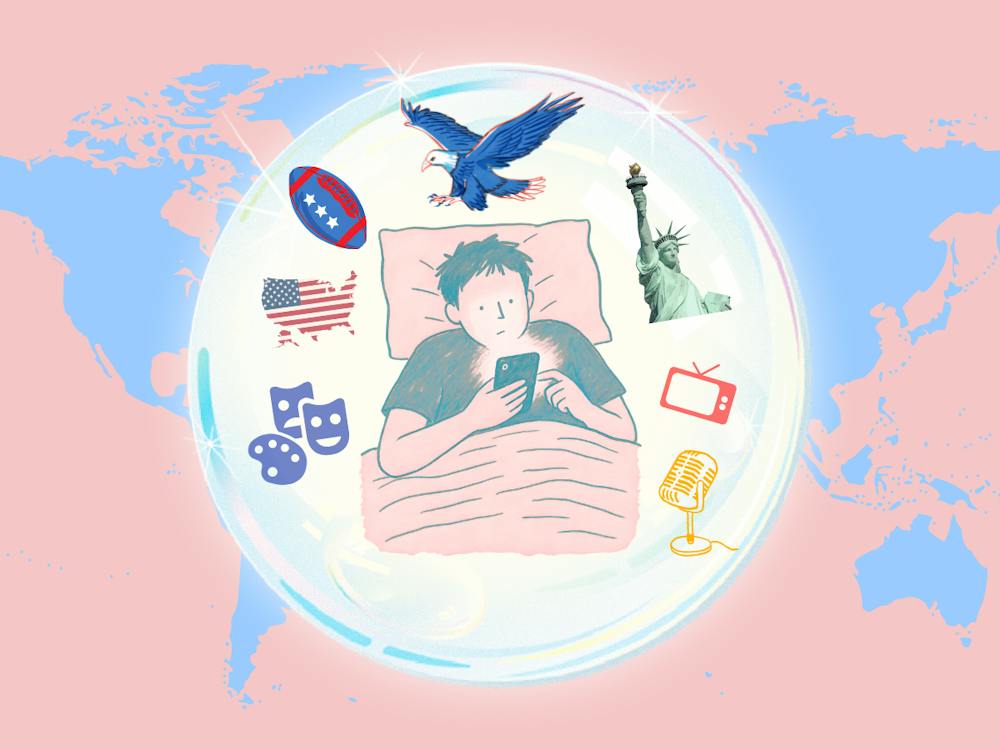
Geography isn’t the only thing keeping us in this bubble. American films, television, music and online spaces have an enormous international presence, exposing audiences abroad to American culture. But that familiarity doesn’t seem to be reciprocated. Americans may recognize domestic celebrities and influencers more readily than international ones, not because foreign cultures are inaccessible, but because our entertainment environment rarely requires us to seek them out. What we consume shapes which countries and experiences feel familiar and which remain overlooked. That imbalance matters even more when it comes to the news we consume.
The way Americans encounter current events has changed considerably, especially among younger audiences. A 2024 Pew Research Center study found about four in 10 Americans ages 18 to 29 regularly consume news from social media influencers. Pew's 2025 findings showed nearly seven in 10 Americans receiving news from these influencers are more likely to come across it by chance than seek it out.
Social media has increased access to international reporting. Someone in Gainesville can watch protests happening an ocean away, read about an election in Brazil or hear directly from people experiencing a humanitarian crisis. These opportunities are valuable, particularly when they allow people to share perspectives that might receive limited attention from established news organizations.
But accessibility doesn't guarantee visibility. Social media algorithms personalize feeds based on users’ previous interactions. If our online activity revolves around American entertainment, domestic politics and local events, international news may only spend seconds on our feeds. Algorithms can introduce us to unfamiliar perspectives, but they aren't designed to give us a balanced understanding of the world. Their recommendations are shaped by what we're likely to engage with, regardless of global relevance.
These platforms aren’t designed to keep us informed; they’re designed to keep us scrolling. A short clip of a protest might show a snapshot without explaining its political context. A viral statement from a foreign leader might attract attention without providing the historical background necessary to interpret it. Even accurate information can produce an incomplete understanding when it’s separated from the surrounding circumstances.
Social media can broaden our perspectives, but there’s a difference between seeing an event and understanding the context behind it. Our responsibility is to recognize the gap created by these digitally curated fragments.
Our information environment isn’t a neutral reflection of the world. Geography influences the places we encounter; cultural dominance shapes what feels familiar; and digital platforms affect which events grab our attention. Recognizing these influences should encourage us to be more deliberate about what we read, watch and follow.
The world doesn't end at America's borders. Our curiosity shouldn’t either.
Contact Shirin Khizzar at Skhizzar@alligator.org. Follow her on X @Shirinkhizzar.

Shirin Khizzar is a sophmore studying Public Health. This is her first semster working on the Alligator staff. In her free time, she enjoys reading, listening to music, and watching movies.


