
Read other stories from the "These stories were not AI-generated" special edition here.
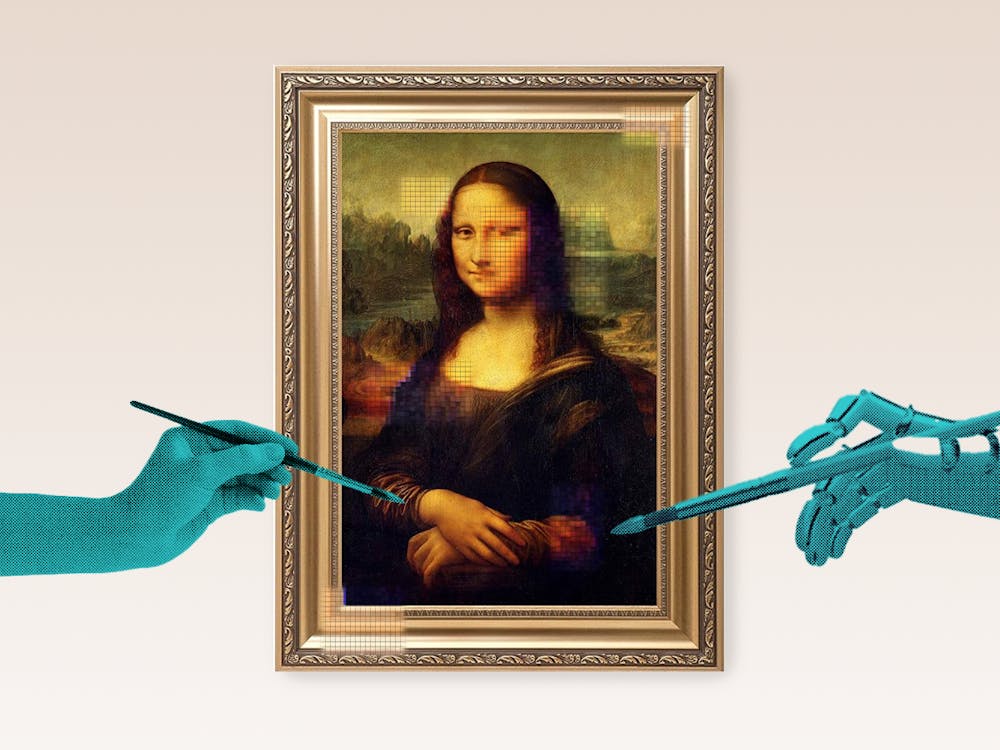
It’s a scenario playing out more and more frequently. Someone directs a chatbot to make artwork. The bot responds with a piece that draws from existing art online. Who now owns the resulting work: the prompter, the bot or the original artist?
That’s the question artists and lawyers are struggling to answer.
Under current U.S. intellectual property law, only humans and legal entities, not AI systems, can hold copyright. But the law didn’t anticipate machine‑generated creative work. Today, courts are sorting out how to treat AI outputs.
For now, the prompter is often considered the author, according to Nouvelle Gonzalo, a managing attorney at Gonzalo Law in Gainesville.
“But then the question arises,” Gonzalo said. “Who's the author when you're putting in the work of someone else?”
The possibilities, she said, are tangled: the user who wrote the prompt, the platform that produced the output or the original creator whose work was used as a springboard.
“Yes, there are gaps. No, there's not enough legal coverage,” Gonzalo said. “The law doesn't move as fast as AI development and technology, so it's just catching up.”
Jacquelyne Collett, a 73-year-old Gainesville artist, feels concerned her two-dimensional work could appear in AI output. She’s less concerned about her glass work, which she said requires crafting, moving, touching and designing of the actual piece.
Throughout her career, Collett has always felt concerned about people replicating her ideas. She now believes AI will intensify that concern on a “wider scale” for the next generation of artists. At her age, though, she doesn’t think she’ll have to participate in that new world of art and copyright complications, which she compared to the “wild west.”
“It's all hypothetical right now,” Collett said. “We're imagining what to be afraid about.”
Current copyright law protects any “fixed, tangible creative work,” such as writing, music, artwork, film and recordings. When AI produces one of those works, the ownership question emerges, because federal law doesn’t recognize a machine as an author.
Derek Bambauer, a UF law professor with expertise in intellectual property, said generative AI poses an intellectual property problem. But he has another, more urgent worry: “front-end copying," when machines create new material identical or similar to existing works.
The real risk comes from AI that mimics or replaces art without licensing, Bambauer said. In doing so, the technology may cut into the original artists’ revenue. Distinguishing human‑made elements from machine‑generated ones is often difficult, which worsens the issue, he said.
The Trump administration is adopting a limited approach to AI regulation. As a result, states are driving most of its governance. Florida appears eager to position itself among the early regulators.
States should focus on real gaps in existing law rather than hypothetical risks, Bambauer said, because predicting which problems will actually emerge is difficult.
“From my perspective, the worry, as always, when you start enacting technology specific regulation, is that it gets out of date very quickly,” Bambauer said. “I think that there's a virtue in waiting until we have a clear sense of the problem.”
Looking ahead, Bambauer said, copyright law must evolve as AI becomes a routine part of creative work, forcing clearer standards for what counts as human authorship.
For now, the safest path remains using material with clear authorization, either by purchasing a license or relying on works released under a Creative Commons license.
Stefano Gaudiano, a 59-year-old self-employed illustrator specialized in comic book animation, newspapers and video games, works from Seattle for the Gainesville-based nonprofit “Sequential Artists Workshop.” He views AI as a new way to inspire artists, he said.
Gaudiano believes every artist should strive to find their own “voice” and what makes their work unique. AI pushes artists to do just that, he said.
“I found AI to be incredibly stimulating,” Gaudiano said. “It has become not only wise but actually vital and necessary for a young artist — for any artist — to really dig deeper.”
His feedback wasn’t all positive, though. He pointed out artists are increasingly getting paid less for work they used to be able to live off of.
“There's a lot of jobs that don't require the human hand anymore,” Gaudiano said. “I think that is definitely a concern, and it is something that we absolutely want to pay attention to.”
The technology has already reduced his existing work opportunities, he said.
A United Nations 2026 report warns generative AI will drive significant income losses for artists by 2028 because of the recent shift towards digital production and consumption, which have created new opportunities but intensified economic uncertainty.
“A conversation needs to happen along the lines of like, ‘Hey, if AI can take away an existing job, what can we do to make sure that this person doesn’t become homeless?’” Gaudiano asked.
Kyle Novak, Santa Fe College’s cultural affairs director, said AI is already affecting creative work as visual models pull directly from existing intellectual property and recontextualize it into new images. He said it also raises questions about appropriation and how new tools are received.
Novak worries generative AI could undercut small businesses and make it harder for artists to earn a living. He hopes they can adapt and use the technology as a tool rather than be pushed out.
“I mean, it's definitely a concern,” Novak said. “Maybe this is an idealistic hope, but that they will figure out kind of how to use it as a tool, and it will become just another piece in the artist's toolkit to work with.”
Contact Sara Dhorasoo at sdhorasoo@alligator.org.

Sara is a journalism senior at UF. She is currently serving as The Alligator's race and equity reporter, and previously served as the first amendment reporter, in Spring 2026. Before transferring to UF, Sara earned her Associate of Arts in Mass Communications/Journalism from Miami Dade College, where she served as staff writer for The Reporter. She grew up in France and aspires to return there and work as a journalist after graduating.