

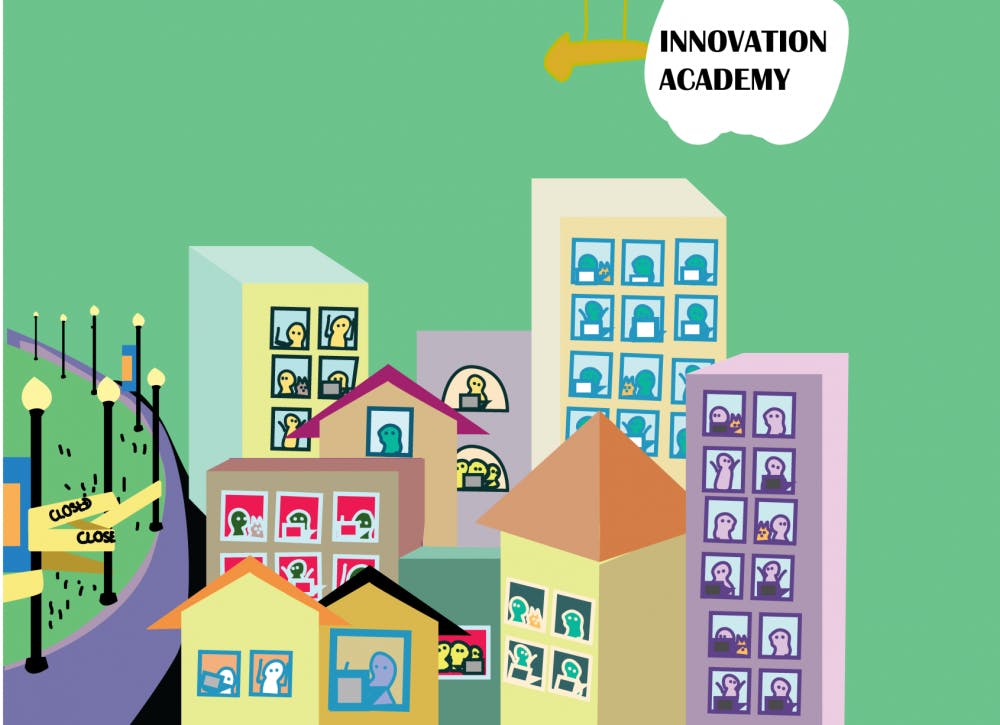
While most UF students leave for the summer, students in UF’s Innovation Academy are just getting started.
Summer is anything but a slow season for innovation students. It’s one of the program’s primary semesters, focused on hands-on projects, design challenges and collaborative coursework intended to prepare students for careers built around entrepreneurship and problem solving.
Through the IA’s unique Spring-Summer calendar, students earn an exclusive minor in innovation while taking courses focused on prototyping and leadership.
Classes begin in the Spring and continue through the Summer. First-year students don’t take on-campus courses in the Fall. Instead, students can study abroad with IA, pursue internships, travel or use the semester to prepare for the upcoming Spring term.
After their first year, students have the option to take online courses in the Fall.
According to Ken Swan, IA’s assistant director, the schedule often creates misconceptions among students outside the program who assume IA Summers are quieter or less intense than the Spring.
“What's happening in summer here is a full UF semester,” Swan said. “It's buzzing in exactly the same way that a full UF semester for Fall or Spring is for anybody who's not in the IA program.”
Swan described the innovation minor as very different from other minors UF offers. While minor courses are often supplementary to a student’s major, he said, the innovation minor is a primary focus for IA freshmen.
“If you're in this program, the very first thing you do for your first year is incredibly intensive and innovation focused,” Swan said.
This Summer, most of that activity is centered around Catalyst. The academy’s showcase challenges students to apply innovative solutions to problems posed by community partners, businesses and government agencies.
Amy Freeman, an IA academic adviser and faculty member, described the course leading up to Catalyst as an intensive introduction to problem solving and design thinking. This year, students are working with the Department of Veterans Affairs to ideate solutions for reducing falls among veterans in inpatient settings.
“Students will start brainstorming, prototyping, iterating on what solutions — once they find a good problem — can come about,” Freeman said. “And then at the end … Catalyst is an equivalent to Shark Tank.”
For many students, Catalyst becomes one of the defining moments of their freshman year.
Allison Tivvis, a 21-year-old computer science senior and IA office assistant, said the five-week course leading up to Catalyst pushes students to fully immerse themselves into a single project.
“You basically just make this problem like your baby, and you nurture it,” Tivvis said. “You do all the things, the marketing, the finances. You create it, and then you present it at Catalyst.”
Tivvis’ team worked on a project for Citibank Tampa during her freshman year. Her group designed a volunteer initiative where employees could earn rewards and recognition for community involvement.
At the end of the term, students present their projects at Catalyst, where judges and audience members vote on their favorite ideas. Top teams receive awards for their concepts and prototypes.
Students and faculty say IA’s close-knit community is one of the program’s defining characteristics. While the UF student body exceeds over 60,000 students, IA classes are capped at 25, creating a small college experience within a major research university.
“I've come to enjoy the Summers more than the Falls,” Tivvis said. “I make friends easier because I'm seeing the same people.”
Smaller Summer classes helped her build relationships with classmates, professors and campus staff in ways she didn’t expect when she first arrived on campus, she said.
“All IA students are very adaptable people, and if you suggest a better alternative, it doesn't mean they'll always take it, but they'll at least consider it,” she said.
Kieran Boodram, a 21-year-old business management senior, said IA experiences like Catalyst have allowed students to learn skills applicable to any major or field.
“I don't care what major you are, whether [you’re in] business, you're in the arts, you're in STEM — everyone needs people skills,” Boodram said. “I would say the biggest takeaway students can take are just those people skills.”
IA’s main goal, he said, is to help students reach their next step, regardless of what it looks like.
Contact Hailey Kon at hkon@alligator.org.

Hailey Kon is a senior public relations and psychology double major serving as this fall's city and county commission reporter. This is her second semester on staff at The Alligator, having previously worked as The Alligator's student government reporter and a contributing writer for The Gainesville Sun. When she's not on campus, she can be found in the Dutch Bros drive-thru or a Ticketmaster queue trying to buy concert tickets.