

Read other stories from the "These stories were not AI-generated" special edition here.
When it comes to smelling fish, there’s only so much artificial intelligence can do.
As the integration of AI becomes more prominent, local businesses are deciding how far they are willing to incorporate it into their systems. For some, AI serves as a tool for brainstorming ideas, managing inventory or scheduling shifts. For others, it’s an unnecessary tool that can’t replace human-driven operations — and one that experts say leaves customers skeptical.
Lee Dedrick, the 60-year-old co-owner of Northwest Seafood in the Millhopper area of north Gainesville, doesn’t find it necessary.
Because Northwest Seafood’s products rely heavily on freshness and quality, the company prioritizes hands-on inspection and trusted relationships with suppliers — something AI can’t replace, he said.
“We focus on inspecting the quality of seafood firsthand,” he said. “Taking a look at it, feeling it, smelling it, touching it, talk[ing] to the people who catch it, produce it, import it.”
While Dedrick said he knows friends and associates who use AI for marketing, Northwest Seafood’s service model remains centered around human operations. Even when it comes to tracking inventory, Dedrick said, visual inspection remains more practical.
“We’re a small business,” Dedrick said. “It takes less than 10 seconds to walk in and put your eyes on what’s stacked up in boxes with labels on them.”
But other businesses have found uses for AI. Small business use of AI increased 18% nationwide from 2024 to 2025, according to an annual report from the U.S. Chamber of Commerce. Over half of retail and restaurant owners reported using the technology.
Eros Puentes, the 38-year-old general manager of La Maracucha Restaurant & Creperie, said while AI helps with internal operations, it will not replace human interactions with customers.
The restaurant operated as a food truck from 2017 to 2023, when the business moved to a brick-and-mortar location on West University Avenue.
When it comes to marketing and promotions, he said, he doesn’t use AI to create posts. However, he used AI to help him visualize a redesign of the restaurant’s logo when he moved to the brick-and-mortar location.
Now, Puentes uses AI for internal operations, keeping track of inventory and making alterations to online menu items, but not for front-end services.
“Our customers do not interact with AI when they’re trying to get our services,” Puentes said.
In separating customer relations from AI, Puentes breaks from the norm among small business owners. Among owners who reported embracing the technology in the 2025 Chamber report, 87% agreed AI helped them communicate more with customers, with a similar percentage saying AI helped them find new customers and build stronger relationships.
La Maracucha uses Toast as its management software to optimize operations and sales. Puentes said he uses the point-of-sale system that Toast provides, which includes its own version of ChatGPT where restaurant owners can ask restaurant-related questions.
“It is great for restaurant questions,” he said. “If you want to solve something quick, I ask the question; it gets me the answer.”
The AI service allows the restaurant to more efficiently manage its menu for online orders, he said. It makes real-time adjustments to online menu items when an ingredient used in several dishes runs out. This saves the staff from manually updating each dish, he said.
“Otherwise, they [employees] have to go to each category and put ‘out of stock’ — that takes time,” Puentes said.
Puentes said he hopes to see an AI tool that would allow him to create a website entirely based on his artistic vision and preference. An AI chat assistant could be implemented alongside it to address simple customer questions.
However, he acknowledged many people prefer speaking with a real person rather than AI. If customers widely decide they don’t like the service, he said, he would remove the feature.
“They want to hear the real person,” he said. “If that makes a difference, then I’ll keep answering the phone.”
Despite its widespread adoption, Won-Ki Moon, a UF advertising assistant professor, said AI use remains a divisive subject.
Smaller businesses typically face backlash when using AI for promotion and marketing, he said, as AI often lacks the “heartwarming vibe” associated with mom-and-pop shops.
Some local businesses might turn to AI because they have a smaller set of resources and staff compared to larger companies, he said. However, patrons might view their use of AI as prioritizing profit over personal touch.
“Sometimes it [can] feel like they don’t want to talk to us in person,” he said. “Rather, they only care about their money and efficiency.”
Moon expects a greater increase of AI use as it becomes more integrated into daily life and operations, he said — but it’s crucial for businesses to be transparent about it.
“They can transparently say, ‘We used AI because it’s better than my hand drawing so you can see our food in a more accurate way,’” he said.
Moon’s research, which focuses on public trust in AI, found many consumers pay close attention to how businesses use the tool. He found there’s a positive reaction toward AI when it can help preexisting employees rather than replace them entirely.
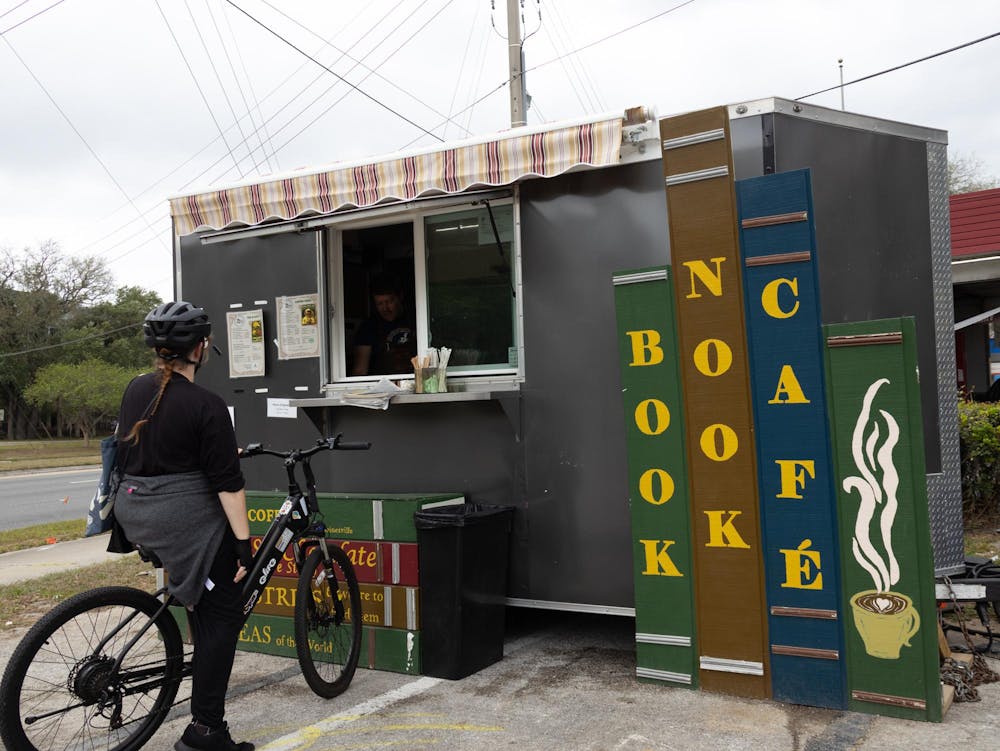
Breton Homewood, the 41-year-old co-owner of Book Nook Cafe, experienced customer pushback firsthand after he used AI to help him during early stages of developing his business.
“When I was originally writing my business plan, I generated ideas I had with [ChatGPT],” Homewood said. “‘How could I make this look like what I want it to look like?’”
As a beekeeper and lover of outer space, he wanted to combine his two interests into a concept of “space bees.” Homewood said using ChatGPT to generate ideas helped overcome the barrier between his creative vision and the challenge of explaining design concepts to someone else.
When introducing his idea to AI models, he said ChatGPT did a better job in creating what he wanted than other AI models. He said other AI models he tested out felt like “AI sloppiness.”
“ChatGPT just somehow knew at the time what I was thinking and did it for me,” he said. “That's exactly what I was after.”
Since receiving backlash from using AI-generated images on his menu through Google Maps reviews and comments from a Facebook post, Homewood said he’s trying to distance himself from it.
While he might continue using AI as a visualization tool, he said he’d reach out to local artists to collaborate with them for the actual product.
“I really love the locality,” Homewood said. “I think that’s where small businesses can start really being competitive and have an edge on people.”
Ultimately, he wants his business’s identity to remain rooted in originality and local collaborations.
“It’s got to be our own product at the end of the day,” he said. “That’s where I’m going from now on with the business.”
Contact Lily Hartzema at lhartzema@alligator.org. Follow her on X @lilyhartzema.
Lily Hartzema is a senior journalism student at UF with a minor in geography. This is her third consecutive semester at The Alligator. She previously served as a copy editor in Summer 2026 and is a returning metro reporter. In her past-time, she enjoys reading, exploring new trails and photographing anything that catches her eye.


