

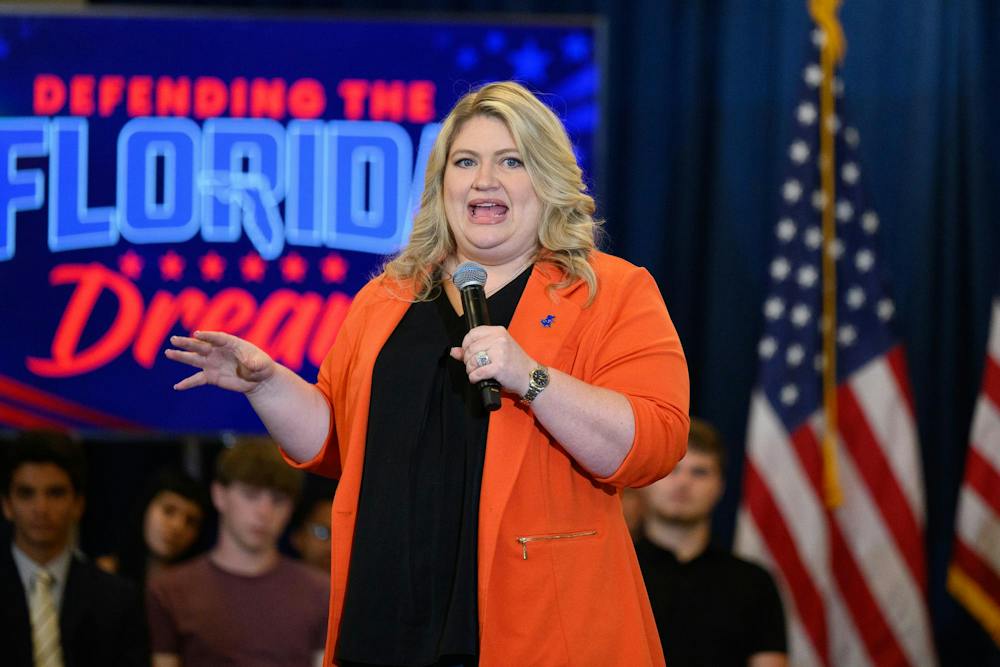
The U.S. House of Representatives’ District 3 covers 12 counties in north central Florida, including Alachua County. The seat, which has been held by Republican Rep. Kat Cammack since 2021, is up for reelection Nov. 3.
Cammack was born in Denver and holds a master’s degree in national defense and strategic studies from the U.S. Naval War College, according to her website. She serves on the U.S. House Energy and Commerce Committee and the House Agriculture Committee.
Her website names healthcare reform, supporting farmers, fighting inflation, artificial intelligence and biotechnology as campaign priorities.
She is running against Democratic candidate Seth Harp and independent candidate Mike Klein.
Harp was born in Auburn, Indiana, and is a seventh grade civics teacher at Lincoln Middle School in Gainesville. His career includes stints at radio stations and media organizations, and he was an adjunct professor at the UF College of Journalism and Communications, according to his website.
Klein was raised in Gainesville, and he began serving in the Army at 17 years old before working in international business, economic development, university innovation and entrepreneurship, according to his website.
Klein and Harp responded to The Alligator’s questionnaire by email. Cammack didn’t respond to The Alligator’s questionnaire, so relevant information was pulled from her campaign website.
The following responses have been edited for length and clarity.
Q. Affordability is consistently rated as a top concern among Florida voters. What specific policies do you plan to enact if you are elected to address this issue?
Mike Klein: “Affordability isn't a hoax, whatever some political leaders may say. It is real, it is painful and it is more than just a household problem; it is also becoming a barrier to American economic growth.
Too often we have a small number of enormous companies, protected by barriers to entry, favorable tax treatment, government contracts or regulatory systems they have become very good at influencing.
The answer isn't to replace markets with government. It is to make markets work again. That starts with enforcing the antitrust laws already on the books. I want the Justice Department and Federal Trade Commission challenging anticompetitive mergers and abuses of market power.
Meanwhile, the housing crisis is based on supply. I would use federal housing and infrastructure incentives to reward communities that actually increase supply and remove barriers to starter homes and workforce housing. I would also remove federal tax advantages that allow large institutional investors to compete unfairly with families for single-family homes.
Healthcare needs competition, too. I would require transparent and enforceable upfront pricing, expand site-neutral Medicare payments and make it harder for pharmaceutical companies to manipulate patents simply to delay generic and biosimilar competition.
Food insecurity is growing. I would enforce antitrust law in concentrated agricultural markets and invest in regional processing, storage and distribution so farmers have more buyers and consumers have shorter, more competitive supply chains. I intend to develop a Household Affordability Test for major federal economic legislation. Before voting, Congress should know what major legislation is likely to do to the cost of housing, food, healthcare and energy; whether it increases or reduces competition; and who ultimately bears the cost.
That includes tariffs. Sometimes America should willingly pay more to protect a strategically important domestic industry. But a tariff is still a tax. If Congress supports one, we should be honest about who pays it and what productive capacity America gets in return.
The same concentrated industries Congress is supposed to regulate are spending enormous amounts of money influencing the people doing the regulating. I support banning corporate PAC contributions to candidates and exposing the real sources of dark money in politics. ”
Seth Harp: “Families are working hard and still watching housing, health care, child care, insurance, utilities and groceries eat up more of their paychecks.
I want to attack those costs directly. My HOME Act focuses on making housing more affordable for working families, seniors and renters. My CUBS. Act would make child care affordable on a sliding scale for working families. I support Medicare for All because healthcare costs should not bankrupt a family or determine whether someone sees a doctor. I also support strengthening Social Security without cutting benefits or raising the retirement age.
Economic policy should be judged by a simple question: Are working people actually better off?”
Kat Cammack: Cammack didn’t respond to The Alligator’s questionnaire. However, she introduced the Next-Generation Equity Savings Tool Act, which intends to lighten tax burdens on first time homebuyers.
Q. How would you describe yourself as a political candidate?
Mike Klein: “I’m an independent and a pragmatist. I’m much more interested in whether a policy works than whether it came from the left or the right.
I'm independent because I want the freedom to reach the right conclusion, even when it isn't the conclusion either party wants. Being independent means I can judge each issue on its merits. Republicans will sometimes have the better idea. Democrats will sometimes have the better idea. Sometimes they’ll both be wrong. I don't owe either of them my vote. Every vote has to be earned.
So, what kind of political candidate am I? One that serves the interests of the people I hope to represent and no one else.”
Seth Harp: “I have always considered myself a Kennedy Democrat. I am a public school teacher, a union member, and someone who believes public service should actually mean serving the public.
I am not interested in blindly following a party or taking orders from corporate interests. I believe in strong public schools, affordable health care, protecting Social Security, workers' rights, responsible gun ownership, clean water, individual freedom, and a government accountable to the people it represents.
As a seventh grade civics teacher, I teach my students that our system only works when people participate and elected officials are held accountable. I am running because I believe Congress needs more people who understand what ordinary working families are actually experiencing.”
Kat Cammack: Cammack’s campaign website includes her congressional record and accomplishments, which states the following.
“In Congress, Kat has a record of holding the far-Left in Washington accountable. She’s adamant about securing the southern border, will always advocate for our small businesses, and has never wavered in her support for the Second Amendment. An ardent budget hawk, she believes taxes should be low and that we must keep government spending minimal and efficient. A civilian graduate of the United States Naval War College, Kat also understands our nation’s duty to stand up for our veterans and first responders.”
Q. What are your top three policy ideas?
Mike Klein: “My top three policy ideas all come back to the same question: Why does an economy this large and productive make life so difficult for so many people?
First, break the connection between money and political power.
We cannot fix much else while the people writing our laws depend on the industries affected by those laws to finance their campaigns. I support serious campaign finance reform, much stronger disclosure requirements and tougher restrictions on the revolving door between Congress, lobbying and the industries Congress regulates.
Second, make affordability an economic policy, not a campaign slogan.
Enforce antitrust laws. End stock buybacks. Challenge monopolies and price-fixing. Increase housing supply. Reduce unnecessary barriers facing small businesses. Invest in domestic production and infrastructure where shortages are driving up costs.
Third, rebuild American resilience.
I want a national resilience strategy that identifies what America can produce, protect and maintain for itself — including food, energy, water, critical medicines, technology and essential infrastructure — and then aligns federal investment around those priorities. This plan isn't isolationism; I believe we should trade with the world. This plan recognizes that the cheapest option today can become extraordinarily expensive when something goes wrong tomorrow.”
Seth Harp: “My first three major proposals are part of what I call my 13 Stripes of Strength.
First, my Social Security Stabilization Plan would raise the taxable income cap to $250,000 while protecting benefits and keeping the retirement age where it is.
Second, my UNITE Act would establish a single-payer Medicare for All system because I believe healthcare should be a right, not something dependent upon your employer or your bank account.
Third is my freshwater Florida plan - saving Florida’s freshwater with our LIFE Line, or Long-Term Investment For Environmental Excellence. Florida’s freshwater is one of our greatest natural and economic resources, and we must start planning decades ahead to protect it. My plan would invest in modernizing aging freshwater and wastewater systems; improve filtration; replace lead pipes; strengthen conservation; protect our springs, rivers, wetlands and aquifer; and expand statewide water quality monitoring. It would also require companies profiting from excessive withdrawals from Florida’s water supply to pay for protecting and restoring it. Clean water should never be something Floridians have to wonder about tomorrow.”
Kat Cammack: Cammack recently-introduced legislation has primarily targeted support for agricultural industries, healthcare coverage expansions and online supervision for minors.
Q. How will you balance economic growth and fiscal responsibility? What specific investments do you plan to make in your district?
Mike Klein: “Economic growth and fiscal responsibility are not opposing ideas. Done properly, one strengthens the other.
The question I would ask about federal spending is simple: Will this make America stronger 10, 20 or 50 years from now? Previous generations built highways, universities, research institutions, water systems and infrastructure that we are still using today. They understood that some things are expenses and some things are investments.
North central Florida has extraordinary assets. We have the University of Florida, world-class agricultural research, major healthcare institutions, skilled people, entrepreneurs, veterans, farmland, forests and one of the most important freshwater systems in the country. A serious, coordinated regional economic development strategy should draw from all of these major assets.
That is how I think about federal investment. Build things that last. Invest in people. Protect resources we cannot replace. Create the conditions for private businesses to grow. At the same time, have the courage to stop funding programs that don't work, subsidies we don't need and contracts that serve somebody's lobbyist better than they serve the American people. Fiscal responsibility is about making sure the next generation inherits more than the bill.”
Seth Harp: “Economic growth and fiscal responsibility are not opposites. Good investments can strengthen the economy while reducing long-term costs.
One of my biggest priorities would be implementing my Freshwater Florida Plan and bringing federal investment home to north central Florida for water and wastewater infrastructure; protection of our springs, rivers and aquifer; and modernization of aging systems. I would also fight for investments in roads and transportation infrastructure, public schools and our healthcare and mental health workforce. Those investments create jobs today while protecting the resources our communities and economy will depend upon for generations.
At the same time, Congress must stop treating every dollar of federal spending equally. We should identify waste, demand accountability from contractors, scrutinize programs that are not producing results and ensure major corporations and the wealthiest Americans pay their fair share. Fiscal responsibility means spending taxpayer money wisely, not simply cutting programs that working families depend upon.”
Kat Cammack: Cammack’s campaign website includes the following about her legislation targeting fiscal responsibility.
“Rep. Cammack most recently voted against increasing the debt ceiling after a new agreement was reached that nullified much of the Limit, Save, Grow Act of 2023 that Republicans passed through the House in May. Rep. Cammack sponsored the REINS Act, a bill that would require all “major rules” costing more than $100M to be approved by Congress. Rep. Cammack is a member of the Republican Study Committee, which passes a conservative budget every year. The Committee released its most recent budget in June 2023.”
Q. If elected, what would be your most immediate priority issue to address?
Mike Klein: “We must get money out of politics so the voices of the many outweigh the greed of the few.
A corrupt Congress cannot fulfill its duty as defined in the Constitution. Public trust in Congress is at 11%, a scathing verdict which has been well earned. As an independent congressman, beholden to only the voters of my district, I will immediately provide leadership, working with like-minded members from all parties to limit the influence of money and corrupt special interests on our nation.
Removing the corrupting influence of money on our political system will directly and positively impact every single other priority policy issue.”
Seth Harp: “People in this district do not need Washington to tell them the economy is working when their own bank accounts tell them otherwise.
I would immediately focus on the costs squeezing working families: housing, healthcare, child care, utilities, insurance and prescription drugs.
My first priority in Congress would be advancing legislation that lowers household costs and leaves working people with more of what they earn.
Washington spends a great deal of time talking about the economy in terms of numbers. I want to talk about it in terms of people: Can you afford your home? Can you see a doctor? Can you raise a family? Can you retire with dignity?”
Kat Cammack: Cammack’s campaign and government websites list border control and support for small businesses, veterans and first responders as priority issues.
All three candidates will appear on Alachua County ballots in the Nov. 3 election.
Contact Christian Haas at chaas@alligator.org. Follow him on X @ChristianH58745.
Christian is an environmental reporter with The Alligator, and studies journalism at the University of Florida. He is a fourth-year student who prefers to spend his free time trying new and random things, cooking, reading, watching TV, or hiking.