

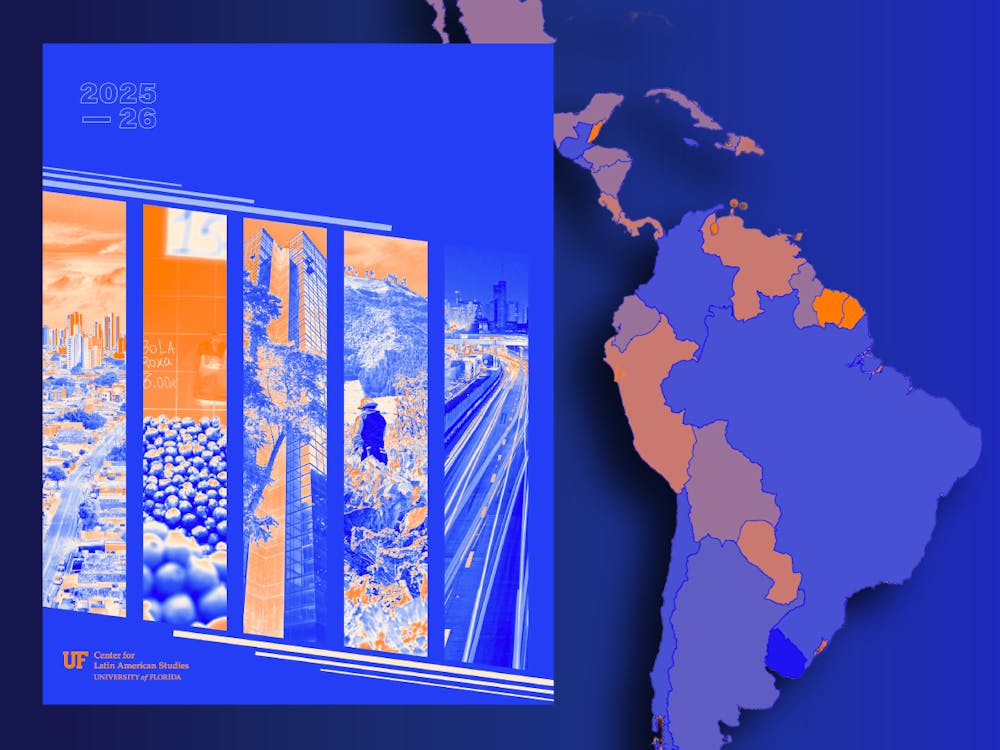
The UF Latin American Business Environment Report released its 24th edition on Nov. 1, 2025, after a hiatus following the COVID-19 pandemic.
As Latin America grapples with years of political upheaval and economic uncertainty, the return of the LABER offers a snapshot of how governments and markets are adapting in response.
UF faculty introduced the report in 2000 in response to the rapidly changing region. It’s since become a longstanding benchmark of business risks and opportunities.
Pilar Useche, the co-author of the 2025-26 report and an applied economist affiliated with the UF Food and Resource Economics Department and Center for Latin American Studies, called the report a "public good."
“It is offered without any charge and helps UF become more visible globally,” she said.
The LABER offers a more extensive analysis of Latin America than other reports, Useche said.
“Most documents and people who are looking at investment opportunities generally focus on the largest countries in Latin America,” Useche said. “We are covering every single country … so it provides a great comparative perspective.”
The LABER’s analysis covers 20 countries across Central and South America, from Mexico to Brazil to Panama.
The 2025-26 edition was produced by a team led by Useche, alongside researchers from UF’s law and business schools and a collaborator from Ecuador.
The report also draws on the research of 160 regional specialists.
This is the first edition released after the report’s discontinuation in 2022, which occurred due to a lack of resources brought about by the COVID-19 pandemic, according to Useche. It was brought back for its value and singularity, she said.
Useche said the findings of the report are not exclusive to the academic community; it can serve as a resource for the business sector, institutions across Latin America and universities in the U.S.
People falsely believe Latin America has no room for prosperity, Useche said.
In reality, the report demonstrates a decline in unemployment and poverty. It also shows growing startups called “unicorns” that are expected to become extremely profitable in the future. Colombia, for instance, received high marks for generating unicorn companies.
Given that the U.S. placed tariffs on Europe, European countries are now seeking partnerships elsewhere, which is another reason why the report is critical today, Useche added. China has also made efforts to expand into Latin America, fueling a push for economic competition in the region.
Of the 20 countries covered in the report, Mexico is the only one projected to experience an economic slowdown, largely because of uncertainty connected to U.S. trade, she said.
Using the report as a teaching tool also gives students the skills to analyze Latin America’s evolving business landscape. For example, the Latin American Business Environment class integrates the LABER into its curriculum.
“[The LABER] is pulling together the teaching, the research and the outreach components that are so central to Latin American studies,” Useche said.
The team regularly presents the LABER at the Coral Gables Chamber of Commerce and hosted its first 24th edition colloquium lecture on Feb. 13 at Grinter Hall with over a dozen members present.
Latin American policies in the past have set a precedent of stating “wonderful things, drafted for utopia, but then were never translated, or intermittently and ineffectively translated, into policy,” said co-author Timothy E. McLendon at the Feb. 13 lecture.
“Some decisions have very big implications for a lot of investment,” McLendon said. “Is there going to be a way to do it right? Because if not, then you have the lost fault, the false opportunity of costs.”
As a result, he added, investors have had to be strategic in structuring projects.
Luis Gomez-Mejia, a regents professor at Arizona State University, recently used the LABER for a presentation he will deliver in the Canary Islands on the challenges and business opportunities in Latin America.
He said many hesitate before investing in Latin America because of “institutional voids,” which occur when key systems like legal protections, financial infrastructure and regulatory oversight are weak and, therefore, unreliable.
Thus, Gomez-Mejia said, investors want evidence of stability. He pointed to the Dominican Republic as an example, noting that although it borders Haiti — one of the poorest countries in the world — it has maintained a strong economic performance over the last decades.
Having the data compacted in one place allows those investors who are seeking evidence to make strategic decisions, he said.
“The report that they put together is excellent,” he said. “It is the only one that I know that puts it all together in one.”
Contact Ariana Badra at abadra@alligator.org. Follow her on X @arianavbm.
Ariana is a first-year journalism major and an El Caimán reporter for the Fall of 2025. In her free time, she enjoys reading, spending time with friends and scouring for new songs to play on repeat to an absurd degree.