

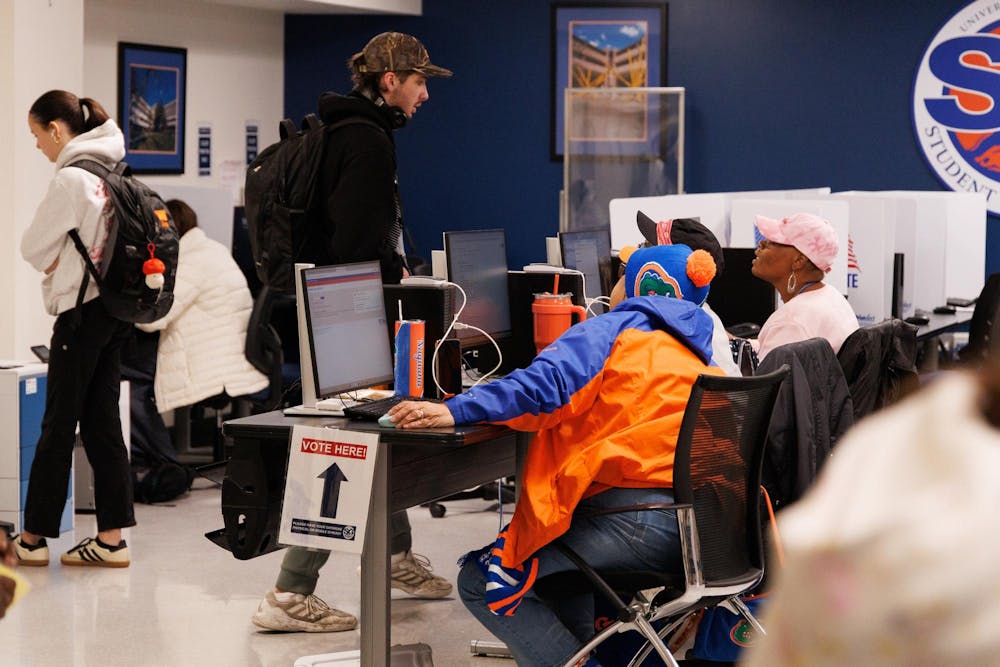
Tuesday marked the first day of voting for the Spring 2026 Student Government elections.
Students cast votes for UF’s student body president, vice president and treasurer, as well as senators representing 17 of the university’s colleges and schools. Freshman, sophomore and graduate senators are also running.
Ever since Change Party opted not to run candidates in the Fall 2025 elections, Vision Party has been the only major contender. Last semester, three independent candidates ran and lost against Vision. But this Spring, Vision is the only party on the ballot; no independent or third-party candidates are running, so the election is entirely uncontested.
At the polls, Alligator reporters spoke with many voters who expressed apathy or frustration with the lack of options on their ballots.
First-day turnout numbers remain unclear, as Supervisor of Elections Lexi Sederopoulos did not respond to requests for information after polls closed Tuesday.
Of those who turned up to vote, Greek life was an incentive for many. The Alligator spoke with 12 students who reported being incentivized or required to vote by their sororities.
Students can vote Tuesday and Wednesday during polling hours — 8:30 a.m. to 8:30 p.m. — at eight polling locations on campus. Students must check in with poll workers using a valid ID, log into the platform with their GatorLink and confirm they have the correct ballot.
The eight polling locations are located at:
- Reitz Union Print Lab, 655 Reitz Union Dr.
- Norman Hall Education Library, 1500 Norman Hall 618 SW 12th St.
- Health Science Center Library, Communicore Building, SW Archer Road
- Heavener Hall, 1325 W University Ave.
- Institute of Black Culture, 1510 W University Ave.
- Southwest Recreation Center, 3150 Hull Road
- Keys Complex, 44 Key Residential College
- Cypress Hall, 1310 Museum Road
Greek life affiliation
Matthew Bravo, a history and political science junior, is running for student body president. Bravo, who was diagnosed with Hodgkin’s Lymphoma last year, proposed a SG-sponsored semesterly bone marrow and stem cell drive as the first item on his presidential campaign platform.
Bravo is also a member of the Delta Chi fraternity, and several of his fraternity brothers said they headed to the polls Tuesday to support him.
Liam Blum, a 21-year-old education junior, said Bravo was his pledge brother in his fraternity, meaning they were initiated at the same time. He voted for Bravo because of his plans for the university, he said.
“Bravo has a lot of good ideas, and I think that we’re all just expecting huge change from voting,” Blum said.
Another Delta Chi member, 20-year-old chemical engineering sophomore Brady Guillen, also voted for Bravo, although he said he’s “not too involved” in SG personally.
“I kind of just voted for him because he was in my fraternity,” he said. “Doing a favor, basically.”
Greek life affiliation was a common theme among Tuesday’s voters, some of whom said their fraternities or sororities required or encouraged them to cast ballots.
Madison McInerney, an 18-year-old pre-pharmacy freshman, said she came so she could attend her sorority events and said that there is little point in voting when there is only one candidate.
However, she still finds the act of voting in elections necessary, she added.
“I’m not forced to vote, only if I want to go to events, but I don’t mind,” McInerney said. “I would have probably voted anyway.”
Others said their sororities encouraged them not just to vote, but to select particular candidates. Brooke Coonur, a 20-year-old natural resource conservation junior, cast her ballot early because her sorority has incentives for voting before noon.
“There’s low-key a lot of Vision candidates, especially from Greek life, that I think they kind of encourage us to vote for,” Coonur said.
Coonur wants to know more besides the portraits Vision candidates post on Instagram; she said she wants to know what they’re campaigning on. At the end of the day, she said, she “kind of just vote[s]” — despite not really knowing any of the people she’s voting for.
Emery Thompson, a 19-year-old business administration student, voted for Vision because she’s in Greek life and wants to support them. Her sorority gives her points for voting, and Thompson believes voting in student elections builds good habits.
“Nationally, you have a duty and a right to vote,” Thompson said. “Practicing that, even on a smaller scale, like on a campus, I think is really important.”
For Jordan Whittier, a 19-year-old UF accounting sophomore, voting was mandatory for her sorority, she said. She wants candidates to stay “true to their candidacy and what they say they’re going to do.”
Frustration with the single-party ballot echoed from voters throughout the day. Christeena Mathews, a 20-year-old finance junior, voted for Vision because there was no other choice, and the group seemed like “pretty stand-up people.”
“Why are we voting if there’s only one candidate? It’s kind of stupid,” she said.
Mathews said she also voted because of her sorority. She said Sigma Kappa, her sorority, doesn’t give her anything for voting, but in the past, members couldn’t attend certain parties or mixers if they didn’t do so.
Olivia Scarpo, a 23-year-old UF mechanical engineering fifth-year student and former member of the Kappa Kappa Gamma sorority, said SG is more important for people in Greek life than other sectors of students on campus.
Scarpo said that while she was in her sorority, voting was strongly encouraged, with people consistently checking in to remind others to vote.
“I don't care,” she said. “I’ve never cared, and people did care.”
Libraries remain contentious
Sydney Feldbush, a 22-year-old UF engineering senior and member of Pi Beta Phi, was required to vote as part of her sorority, too. But Feldbush also had two main issues she would like to see addressed.
“I would like to get some of our bus funding back,” she said. “I’d like to see more hour extensions in the libraries.”
Libraries have been a contentious issue for SG ever since Marston Science Library’s 24/7 hours were cut to five days a week in Fall 2024, then reduced again in Fall 2025. Now, the library has adopted a 24/5 model, with nighttime use available on weekdays.
SG touted the return to five-day, all-night hours as a success on social media. But some students are still unhappy, asking for a full 24/7 model.
Mia Napier, a 20-year-old UF health science sophomore who said she’s required to vote by her sorority, said she hopes Vision candidates follow through on their objectives.
“They make promises, but I want to see real, actual change being made, especially with the libraries,” she said.
Napier doesn’t like how only one party is running in this semester’s student elections, she added, because mandated voting “kind of deters the whole point of freedom of expression,” she said.
She wasn’t the only person dismayed by the one-party system. Giovanni Forcella, a 20-year-old UF accounting sophomore, also said he wished the Vision Party wasn’t the only option.
“It’s a shame that they’re the only party,” he said.
Frustration with single party
Shelby Parker, a 19-year-old dance and applied physiology and kinesiology sophomore, said Vision party being the only major party is a concern.
“That’s not really how democracy and a democratic system is supposed to work, even if it’s on a smaller scale,” Parker said. “That’s not really how it’s meant to be structured and stuff, and so it doesn’t fully represent the needs of every group of people on campus.”
She added Vision being the only party puts the independent candidates at a disadvantage.
In the Fall, three independent senators ran for Yulee Area, Hume Area and off-campus positions, but they all lost to Vision candidates. Vision swept the election, winning all 49 of the contested seats to maintain its dominant majority in the Student Senate.
Alyssa Cowens, a 22-year-old dietetics senior, votes every year in the elections, because she wants her voice to be heard. But this year, she was surprised to see only one candidate for each voting option.
“I'd love to see more people want to get involved,” she said. “It would be interesting. I mean, I won't be here to see it. I'm sure it makes it a little bit more exciting, and opportunities for different things to happen on campus when you have options for who you’re picking.”
Kayla Arora, a 15-year-old educational sciences freshman, is boycotting the election this year because there’s only one party.
“There’s only one party, and it’s Vision Party, and they haven’t done a great job of representing students,” Arora said. “I’m not voting because there’s only one choice, and they’re not the choice I’d like.”
Arora was among those who ran independently last semester for an off-campus seat. She later credited her loss to the redistricting of off-campus areas into one at-large district in Fall 2024.
Ava Orlando, a 22-year-old biology senior, thinks it’s strange that only one party is running, but she said it’s still important to vote, because SG manages a multi-million dollar budget.
“I just want them to do the right thing with it,” Orlando said. “With the money, make sure it goes to somewhere that students actually need, rather than silly things.”
Others were more direct. Nicholas Ginelli, an exploratory engineering sophomore, said he voted for the Vision Party because there were no alternatives.
“I voted for the Vision Party, because it was the only one,” he said.
College senators
In addition to voting on the executive ticket, students also cast ballots for the senator who will represent their college or area. The number of senators for each college or area varies depending on enrollment. For example, the College of Liberal Arts and Sciences has the most spots available at eight, while smaller colleges like nursing and pharmacy have just one each.
German Rodriguez, an 18-year-old UF philosophy freshman, voted for his friend Wyatt Clarke, a Liberal Arts and Science candidate. He hopes Clarke can expand its programs, Rodriguez said.
“I know every other school is doing different things, such as technology, AI, healthcare,” Rodriguez said.
Vision Party’s platform for Liberal Arts and Sciences includes expanding waitlists for economics classes to increase student access; placing restrictions on bulletin board access “to ensure all student organizations can utilize the resource;” and creating an alumni spotlight and connection program, according to a social media post.
Jax Yellin, a 20-year-old political science sophomore, also voted for Clarke as liberal arts and sciences candidate. Like Rodriguez, Yellin said he’s friends with Clarke.
Clarke is involved in the Gator Student Investment Fund, Yellin said, and he knows he has the needed bureaucratic experience to succeed.
“To me, it's more about qualification, because I trust the party and what their initiatives are,” he said. “So to me, I'm looking for the guy who's going to be the most qualified, and I think he is.”
Results of the election will be announced after polls close Wednesday at 8:30 p.m.
Isabel Kraby, Alexa Ryan, Vanessa Norris, Julianna Bendeck, Cameron Countryman, Jeffrey Serber, Ariana Badra and Lily Hartzema contributed to this report.


