
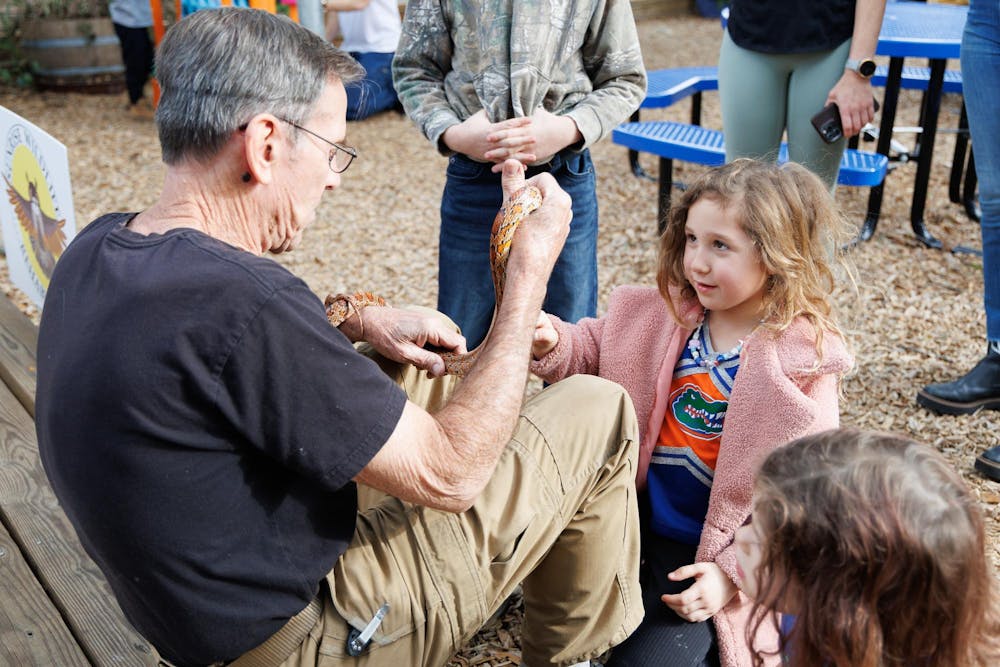
More than 50 people gathered outside First Magnitude Brewing Company the afternoon of Jan. 17 to commemorate the 25th anniversary of the Florida Master Naturalist Program.
Marty Main, a professor in UF’s wildlife ecology and conservation department, joined the school as an assistant professor in 1996.
After struggling with lab-based research, Main began looking for a way to share his knowledge of Florida wildlife beyond academia.
One day, he met with about 100 educators and biologists and outlined an idea to link Florida’s diverse ecosystems, from the Everglades to the beaches. From there, he created the renowned Florida Master Naturalist Program.
“There were a bunch of different ideas of how we should do it,” Main said. “We had to be somewhere in the middle between hugging trees and all scientific terminology.”
The FMNP educates and trains participants to understand Florida’s ecosystems and share that knowledge with others through lectures and field trips. The program emphasizes conservation, sustainability and public education.
“Part of what we do is train them how to talk to other people about nature, so they can talk to their children,” Main said. “They become volunteers, or they get jobs. They become better ecotourism guides and park rangers.”
What began as a single course has grown into 11, with more than 30,000 graduate certificates awarded. To become certified Florida Master Naturalists, participants must complete three core courses: coastal, freshwater and upland systems.
This certification provides credentials participants can use when applying for environmental jobs or pursuing conservation careers. The program now works with about 170 partners across Florida to deliver its content.
Over the years, the program has allowed retirees to find new passions.
One example, Main said, was Barbara Howard, a former president of Friends of the Tampa Bay National Refuges, who took the course once she retired. She completed it and became deeply involved in conservation efforts. Main later nominated her for The Wildlife Society’s Citizen Conservation Award.
In some cases, graduates have played direct roles in protecting land and wildlife.
“There was a group that saved an area that was going to be turned into condominiums,” Main said.
He could retire as early as this upcoming fall, but budget constraints may delay hiring a replacement. If he finds someone to take over the program, he would move to a non-tenure or state specialized agent position.
Saqib Mukhtar, a UF professor and associate dean for Extension, agriculture and natural resources, shared an office suite with Main when he joined the university 12 years ago. Mukhtar conducts needs assessments to determine priorities, and he credits the FMNP with helping the process go smoothly.
“How do we preserve and conserve natural resources? To conserve and preserve all the natural resources, you need to know what they are. And how do you do that, and who do you work with?” Mukhtar said. “That's what I believe Dr. Main’s program does.”
He emphasized the importance of young people learning about the natural environment as Florida’s landscapes and ecosystems continue to change.
“It’s almost like you started your own little group of people who are now completely immersed in understanding of our natural resources,” Mukhtar said.
Megan Abram, a 26-year-old aspiring Florida Master Naturalist and administrative coordinator at Alachua Conservation Trust, did not let her young age stop her from joining the program.
The classes enabled her to collaborate with people across the state who all have the same passion to protect the wildlife.
“When we are all able to learn the same things and put the same message out, we have a stronger front,” Abram said.
Contact Colby Kistner at ckistner@alligator.org. Follow him on X @colbykistner22.

Colby is a junior sports journalism student in his first semester with the Alligator covering golf. He has experience covering Buchholz and Santa Fe High School sports. He also worked in UF's innovation center where he wrote and created radio content for WRUF. He is an avid hockey fan with his teams being the Seattle Kraken and Florida Panthers. He is looking to minor in business administration.