

When Kevin Kendrick’s nephew didn’t get accepted to UF, he decided to attend Santa Fe College instead, with the goal of eventually transferring. What his family didn’t do, Kendrick said, was “b---- and complain.”
But parent complaints are exactly what Kendrick thinks are driving an ongoing legislative push to increase the share of seats at Florida public universities reserved for in-state students.
A bill, which passed its final Florida House committee Feb. 26, would require at least 95% of new full-time, first-time college students enrolled at each of Florida’s four preeminent state research schools — including UF — to be Florida residents starting in 2030, based on an average across three years. The bill’s next step is a full floor vote in the House.
A similar but not identical Senate version of the bill, filed by Sen. Erin Grall, R-Vero Beach, has yet to be heard in any committees. Identical versions must pass both the House and Senate in order to proceed to the governor.
Kendrick, who has two kids attending UF as in-state students, said universities should maintain flexibility. He doesn’t think in-state students are being rejected because of out-of-state applicants. Instead, he said, admissions decisions reflect competitiveness and limited space.
“The University of Florida should have the ability to attract the best students from across the country and from across the world,” he said, “and not have limitations on how many students actually come from inside the state of Florida.”
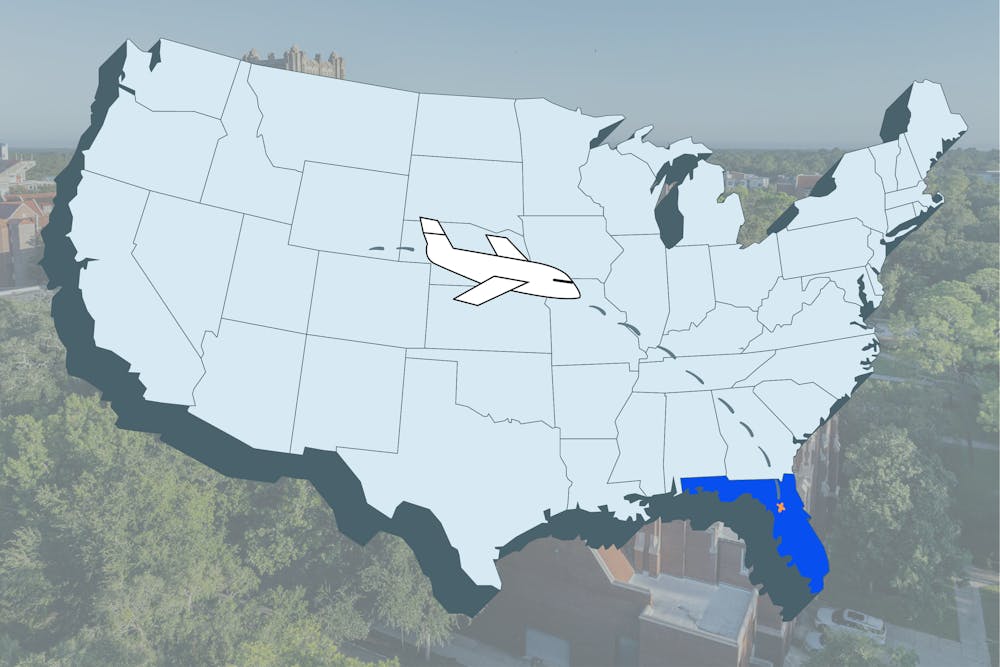
UF, Florida State University, the University of South Florida and Florida International University would all be affected by the change due to their “preeminent” status. The University of Central Florida also recently met the academic benchmarks for the designation and will join the group if the Florida Board of Governors grants final approval in June.
Currently, state law caps nonresident enrollment at 10% across Florida’s 12 public universities, not at each individual campus. Because the cap is calculated statewide, individual universities may enroll more or fewer than 10% nonresident undergraduates, as long as the systemwide total remains under the limit.
Over one in five UF and FSU students come from outside Florida as of Fall 2024, for example, while other public universities enroll fewer out-of-state students to balance the umbrella limit.
Under this bill, if a preeminent university fails to meet the 95% requirement, it would lose eligibility for certain state funding, which totaled $25 million per school for the 2024-25 fiscal year.
The bill’s introduction ignited heated debate on social media among UF parents and students. The debate intensified after early action decisions were released — reserved for in-state applicants — with many opening rejection letters instead of acceptances.
Rep. Jennifer Kincart Jonsson, R-Lakeland, sponsored the legislation. Her goal in doing so, she said, was to open up as many seats for in-state students as possible.
“This is something that I think has been needing to be addressed for a long time, but I'm the legislator here that's willing to address it,” she said.
In Kincart Jonsson’s opinion, many of the “best and the brightest” Florida students who are being rejected from the state’s top universities are just as qualified as the nonresident students being accepted, she said.
The UF records department said it didn’t collect data on acceptance rates or admissions statistics of out-of-state applicants versus in-state applicants for the Class of 2029.
However, over 43% of the entire Fall 2024 freshmen class, including PACE and online students, were out-of-state students, according to enrollment data.
The percentage of out-of-state students enrolled has increased steadily for each freshmen class at UF over the past 10 years, with around 14% of freshmen in Fall 2014 hailing from outside of Florida.
What’s the cost?
The move follows ongoing debates over in- and out-of-state tuition rates. All four preeminent universities raised their out-of-state tuition rates by 10% beginning in Fall 2025, marking the first increase in over a decade.
Florida has long prided itself on affordable education. Its in-state tuition was the lowest among all U.S. states and Washington as of 2022-23, according to the National Center for Education Statistics. Its out-of-state tuition was the fifth-lowest.
The gap between in- and out-of-state tuition in Florida is also relatively small compared to other states. Average tuition and fees for 2022-23 were about $13,300 higher for out-of-state students than Floridians. That’s smaller than the national average difference of $18,550 between residents and nonresidents for each state.
In January, USF approved an additional 15% increase in out-of-state tuition fees to be implemented starting in Fall 2026, pending approval by the Florida Board of Governors.
Some legislators opposing the bill argued it would cause universities to lose money from people paying out-of-state tuition rates.
Although lower than the national average, out-of-state tuition per credit hour at UF remains over four times the price of in-state tuition. The average out-of-state student at UF pays over $120,000 in tuition for a four-year degree, while the average in-state student, without the Bright Futures scholarship, pays around $25,000.
During discussion of the bill in the Careers and Workforce Subcommittee Jan. 26, Rep. Allison Tant, D-Tallahassee, asked how schools would deal with the loss of out-of-state tuition to their budgets, saying that money sometimes makes up for the relatively low in-state tuition rates.
In response, Kincart Johnson suggested “taking care of our Florida students first and making it work.”
Two other legislators asked why residency is being used to determine preeminence status during the Jan. 28 meeting.
“If the goal is excellence, then why is residency, rather than achievement or research output, the trigger for preeminent eligibility?” said Rep. Leonard Spencer, D-Gotha.
Parent perspectives
Jodi Furman, a college admissions counselor and a UF parent, said she’s glad to see that legislators are making sure Florida students are getting a “fair shake” in the admissions process.
However, she said she doesn’t necessarily agree with the “perception that out-of-state students are ‘stealing spots,’” as long as the state continues to keep an eye on enrollment to make sure universities aren’t overwhelmed by students coming from outside Florida.
“I do think that something needed to be done to identify, to ensure, that we are continuing to be the University of Florida and not the university of everywhere else,” she said.
Clara Maria Sowers, a Florida resident with one student at UF and two more hoping to attend in the future, called the bill “entitlement at its finest.”
“I believe this is because there are some, probably Gator grads, that are very upset that their child didn’t get in,” she said. “It’s not an issue of improving education, higher education, for Florida students. It’s not going to help anybody.”
The bill has not yet been scheduled for a full House floor vote at the time of publication.
Contact Alexa Ryan at aryan@alligator.org. Follow her on X @AlexaRyan_.

Alexa is a second-year journalism and international studies student and The Alligator's Spring 2026 Enterprise Politics Reporter. She previously served as the Fall 2025 Criminal Justice Reporter. In her free time, she enjoys running, traveling and going on random side quests.