

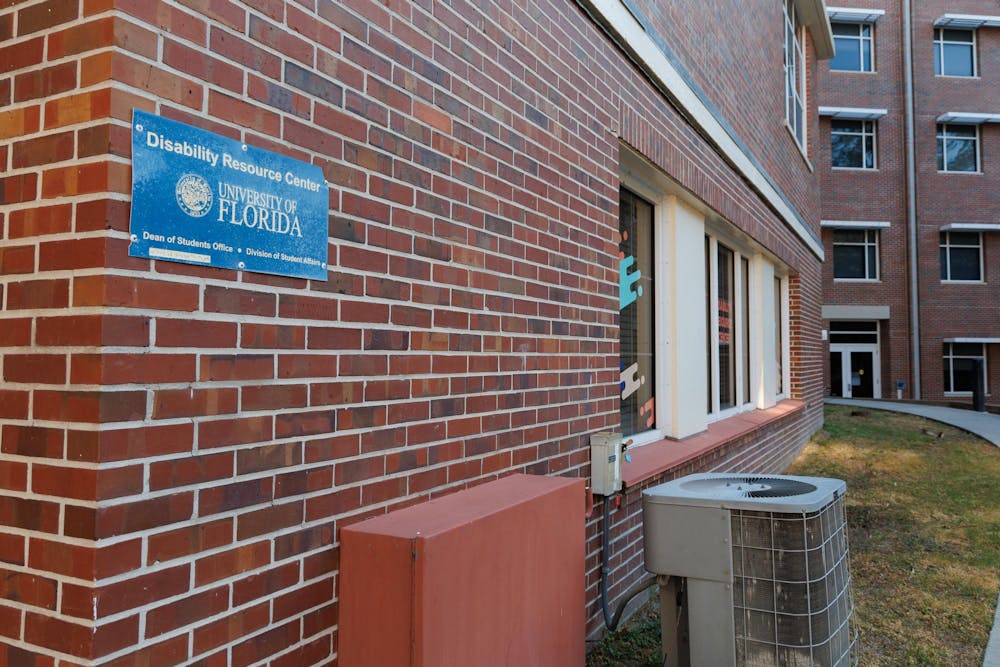
As an April 24 federal deadline approaches, UF faculty are overhauling hundreds of lectures, slides and documents to comply with updated disability access rules — leaving some overwhelmed and questioning whether they have the time or tools to get it done.
At UF, students rarely go a day without logging into Canvas or accessing online materials. As more coursework and communication move online, digital access has become inseparable from academic participation.
In April 2024, the Department of Justice updated the Americans with Disabilities Act's Title II regulations, which prohibit government entities from discriminating on the basis of disability, requiring all public universities to ensure digital spaces are accessible. The DOJ gave universities a two-year window to comply with the new regulations.
“It’s such a double-edged sword,” said Rose Briccetti, a UF assistant professor of art. “I love my job … and I love being able to make my content more accessible or open to a broader audience. I think a lot of us are feeling really overwhelmed, and it’s across all fields.”
Briccetti said while she believes these rules are a step in the right direction for accessibility, they have “doubled her course prep time” and are changing the way she teaches. The learning curve is particularly steep in the College of the Arts, where many classes focus on visual communication, not the written word, she said.
According to a document published by the DOJ, public entities are increasingly providing services through websites and apps. However, many of these services are not designed accessibly, making them unavailable to individuals with disabilities. For example, people who are blind may use a screen reader to deliver visual information. If an image doesn’t include alternative text, those people may have no way of knowing what’s depicted.
Starting April 24, all UF online materials, websites and mobile applications must meet Web Content Accessibility Guidelines. According to a UF College of Health and Human Performance webpage, faculty and staff are required to go back and update any course materials that do not already meet these guidelines, including Microsoft Office files, website content, social media and videos.
Kristin Malloy, the Title II coordinator responsible for ADA compliance at UF, said in an email her office was busy supporting all UF employee accommodation requests and could not provide a statement.
With this deadline quickly approaching, faculty have found themselves combing through hundreds of documents and presentations, rebuilding entire courses slide by slide.
For every presentation, each slide now needs to use default slide layouts and have a unique title. All charts, images and graphics must have alternative text providing an in-depth description of the image, and all videos must have captions.
For some courses, this may not look like much — deleting a few photos, changing the font size and reworking the design in a few places. But for some professors, particularly those in visual fields like art and mathematics, these new requirements have them altering hundreds of slides.
Professors in other departments are also experiencing issues with new compliance guidelines.
Carol Demas, a senior lecturer in the UF College of Liberal Arts and Sciences math department, said she spent 20 to 30 hours modifying just one file. Because of the complex equations they use, math professors can’t work with Microsoft Word; instead, they use a platform called LaTeX, a high-quality document preparation system standard for math and science in academia.
“I want to do what they tell me to do, but they’re not giving me any tools,” Demas said. “Help is not available. We basically have to figure these things out ourselves.”
As a coordinator for the Elementary Differential Equations class, Demas is responsible for updating course materials dating back as far as 15 years ago. The process requires her to tag every equation across dozens of documents while responding to student concerns about reduced access to past exams and solutions.
She said many professors feel the additional accessibility requirements take time away from research and mentoring graduate students. Some professors have chosen to remove materials from Canvas altogether, she said, rather than update them for compliance.
But for instructors that oversee large courses, like Demas, that isn’t a realistic option. She said providing supporting documents, practice exams and solutions are a part of her job, even if adapting those materials significantly increases her workload.
Despite the new requirements being announced two years ago, professors still feel unsure about how to implement them due to little guidance from the university, she said.
“We said we talked about it years ago, and that’s true,” Demas said. “But what’s also true is I don’t feel that we’ve been given the guidance or the tools to implement it correctly. And that may take several more years.”
Demas said she doesn’t personally see how the ends could justify the means — her workload has been doubled to adapt for something she’s never had a student need. But for other professors, the shift is barely noticeable.
Joseph Gullett, a UF assistant professor in the Department of Clinical and Health Psychology, hasn’t found the new guidelines bothersome at all and embraces this new phase of teaching.
Under the new guidelines, all videos and live lectures must include captions or live transcripts to ensure accessibility for students who are deaf, hard of hearing or have auditory processing differences. However, Gullett has found displaying a running transcript while he talks has helped all students, not just those who need accommodations.
He and his teaching assistant said for every lecture, they spend around 30 minutes adjusting for accessibility. They’ve found their college has been very helpful in providing consistent access to resources and technical help across the board.
“I don’t know, really, how many people are going to care that there’s alt text on an image and use screen readers,” Gullett said. “But if, as long as one person uses it when they need it, then that’s worth the effort.”
Julia Daniyar is a contributing writer for The Alligator.


