

Many people in Gainesville might know their Myers-Briggs types or even take pride in their identity — whether that’s INFP, ENFJ or one of the many famous four-letter combos. But they may not know the worldwide personality assessment has roots in their own city.
UF developed the first computerized scoring system for the instrument in 1973.
“This is one of those Gainesville stories that’s just been hiding in plain sight,” said Mark Enting, the 59-year-old president and CEO of the Myers & Briggs Foundation.
The MBTI consists of 93 or 144 questions, depending on the version, and sorts takers into one of 16 types based on how they view the world and make decisions. It uses divided scales: extraversion/introversion, sensing/intuition, thinking/feeling and judging/perceiving. It produces a four-letter type using the decision of each scale.
On Wednesday, the Matheson History Museum hosted “The Myers-Briggs Type Indicator: Gainesville Roots — Worldwide Influence” event. During the showcase, Enting acted as the speaker and dove into the nonprofit’s history and its ties to Gainesville.
He said through UF, a community of researchers built something that quietly became international.
Enting spoke at the lectern to over 40 guests in a room surrounded by Gainesville historical facts printed on the walls. The projector behind him presented photographs that documented the history as he told the story.
Katharine Cook Briggs and her daughter, Isabel Myers, created the Myers-Briggs Type Indicator in Michigan throughout the first half of the 20th century, though the actual name came later.
During World War II, Briggs had read psychoanalyst Carl Jung’s book “Psychological Types,” published in 1921. She was inspired and researched the conflict and differences in communication at that time. In 1943, the instrument Myers developed became a copyrighted form.
That’s when Gainesville entered the picture. UF clinical psychologist Mary McCaulley discovered the tool in the mid-1960s. She used it with her students and reached out to Myers. They met in 1969 and started a collaboration at the UF typology laboratory, soon creating the now-famous scoring system.
The UF typology laboratory left the university in 1975 and became a part of The Center for Applications of Psychological Type. The first Myers-Briggs Type Indicator conference was held that same year in Gainesville.
“It can be as simple as you want it to be, but it can also be something that if you really want to dive into it, it can become lifelong work,” Enting said of the indicator.
Judy Provost, an 84-year-old Gainesville retiree, attended that first conference. At the time, she was working in Valencia College’s Displaced Homemaker Program, which was a federal grant to help widowed or divorced women get into the workforce. She started applying the Myers-Briggs Type Indicator to her work to gather data.
At the conference, Provost met Myers and McCaulley — coming face-to-face with the creators of the tool she’d come to embrace. She went on to work at Rollins College in Winter Park, Florida, where she administered the assessment to all entering freshmen as a continuation of her personality research.
Provost attended the history talk and told the audience about her experience meeting Myers and McCaulley all those years ago.
“It was like a trip down memory lane,” Provost said of Wednesday’s event.
Others spoke up about their own experiences with the indicator during the event’s questions panel. Larry Condra, a 71-year-old retired Gainesville counselor, was among those participants. Growing up, he said, he was the odd one out in his family. His family members were organized, predictable and always on time. Condra went with the flow.
“I was kind of loosey-goosey, extroverted, and I always kind of felt like there was something wrong with me,” Condra said.
While he was in graduate school at Vanderbilt, he took the Myers-Briggs Type Indicator, and everything clicked into place. His type was ENFP, or extroverted, intuition, feeling and perceiving.
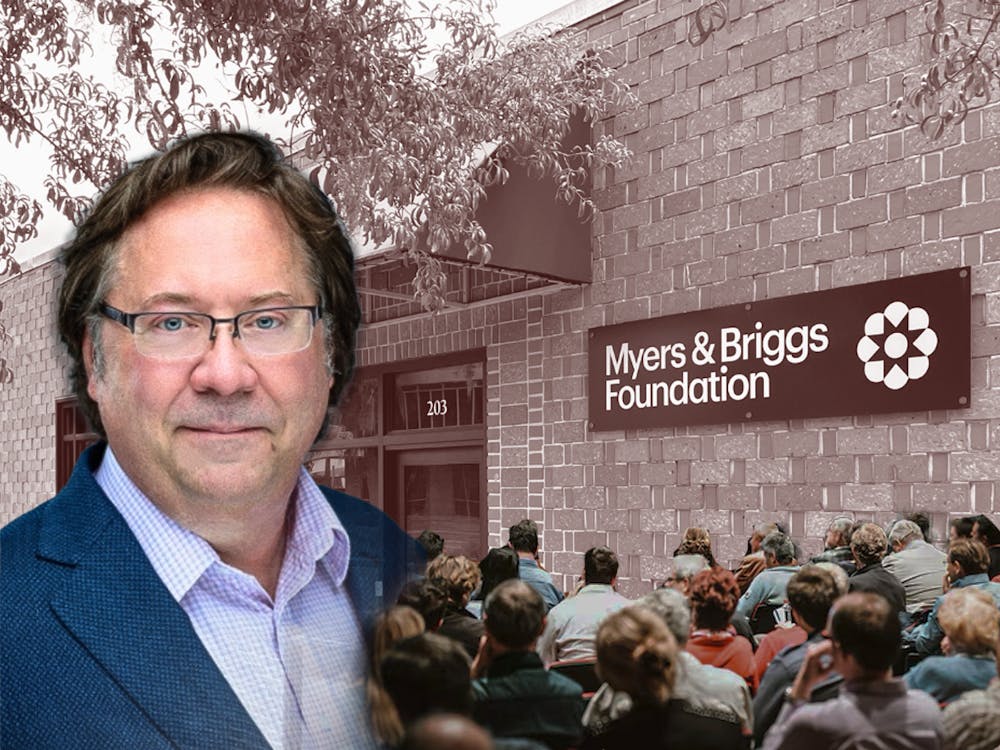
The Myers-Briggs legacy maintains its physical presence in the city. The CAPT stayed local to Gainesville, and in 2023, it merged with the Myers & Briggs Foundation. Today, its office is located in downtown Gainesville.
Wednesday’s event came about after Salvatore Cumella, the 46-year-old executive director of the Matheson History Museum, met Enting in November 2024 at a “Collaborating with Strangers” event hosted by the museum.
The speed-dating event offered participants the chance to get to know the other CEOs and leaders in the community. As they were talking, Cumella was blown away to discover that the foundation has roots in Gainesville. He asked Enting, “You realize no one knows that?” Cumella said this was the kind of history he wanted to tell in the museum.
“One of my goals as director was really to bring in new and interesting aspects of our local history,” Cumella said.
Contact Teia Williams at twilliams@alligator.org. Follow her on X @teia_williams.

Teia Williams is a journalism senior at UF and the Fall 2026 criminal justice reporter. This is her fourth semester with The Alligator. If she isn't writing an article, you can find her at a concert, reading a book or somewhere soaking up the sun.