
Theresa Sumrall works at the UF College of Medicine, where she does clinical data management and sits outside to enjoy the weather in her free time. She also finds a lot of dead birds.
“I'll hear an impact,” she said. “I'll see the body fall.”
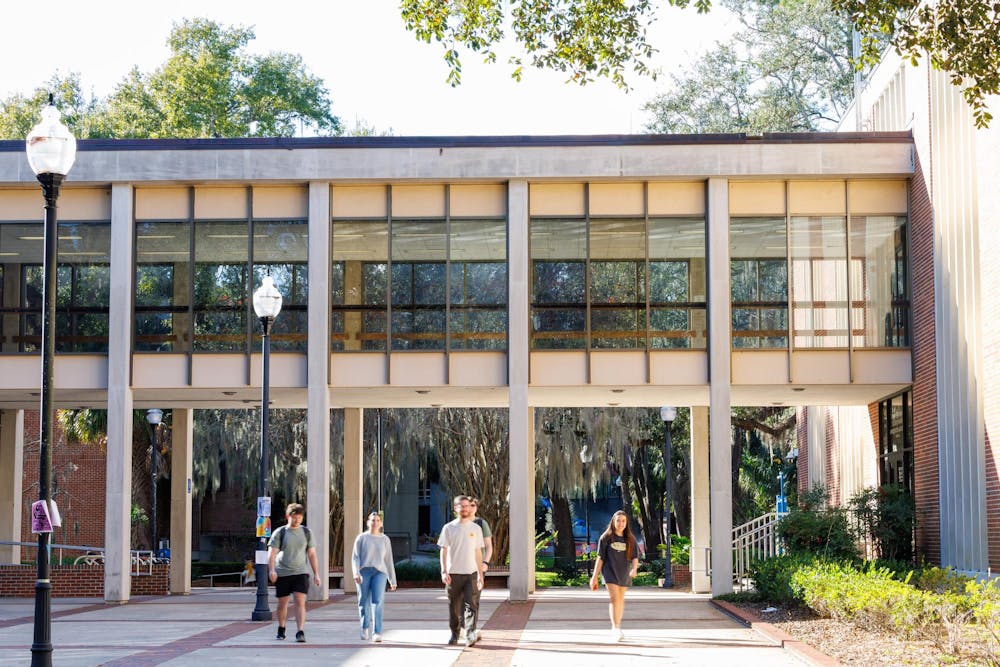
In spring and fall, which is the migration season for many bird species, there were weeks Sumrall would find over a dozen birds that had collided with the Health Professions, Nursing and Pharmacy building. The five-story structure has a window stretching across its facade, reflecting the Bartram-Carr Woods Conservation Area.
When Sumrall finds the bodies, she photographs them and uploads her pictures to iNaturalist, a citizen science platform where users can post wildlife photos for identification. Since 2021, she has recorded 90 observations on the platform of 44 unique species. Sumrall posts most of her observations to the UF Bird Window Collision Project’s page, which collects data on bird window strikes around campus.
The Bird Window Collision Project advocates for bird-friendly building techniques, especially when it comes to windows like that of the HPNP building, which is just one of many potentially harmful areas on campus. The Fine Arts buildings, connected by a glass walkway, also draw many reports of bird collisions on iNaturalist.
“It was humans who decided on that architectural design and signed off on it and built it,” Sumrall said. “Not the cats or the raccoons or the possums. They're just doing their best to live in a world that we've crafted, and every problem that animals face is a result of something we've done.”
Mark Hostetler was always aware of bird window strikes, but the Bird Window Collision Project came about after his students referred him to a hotspot at Jennings Hall. There, he found around 40 songbirds of the red-eyed vireo species, seemingly killed in one mass collision.
He and his students decided to start the iNaturalist project to gather data and discern which buildings were dangerous. From there, fueled by “a couple of pizzas and very little money,” they created a solution: a special type of wind curtain to be mounted on dangerous windows, which they dubbed the Acopian BirdSavers.
The BirdSavers are made from paracord, which is hung vertically above windows to create visible columns in the panes, in the hopes of breaking up the reflection for incoming birds.
These Acopian BirdSavers now guard the windows at Newins-Ziegler Hall. While this solution only costs $2 to $3 per window, making it cost-effective, it is often only a temporary solution. More permanent options, like tapes and decals that act as wallpapers and break up window reflections with patterns or designs, are often more expensive.
In 2021, UF started requiring all new buildings to implement a bird-friendly strategy in its design. For newer buildings, the policy recommends reducing the reflectiveness of windows by using fritted or etched glass, or films and decals that break up the reflections. Malachowsky Hall, which opened in 2023, was built with fritted glass, which uses dots to break up the reflection of the windows. While protecting birds, this glazing also reduces heat gain in the building, according to a written statement from the UF Office of Planning, Design and Construction.
“As with all aspects of construction, PDC continuously evaluates how to balance the unique needs of campus facilities in a cost-effective manner,” it said.
Elle Henson, a 21-year-old UF wildlife ecology and conservation junior who works with the Bird Window Collision Project, sees the policy for new buildings as a positive step.
“Building it into the building is way more sustainable than building and then having to go back and retrofit all the windows,” she said. “Which is kind of what we're having to do now with some of the older buildings.”
Retrofitting, or adjusting windows to be bird-friendly after the building has been constructed, is the challenge Henson faces when it comes to the Fine Arts building bridge. The bridge has 42 panels of windows, which means bird-proofing them will require covering 1,150 square feet. She estimates the project could cost at least $11,500.
But for Henson, the cost is worth it. The UF Bird Window Collision Project has 373 recorded observations of dead birds on campus on iNaturalist, with red-eyed vireos and cedar waxwings among the most commonly harmed species. In the Bartram-Carr Woods, across from the HPNP building, 114 unique bird species have been identified since 2016. Similarly, 104 have been observed in the McCarty Woods on campus since 2016.
“Birds are awesome, and they deserve the same respect we give to any other animal or human,” Henson said. “So I think we should take that into consideration when we build on campus.”
Contact Juliana DeFilippo at jdefillipo@alligator.org. Follow her on X @JulianaDeF58101.
Juliana is a second-year journalism student and the Spring 2026 Enterprise environment reporter. This is her fourth semester on The Alligator, and she previously served as an Avenue reporter and the Fall 2025 Avenue editor. In her free time, she loves reading, updating her Letterboxd account and doing crosswords.