

My generation, for lack of a better way to phrase it, sucks at reading.
Because many of Gen Z’s formative years — notably middle and high school — were spent online, we became all too familiar with SparkNotes, YouTube summaries and the academic devil itself: ChatGPT. As a member of the high school graduation class of 2025, I’m not surprised that reading comprehension scores are the lowest they’ve been since 1992.
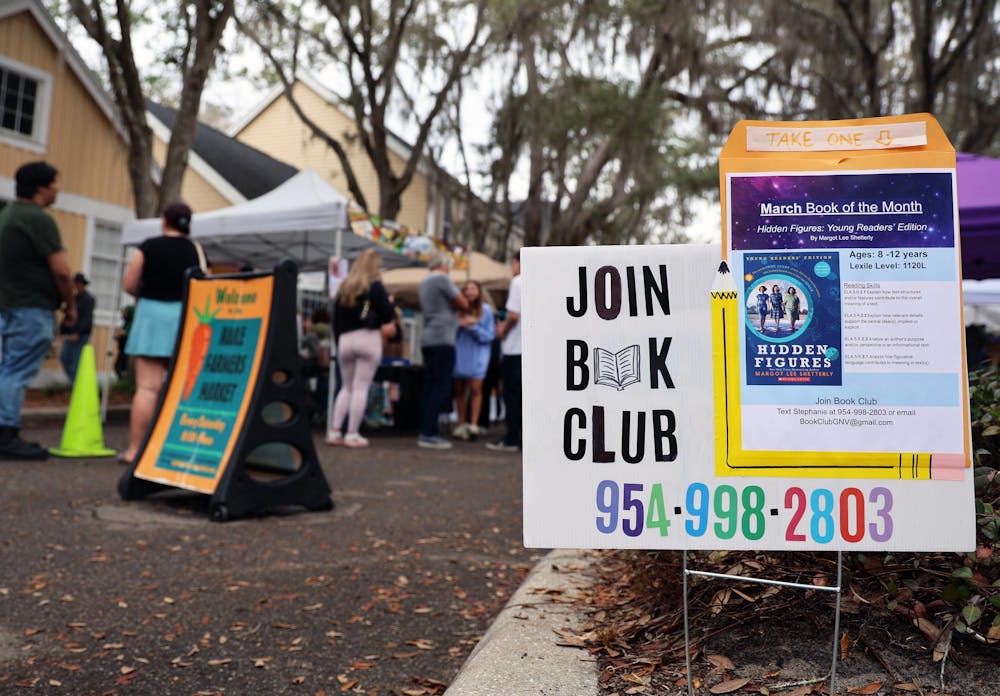
Yet the decrease in reading scores is paradoxically juxtaposed with a rise in book clubs both online and offline. I promise it’s not because we’re slowly becoming our parents, at least for now. The youngest members of a post-COVID society are finding new ways to fuse the returned normalcy of “the social gathering” with the lost art of sharing and reading literature.
The question has become whether the resurgence of book clubs can help us recover from the reading gap left by the pandemic, or if this generation needs to find other ways to uncook itself.
COVID-19 did not simply interrupt schooling; it altered how we read. Remote instruction rewarded efficiency over depth. Faced with shortened periods, screen fatigue and constant digital distractions, students adapted by reading strategically rather than attentively.
The objective became extracting key points quickly enough to complete an assignment, not sitting with ambiguity or tracing an argument across chapters. Search functions replaced margin notes. Summaries replaced sustained engagement. Over time, this trained a generation to prioritize speed and completion — useful habits in a crisis, but corrosive to critical reading.
That’s where book clubs enter the picture.
They reintroduce friction. You can’t bluff your way through a two-hour discussion with a summary. If someone says the protagonist is manipulative and you disagree, you need evidence. If a theme keeps resurfacing, someone will point it out — and if you missed it, you feel it. Not in a punitive way, but in a clarifying one. The social setting quietly raises the standard.
Book clubs also bring back something high school English used to do well before Zoom flattened it: live disagreement. In a classroom, a teacher might push you to defend a claim. In a book club, your peers do. “Where did you see that?” “I read that differently.” Those questions force you back into the text. They make interpretation active again.
At the same time, these groups strip away the grade. That matters. Without the pressure of assessment, reading becomes less about performing intelligence and more about forming it. People choose books they actually want to read. They show up because they are curious, not because attendance is mandatory. Pleasure and accountability coexist.
Research suggests book clubs and group reading don’t just get people to read again — they engage cognitive processes that traditional isolated reading often doesn’t. By discussing texts with others, readers are pushed to articulate interpretations, defend them with evidence and reconsider competing viewpoints, which are core components of critical thinking and deeper comprehension.
In formal studies of book club-style discussions, participation has been shown to sharpen critical thinking and interpretation skills, particularly by encouraging learners to express and exchange ideas in ways that deepen their analytic engagement with texts.
Additionally, reading and discussing books in groups increases time spent with full texts and boosts intrinsic motivation — two factors linked in literacy research to stronger reading comprehension and sustained engagement.
Shared interpretive reading has also been associated with richer cognitive engagement, including the ability to consider both the surface action and the underlying meaning of narratives. Educational researchers identify these skills as central to higher-order literacy.
Will this close the literacy gap reflected in national data? Probably not on its own.
Access is uneven. Book clubs tend to cluster in college towns, online communities and social circles that already value reading. They require time: time to read 250 pages after work, time to meet for two hours on a Sunday, time to think. Not everyone has that luxury. Students balancing multiple jobs, caregiving responsibilities or unstable housing are unlikely to treat a novel as a weekly commitment.
There is also the question of structure. Informal discussion, however thoughtful, cannot fully replace systematic instruction. Schools provide scaffolding: explicit teaching of literary devices, structured writing assignments, targeted feedback and exposure to a wide range of genres and historical contexts. A book club may sharpen interpretive habits, but it rarely teaches the foundations from scratch; it assumes a baseline level of fluency.
National literacy gaps are also not only about interpretation. They involve vocabulary development, decoding ability and long-term reading stamina — skills built cumulatively over years. Those deficits cannot be reversed solely through voluntary gatherings, however well-intentioned.
But culturally, something important is happening. A generation that learned to skim is voluntarily slowing down. A cohort trained to optimize is choosing to linger. In living rooms and cafes, young adults are reopening pages, revisiting passages and arguing — respectfully — about what a sentence means.
We may still “suck at reading” compared to where we should be. But, if the pandemic trained us to consume efficiently, book clubs are training us to engage deliberately. That may not fix everything. But it is, at the very least, a start.
Contact Sasha Morel at smorel@alligator.org. Follow him on X @BySashaMorel.
Sasha Morel is a sophomore at the University of Florida studying Politics, Philosophy, Economics, and Law, as well as Anthropology. His returning column focuses on policy analysis surrounding domestic, global, and local politics, with a focus on targeting root causes of common issues and highlighting unrepresented perspectives. Outside of the Alligator, Sasha is a nationally recognized debate coach for high schoolers across the US.


