

Spring break is one of those American traditions that feels familiar before you ever experience it. Films, TikToks and Instagram have already done the work. I thought I knew what it was: a week of sun and travel, all contributing to the sort of freedom nobody photographs.
But being here in person, what stands out is not the partying. It’s how much structure there is.
Spring break is not just a holiday. It’s a fixed institution of American student life, complete with its own aesthetic and expectations. Coming from Ireland, that’s what makes it fascinating, simply because we have nothing like it.
Irish students get breaks. We have reading weeks, summers, weekends away, post-exam trips and the occasional bank holiday, which is the U.S. equivalent to a federal or public holiday. But none of that carries the same weight.
In Ireland, time off is just time off. Here, spring break feels like an event with its own script. It’s planned around, talked about in advance and sold back to students as something larger than a week without classes.
Part of that is how completely imagined it already is before it even begins. There is already a whole visual language attached to it: beaches, airports, matching outfits, crowded bars, boat days and bad sunburns. Even people who do not take part seem to know exactly what spring break is supposed to look like. I noticed Fort Lauderdale locals would frequently call us "spring breakers" as we passed by.
Places like Florida already look the part. The weather is not just a bonus; it’s the whole premise. Ireland has no equivalent moment where the season, the academic calendar and the collective desire to flee all align at once. Our breaks happen in spite of the weather, not because of it.
The gap between the two became sharpest for me on St. Patrick's Day in Fort Lauderdale. It should have felt familiar. There was still the green, the crowds, the drinking and the general sense that everyone had decided to become Irish for the afternoon. But something was off.
At home, St. Patrick's Day is a public occasion first. Even if most people spend it in a pub, there is still a shared sense of participating in the same national event. In Fort Lauderdale, it felt folded into the existing spring break atmosphere. The Irishness was there, but it read more like a theme layered over a party that was already happening, rather than something rooted in tradition.
That is the clearest way I can put the difference. In Ireland, St. Patrick's Day is a national ritual with a party attached. In Fort Lauderdale, it felt like a party with Irish symbols attached. That’s not a criticism. It’s just a different kind of celebration, and one that borrows the iconography without needing the history behind it.
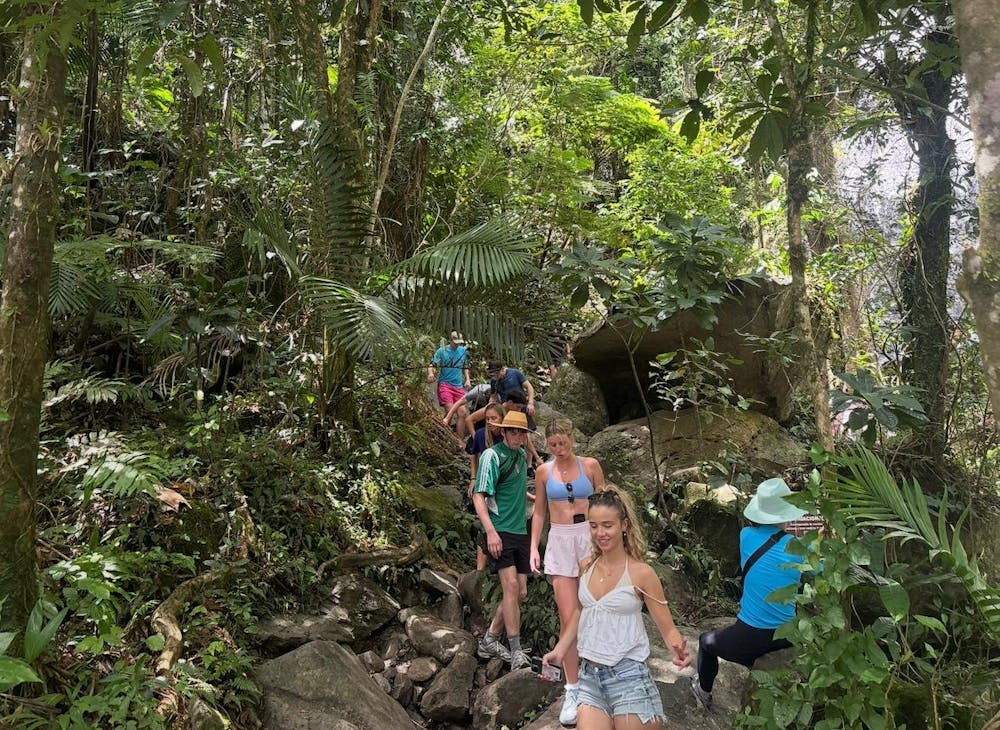
What sharpened the realization was flying to Puerto Rico the day after. Even though it is a U.S. territory, the atmosphere felt completely different and louder in some ways, quieter in others; less choreographed, more alive to itself.
The polished, performative version of spring break I had been watching all week in Florida suddenly looked exactly like what it was: a very specific product. One built around tourism, spectacle and the shared expectation that fun should look a certain way.
That was the moment the whole thing clicked. What I had been watching in Florida was not just young people enjoying time off. It was a particular version of leisure that has been packaged, exported and recognizable from a thousand miles away before you ever arrive.
Contact Evelyn at eocarroll@alligator.org. Follow her on X @evelynocarroll.
Evelyn O’Carroll is a junior Political Science and Social Policy student from Trinity College Dublin, currently on international exchange for this semester. She writes a column documenting her experiences of studying abroad at the University of Florida.