

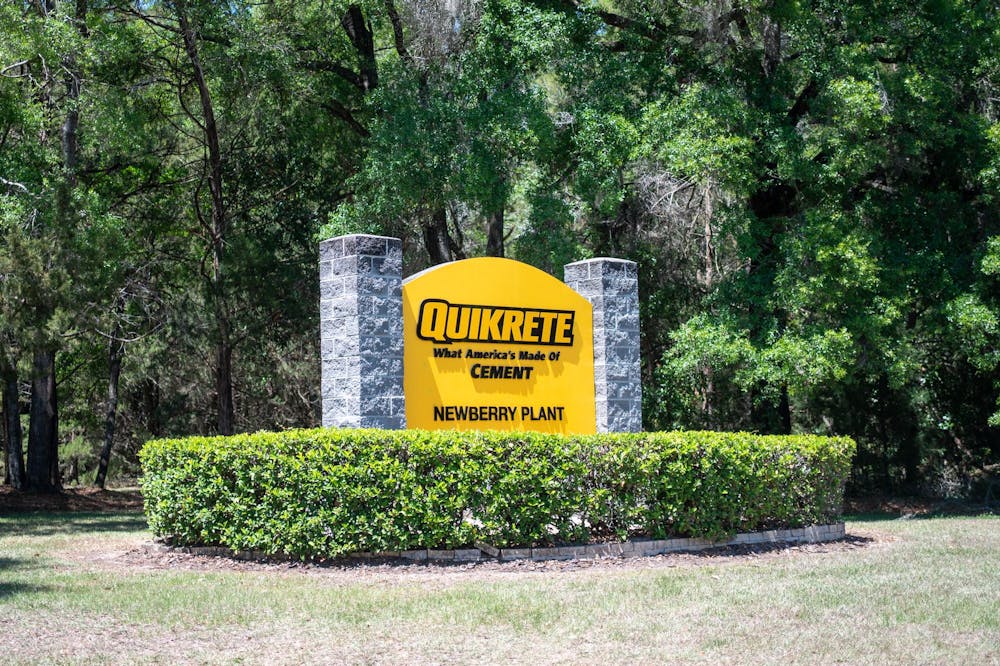
When Jeff White moved to Newberry 16 years ago, he and his wife planned to stay for the rest of their lives. They used to joke that the noise from the nearby cement plant was the beach making ”a little breezy noise,” despite living two hours from the nearest ocean.
But the noise has gotten harder for the 57-year-old retiree to ignore. Along with the dust and a lack of communication from Quikrete, the company that now owns the plant, White’s grown progressively more frustrated.
Despite complaints about the noise and dust that result from the blasts — controlled explosions conducted in quarries to extract materials to mix into concrete — Newberry residents report very little change from Quikrete. But the plant’s byproducts are more than just an annoyance. Exposure to cement dust could be harming residents and their crops.
The cement plant, located at 4000 NW County Road, was originally opened by Florida Rock Industries around 25 years ago. Quikrete recently took over the plant from previous owner Argos USA.
When blasts take place at the plant, White said, his house shakes. A tan, hard-to-remove dust covers the area.
Sometimes, the blasts shake White’s home so much the pictures hanging on his walls start to slide out of their frames, he said. The constant sound of machinery “messes with your mind,” he added.
On Easter morning, White said he woke up to the beeps of reversing vehicles outside of his home.
“I actually asked that guy, ‘Send me your address, and I'm going to come sit in front of your house on Sunday morning, pull out a piece of equipment, just let it sit out there and run in the yard with the back-up beeper on it,’” White said. “But he wouldn't do that.”
He and other residents are in a group chat with Quikrete environmental manager Keith Shannon, who gives them warnings in advance of any blasts.
The blasts cause eruptions of dust, which gets blown into neighboring areas. The dust is not easy to remove, so Quikrete sends employees to clean it off of cars.
To White, the blasts cause more serious disruptions than pesky collections of dust. He and his wife’s double-wide mobile home has started to split down the middle as a result of the shaking, White said.
But Quikrete won’t acknowledge the damages, he added, and his repeated attempts to communicate with Quikrete have gotten him nowhere.
“I wish they would just be a little more understanding and more willing to just fix their issues,” he said.
In an email to The Alligator, Quikrete spokesperson Patrick Lenow acknowledged the “small number of neighbors” who had complained about dust and noise. He wrote other nearby businesses could be contributing to the issues, though he didn’t name any specific examples.
“We listen and take what is shared seriously, even when it’s not clear what business may have caused their concern,” Lenow wrote. “We’ll do our best to work with this handful of neighbors to alleviate their concerns.”
He emphasized the plant’s economic benefits and wrote the facility complies with all federal and state regulations.
“While QUIKRETE’s ownership is recent, we’re thrilled to be here, and it’s important we’re viewed as a good neighbor making a positive impact,” he wrote.
Juan Briceno moved to Newberry in 2021. Before the move, the 41-year-old UF agricultural and biological engineer researched the cement plant and found no serious health concerns.
According to a cement pollutant study, a distance of at least 4.5 miles is recommended to maintain safe public health conditions. Briceno lives less than a mile from the Newberry plant.
Loud noise, dust accumulation and vibrations soon became pests in Briceno’s day-to-day life, he said.
“That doesn’t affect my livelihood [but] affects my house, and I have cracks in the walls, ceiling, everywhere,” Briceno said. “It’s like a little earthquake that shakes the whole house.”
Briceno initially wrote off the explosions as a nuisance, he said, until he noticed cement kiln dust, a highly alkaline byproduct of cement manufacturing, began to coat his truck’s windshield and roof.
“A big plume of dust goes up in the air, wind picks it up [and] it goes everywhere,” he said. “My neighbor said, ‘It looks like it’s snowing.’”
Each year from late spring to early fall, he said, the plant blasts multiple times a week. He compared the noise to a generator running 24 hours a day.
While Briceno said he’s tried to communicate with Quikrete, no progress has been made.
“They send very threatening letters,” he said. “There’s nothing I can do. I feel like I have my hands tied.”
In a letter Briceno received Oct. 25, 2025, Elkin Rodriguez, the plant manager, wrote the company would no longer listen to his grievances. He cited Briceno’s “escalating use of abusive and threatening behavior” toward environmental manager Shannon, who didn’t respond to requests for comment.
“We are cutting off all communications with you,” Rodriguez wrote in the letter.
Other neighbors received letters alleging the same behavior. Briceno denied making any threats to the company or its employees.
In a previous letter from 2024, Argos, the company that previously owned the plant, wrote operations wouldn’t be deterred by damage complaints.
Paul Miller, a 78-year-old Newberry resident and certified organic farmer, said the build-up of dust has begun to affect his farming practices.
To remain U.S. Department of Agriculture certified organic, farmers are required to keep an audit-trail of documentation that complies with USDA organic regulations, according to the USDA.
Miller said he’s worried the dust could cause potential health risks that may cause him to lose his certification. He contacted a USDA organic certifier to inspect the site, he added, but he hasn’t heard back yet.
“They also emit aerosols, and that gets on things,” he said. “Our fields are wide open.”
Cement kiln dust can cause extreme nutrient imbalances in agricultural soil, which can result in reduced crop yields, according to the same cement pollutant study.
The blasting has caused severe vibrations and damages to Miller’s property, he said, which have in turn led to issues like flooding.
“I was out in the field, but when I came in, the house was flooded, and they [had] blown the toilets off the wall,” he said.
Miller said he’s requested compensation for the destruction caused by Quikrete by submitting requests but has been dismissed each time.
Shortly after Miller moved to Newberry, he said the plant manager and two staff members visited to discuss the damage complaint he’d submitted. Since the plant was operating under legal noise limits, the manager told him he couldn’t take legal action, Miller said.
When he accused the blasting of destroying his plumbing, Miller said the manager told him it was his problem, not the plant’s.
“He said, ‘We could blast the windows out of your house, and you could do nothing about it,’” Miller said.
A Newberry resident since 2019 and a lifelong Alachua County resident, Miller said he doesn’t plan on leaving his property.
“We’ve been farming organically [for] at least 55 years,” he said. “I was raised here, and this is my home.”
Contact Lily Hartzema at lhartzema@alligator.org. Follow her on X @lilyhartzema. Contact Juliana DeFilippo at jdefillipo@alligator.org. Follow her on X at @JulianaDeF58101.

Juliana is a second-year journalism student and the Spring 2026 Enterprise environment reporter. This is her fourth semester on The Alligator, and she previously served as an Avenue reporter and the Fall 2025 Avenue editor. In her free time, she loves reading, updating her Letterboxd account and doing crosswords.
Lily Hartzema is a senior journalism student at UF with a minor in geography. This is her third consecutive semester at The Alligator. She previously served as a copy editor in Summer 2026 and is a returning metro reporter. In her past-time, she enjoys reading, exploring new trails and photographing anything that catches her eye.


