

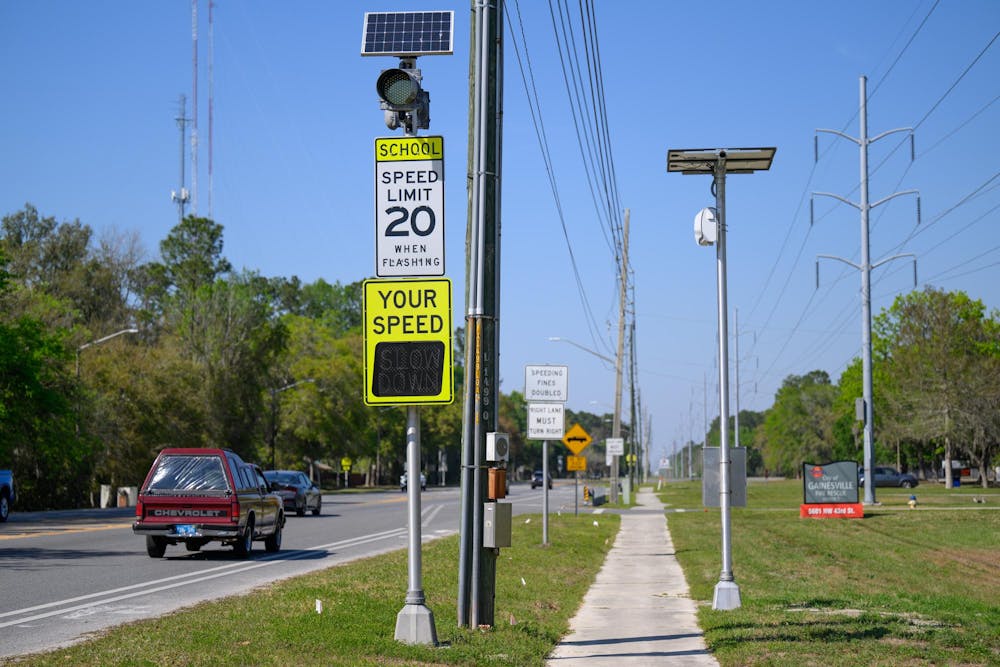
Drivers passing through four Gainesville school zones will soon be monitored with speeding cameras.
The Florida Legislature legalized speeding cameras in school zones in 2023. Since then, law enforcement agencies across the state have partnered with a variety of companies to install and manage the cameras, including RedSpeed USA and Altumint.
Speeding cameras have faced scrutiny for false ticketing in cities like Cape Coral, and critics accuse the cameras of serving as a new revenue stream for counties rather than a safety measure.
Amid uncertainty, the Gainesville Police Department and Alachua County Sheriff’s Office chose different companies. GPD opted for RedSpeed USA, while ACSO chose Altumint because of recommendations from other Florida law enforcement agencies.
Gainesville Police Department: RedSpeed
The speeding cameras in Gainesville will scan license plates of vehicles passing through school zones and report speeding violations to GPD.
Talbot Elementary School and Lincoln Middle School will see the first camera implementation, though the exact date they’ll begin being used is unclear, said Art Forgey, GPD’s public information officer. The locations were chosen based on historical traffic data gathered from the GPD traffic unit.
Once the cameras are installed, Forgey said, they will turn on 30 minutes before the school day starts and turn off 30 minutes after the school day ends.
RedSpeed cameras use Automated License Plate Readers from Flock Safety, a private technology provider controversial for privacy concerns. The cameras scan license plates of vehicles going at least 10 miles over the speed limit.
Once a violation is recorded, RedSpeed will send the license plate number, make and model of the vehicle to GPD to verify. A GPD infraction enforcement officer will review and confirm the violation before mailing a $100 ticket to the vehicle owner, Forgey said.
“The speed detection is verified with each vehicle, and there’s a picture that goes with it,” Forgey said. “If you’re speeding, you’re speeding.”
Florida law requires a 30-day grace period after the camera’s implementation. During that time, drivers won’t receive a ticket for speeding but will be sent a warning from GPD. The department is required to conduct a public awareness campaign during the period to ensure drivers know about the cameras.
The cameras cost nothing to taxpayers, Forgey said. RedSpeed USA will get a portion of each fine, and the rest will be distributed between the county, the Florida Department of Revenue, the school district and school crossing guards, according to Florida law.
GPD will monitor the cameras’ impact over time, tracking any changes in speeding violations. If the cameras slow people down, Forgey said, the department hopes to install them in every Gainesville school zone.
“We hope that it just slows everyone down,” Forgey said. “That’s the whole target of this.”
Alachua County Sheriff’s Office: Altumint
ACSO chose a different camera vendor for other schools within Gainesville.
ACSO plans to add speeding cameras outside Kanapaha Middle School, Kimball Wiles Elementary School and Lawton M. Chiles Elementary in early April.
The program will eventually expand to all schools in Alachua County.
The sheriff’s office chose Altumint as a camera vendor. Other law enforcement agencies spoke highly of the company, according to Capt. Chris Sims, ACSO’s public information officer.
ACSO will have two trained civilians confirming each citation and sending tickets to violators. Violations aren’t added to driving records, so getting ticketed won’t affect car insurance if tickets are paid on time, Sims said.
“This isn’t about building revenue,” Sims said. “This is about ensuring that people slow down.”
Jason Norton, Altumint’s chief revenue officer, said the company’s speeding cameras are different from RedSpeed’s because they don’t use Flock’s Automated License Plate Reader technology.
Altumint’s cameras only capture a license plate if the vehicle is speeding more than 10 miles over the speed limit, he said. A RedSpeed ALPR camera can document every license plate that passes by.
“Even in a school zone, you could be going 25 in a 15 … but I can’t capture that plate,” Norton said. “ALPR can capture that plate.”
Documenting every license plate passing by raises a few concerns about remote surveillance, according to UF law professor Derek Bambauer.
Under Florida law, speed cameras in a school zone can’t be used for remote surveillance, and data recorded on a speeding camera can only be used to document speeding violations or incidents that happen in the footage.
The term “remote surveillance” isn’t strictly defined in the statute, but if RedSpeed’s ALPR cameras store data collected outside school hours or use it for purposes other than ticketing, the cameras could be practicing remote surveillance, Bambauer said.
“The concerns here are less about the cameras themselves and are more about the underlying policy questions,” Bambauer said. “Do we want local law enforcement using data that they’re gathering for purposes other than just enforcing the 20 miles an hour in school zones?”
RedSpeed USA didn’t respond to multiple requests for comment, and it’s unclear whether the speeding cameras are capturing data 24/7.
Contact Vanessa Norris at vnorris@alligator.org. Follow her on X @vanessajnorris.