

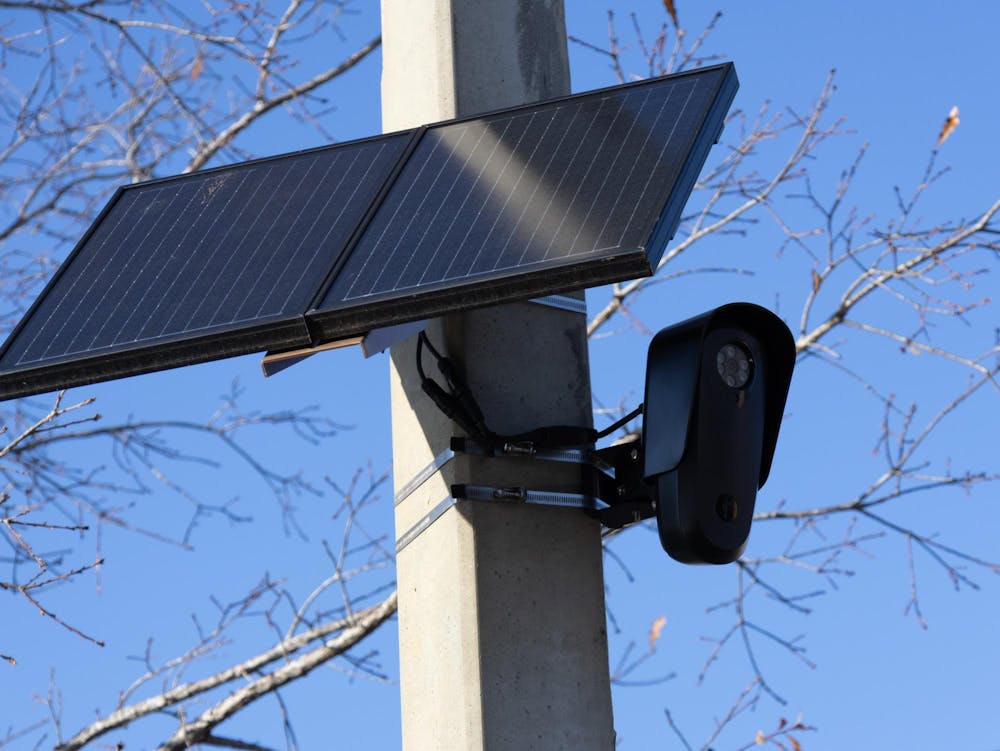
Gainesville residents have taken to social media over the last months to express disdain for surveillance cameras installed throughout the city.
“Flock is a cancer that’s been willingly invited to everyone’s lives,” one Reddit user wrote.
Another claimed residents now live in a police state.
Flock Safety is a private surveillance technology provider for over 5,000 law enforcement agencies across the country. Its cameras are designed to monitor vehicles and store plate and location data for 30 days. The devices also capture “vehicle fingerprints,” or details about a car, including make, model and any unique features.
The Gainesville City Commission’s approval of a contract with Flock in 2024 allowed law enforcement to enter an agreement with Flock, according to Art Forgey, the Gainesville Police Department public information officer.
Last year, GPD paid Flock $25,000, Forgey said, using 10 total cameras. Private companies can also buy and use Flock technology. Crowdsourced camera detection site DeFlock.me indicates about 100 of these cameras exist in total throughout the greater Gainesville area, many of which are clustered near Butler Plaza shopping center and around the main UF campus.
The cameras’ controversies in Florida became apparent in 2022, when three South Florida residents sued the city of Marco Island, claiming constant surveillance is unconstitutional. Now, experts and activists alike are calling for restrictions on the technology.
A legal lens
Camera data is always vulnerable to hacks and misuse, despite reassurance otherwise, said Derek Bambauer, a UF law professor and cybersecurity expert.
“It’s something I worry about a lot, and I think that we should never take a vendor’s answer that it’s secure as worth anything,” he said.
Historically, the use of private data by the government is not “particularly encouraging,” he added. While it doesn’t mean Gainesville officials may misuse the systems, Derek said, there have been unexpected uses of camera footage.
A Texas sheriff’s office was found to have used data from more than 83,000 cameras to track a woman suspected of getting an abortion in 2025. Nearly 7,000 of the cameras searched by the officer were Flock Safety cameras, including ones in states like Washington, where abortion is legalized.
While systems like Flock Safety might encourage people to abide by the law, Derek said, he worries the possible oversight makes residents apprehensive. If people believe their local governments are monitoring them, he said, they may not participate in community discourse, such as political protests.
“It would be very useful if there was a little bit more transparency,” he said.
Jane Bambauer, another UF law professor, said limiting individual access to the data would prevent “fishing expeditions,” or misuse by officials for political motivations.
A privacy and technology law expert, Jane said smaller law enforcement units may be less sophisticated, and thus are less likely to have rules specifying who can access camera information.
“That should be treated as a prying of genuinely private information,” she said.
She recommends legislators dictate when footage from Flock Safety cameras can be used. Incident-driven cases like a high-level or violent crime, she added, would be appropriate, allowing officers to use the data to examine a crime scene rather than to track individual suspects.
The Alligator contacted Flock representatives for comment on the privacy and access concerns raised and was redirected to the company’s privacy and ethics page. Under the personal information section, Flock said it collects images of vehicles and license plates, not names, addresses or social security numbers.
Front lines
Detective Sgt. Nicholas Ferrara, of the GPD's financial and organized crimes unit, said police forces can customize camera systems to only alert stations for cases of stolen vehicles, wanted people and stolen license plates.
“I think there are a lot of misconceptions to the usage of license plate readers,” he said.
While Flock Safety cameras are always on, Ferrara said, they’re not always recording. Instead, they are designed to pick up motion from a vehicle and record a license plate tag, essentially acting as a police officer monitoring traffic.
Flock cameras are solar-powered and operate 24 hours a day, seven days a week. But they only capture images of vehicles as they pass.
Cameras aren’t commonly placed outside of locations people frequent, such as bars or casinos, Ferrara added, so police can’t surveil residents in their everyday lives.
“And truthfully, we don’t do that,” he said.
To promote data safety, every police officer has unique login information to access the system, Ferrara said, and every log on and search is recorded. If a concern is raised about someone’s searches, officials may investigate searches and question officers if necessary.
Once an officer no longer works with GPD, their access to the camera systems is removed, he said.
Cameras like Flock Safety’s have helped solve crimes, Ferrara said, a merit people forget.
“It’s been a lifesaver for a lot of cases,” he said.
One case in particular, he added, “always sticks out.”
A few years ago, after an attempted ATM break-in on Newberry Road, camera footage allowed Ferrara and other forces to uncover the suspects behind multiple burglary and grand theft auto cases in Alachua and Bradford counties.
On the ATM security video, Ferrara said he noticed a unique Volvo SUV, which he later tracked down as a stolen vehicle through Flock Safety footage. A car following the Volvo, however, was not stolen, so officers were able to track the owner and solve the cases, Ferrara said.
“It makes the community safer, makes me feel safer and allows us to do our job more efficiently and effectively,” he said.
The dissent
To Chad Marlow, a senior policy counsel at the American Civil Liberties Union, automated license plate readers aren’t the inherent issue. The issue is Flock Safety.
Using Flock Safety products for limited surveillance, Marlow said, is like buying a Ferrari with the intent of only driving at 5 miles per hour.
Flock’s business model is based upon broad sharing of local data throughout the country and the world, he said, and the company itself has access to footage, which Marlow said is not in the interest of local residents.
“If police want to use ALPRs [automated license plate readers] responsibly, then why are they contracting with the least responsible ALPR company in the country?” he asked.
Flock Safety’s privacy and ethics guidelines state customers own 100% of their data, and only they may decide who to share it with. Private customers, the website says, cannot access law enforcement records.
Marlow argued most citizens haven’t committed crimes warranting constant surveillance. Just because someone didn’t do anything wrong doesn’t mean they’re unconcerned about their privacy, he said.
“The idea that you only have to be worried about your privacy if you're doing something wrong just doesn't actually hold up when you run it by real world scenarios,” he said. “That doesn't necessarily mean they want every single aspect of their life to be an open book to the government.”
Ultimately, Marlow said he wants to see rules implemented to limit data sharing and data retention. Flock Safety systems, including that of the GPD, store footage for 30 days, which Marlow believes is too long.
He also hopes end-to-end encryption for data will be added, to protect from hackers, and for data to only be used in necessary circumstances, such as in the case of a kidnapping.
Marlow said Gainesville’s local government, police department and ultimately the state should issue guidelines to control camera data use.
“There's a lot of different guardrails that can be put in place, and really none of these systems should be used until those guardrails are in place,” he said. “That's the way you keep people safe.”
Contact Maria Arruda at marruda@alligator.org. Follow her on X at @mariazalfarruda.

Maria Arruda is a second-year journalism and political science student, currently working as the City Commission reporter for The Alligator. Previously, she reported on Student Government under The Alligator's University desk. She enjoys running, reading and going to movie theaters!


